A gentle wind rustled the forest leaves, the whispering sound drifting to greet the grey clouds that sprinkled a soft rain and moistened the earth. The woodsy smell of pine and moldering vegetation stirred in the humidity, and a quiet day unfolded its tranquillity. The serene mask concealing the secret burial of four women. The illusion muting the echo of their pain pulsing beneath the soil. Hollows in the earth, rich with putrefaction, where tree roots entwined their bones, cradling them, winding around and through the decaying remains. Dirt filled the hollow eye sockets and mouths that once screamed their last words. Insects feasted on the bits of flesh still clinging to the bodies. Four souls discarded and abandoned. No one searched for them here. No loved ones mourned at their graves. Buried in a dumping ground by a callous monster. To be forgotten. Yet, the trees remembered them. Cherished their forsaken existence, acknowledged their erasure. Wept for these ghosts twisted into their roots, into their loam, death slowly calling out to life until an understanding blossomed as deeply as the spring buds. They all knew a fifth body was inevitable. They decided it would be the last…woman at least. There would be a sixth death. Not buried, only left to rot among the scavengers and forest debris. His bones would not lie with theirs. His bones would be scattered, stolen and eaten to feed the animals. His blood would seep into the dirt to be washed away with the rain. A murmur sifted through the trees. They would enjoy killing him. It was only a matter of time.
Symbiotic—that was the word. They said it a lot, along with a bunch of other words. Win-win. The next step in human evolution. A paradigm shift. Big words for bold claims.
But he was skeptical. More than that, he was grossed out. After all, he had always hated mushrooms: their rotting scent, their spongy texture. At least, he imagined they must feel spongy. He had never touched one, let alone let one colonize him. The thought of that scent following him all day, those red-orange caps popping up from his skin—it was the stuff of nightmares. Objectively terrifying.
So why did they look so happy about it?
Honestly, he didn’t want to know. If he were any healthier, he wouldn’t have to listen to their claims, wouldn’t have to be visited by their so-called pharmaceutical reps who stunk of fungus, wouldn’t have to look at their too-pale eyes or their too-wide smiles.
But he was short on time, short on options. He knew it. They knew it.
“We are very proud of our results,” the rep said, strangely serene for a man with quarter-sized mushroom caps growing like scales along his arms. “One hundred percent success. Not a single outlier. Every single one of our patients has reclaimed their mobility, renewed their energy, and gotten back out into the world!”
He wanted to tell the rep where he could shove his mushrooms, but his eye-tracking communicator wasn’t equipped with such colorful expressions. He had already lost his ability to speak, his ability to hold a pen, his ability to do much more than lie in a bed and wonder how slowly death would come.
“Those results,” the rep continued, “are why our procedure is fully covered by every major insurance company. In fact, it is increasingly recognized as a fast, effective, and cost-saving alternative to other treatment options. The primary course of treatment. I believe you already know that your coverage plan has recently been modified to reflect that trust in our procedure. If you wish to continue with your insurance provider, they expect your full cooperation, which I’m sure you can agree is in your best interests.”
Cooperation. A strange word for a lack of choice.
He thought of that word again as he was wheeled in for the procedure. As they brushed his arms with a slimy gel. As they sprayed his sticky self with nutrients. As they brought out the vial of spores. As they wrapped him in a strange tape, leaving him to wait in the darkness. To wait. And wait.
He wasn’t sure if he slept. He wasn’t sure how much time was passing. He wasn’t sure if the mushrooms were growing, and he was grateful that the darkness and tape meant he couldn’t see.
Cooperation. A strange word, indeed. What was that other word? Symbolic?
“Symbiotic,” it said with his voice, smiling with his lips.
The observation dome gave Pat a panoramic view of the alien world outside their habitat. The landscape was barren, deadly to unprotected humans, but he still wished he could walk outside without a space suit. It broke his heart to know he was going to die without ever feeling sunlight on his face again.
Hank entered the living space from the service area.
“Still staring outside?”
“Yup.”
“Thought I asked you to look after the hydroponics.”
“I don’t give a shit about the hydroponics. Let them die, they don’t produce enough food, barely any oxygen and we can save the water for ourselves.”
Hank frowned, but Pat ignored him. Hank’s rigid dedication to duty was starting to grate. There was no point tending to the poor, shriveled plants. They would be dead soon enough.
“It isn’t for the plants, it’s for you. You should try to keep busy. Staring outside all day isn’t good for your mental health. We need to keep our spirits up; staying active helps.”
“We’re as good as dead, why bother?”
“Mission control is still optimistic about our chances.”
“We’ve got no chance. Bloody reusable rocket. Hardly very reusable when it breaks up in Earth’s atmosphere on its first return journey. And now we’re stuck up here.”
“They’re building a replacement. The last report said it was nearly ready.”
“So what? It can’t get up here in time to rescue us.”
“It might. If you put a little more effort into the hydroponics, we could supplement the dehydrated food.”
“We’ll run out of oxygen before we run out of food.”
“The filters are still working.”
“Not for much longer.”
“Why are you being so negative?”
“Why are you being so positive?”
“Because we still have a chance. We need to keep optimistic, keep fighting.”
“All I want to do is go outside one last time.”
“Go out then, the suits are still okay.”
“No, I mean without a suit.”
Hank left, back into the service area. Pat wished for the thousandth time he hadn’t volunteered. Private money was behind the project. A consortium of billionaires had clubbed together to achieve what governments were unwilling or unable to attempt; the human colonization of an alien planet. Pat thought back to the day when the expedition had been announced to the press. The whole world had exploded with excitement and optimism. They’d been the most famous people on Earth. They were the pioneer crew, the first men to land on Mars. Their mission was to erect the habitats and tend the hydroponics that would provide shelter, oxygen and food for the main, permanent expedition. The press and public loved them; they were the brave explorers, breaking the final frontier.
In retrospect, it was clear that billionaire entrepreneurs weren’t any better than governments at building rockets. The famous, innovative reusable rocket, the one that had landed them on the surface of Mars, had exploded on re-entry into Earth’s atmosphere. Faulty heat shielding seemed to be the culprit.
Pat knew they were screwed. The consortium had only built one rocket. The plan had been for it to return to Earth, then head back to Mars with the main crew and fresh supplies. Most of the payload that had accompanied Hank and Pat had been equipment. The habitats, the seeds and the tools. Their supplies of food and water had been carefully calculated to be sufficient for the time required for the rocket to complete the round-trip back to Mars. There had been some excess calculated into this equation, but not enough to sustain them indefinitely. When the news of the disaster had reached them, they’d immediately rationed everything, but despite their best efforts the food was almost gone, the oxygen and water the same. Time was running out.
Pat stared at the arid, rocky terrain outside. There was no life on this barren rock, although it was possible it had existed at some point in the distant past. He thought about Bradbury, the author of one of his favorite books, The Martian Chronicles. On Bradbury’s version of Mars, there’d been canals. There’d been Martians who lived in the cities and vacationed in marble villas in the hills. In his book, human colonists had killed the Martians by accidentally infecting them with chickenpox. The humans had defeated Mars, not by their own efforts, but by introducing a deadly pathogen.
Pat looked at the distant hills. He wished it was true; that the Martians were real, that they’d retreated to their villas when the ship had arrived. He wished they were up there now, watching the invaders from Earth. Pat hoped the Martians would see their plight and take pity on them, decide to help. Pat closed his eyes and wished for it to be true. In his mind’s eye, he saw the Martians descend from the hills and travel across the plain in one of their amazing sand ships. He saw them park outside the pathetic little habitat.
Pat opened his eyes. There was a knock on the airlock door.
The scrolls were delivered to the community mailboxes.
Residents had long since stopped checking for mail so they were unaware of the presence of the scrolls until they received the text:
You are in possession of information regarding the end of the world. Everyone is invited to read the scroll together at 10amET on September 30th; doing so will inform you of how our collective life will end. If you lose patience and read it earlier, you will spontaneously combust.
You are also welcome to not read the scroll and have the events that unfold surprise you.
“Surprises are good,” Carl said as he tossed the scroll in his recycling bin. “No point obsessing over something I can’t control.” He was also unable to control the smell of burnt flesh coming from his neighbors who decided to tempt fate and read their scrolls early.
The doctors and nurses were the first to lose their jobs. When the world was about to end, people lost interest in health. Police officers, on the contrary, were experiencing an accelerated need. With little time left on Earth, people were choosing to experience their viler desires. Murders were commonly occurring, as were robberies and vandalisms.
“What if we just stopped answering the calls?” Officer Payne asked his partner. “They can fire us; it won’t matter.”
“Fire…,” his partner mumbled, eyeing the burning piles of humans and detritus that they passed in their squad car, “so much fire…”
On the morning of September 30th, survivors pulled lawn chairs up to their mailboxes and waited. Some had champagne and fireworks; others held rosaries and religious texts. Many mailboxes stood as solitary sentinels; their owners had succumbed to curiosity or violence.
At 10:20am, whimpers and soft sobs could be heard. One woman moved from her chair to sit on her husband’s lap. Another woman held her dog close. Two children were asked to lower their voices, and an old man Facetimed his son.
At 10:25am, the neighborhood was silent. Even the birds were waiting with anticipation.
At 10:30am the residents opened their mailboxes and unfurled their scrolls. They were told that the world was going to end in five minutes when a large meteor crashed into planet Earth. They spent those five minutes searching the skies and praying and sobbing and cursing.
At 10:35am…nothing happened.
At 10:38am…still nothing happened.
“It said Eastern Time, right?” Mrs. Wilson asked tentatively.
Carl, who was the only one without a scroll, as recycling had taken care of it weeks earlier, found the original text that had been sent and read it aloud. “Definitely Eastern Time.”
Officer Payne finished sipping his champagne and added, “But it didn’t say what year.”
Slow tears dripped down his face, blurring the small screen of his cell phone and the picture he’d uploaded as wallpaper. The woman staring from that screen looked to be in her late seventies, with hair gray and sparse as drought-killed grass. He remembered her wrinkles but couldn’t see them here because her smile sent them into hiding. He sniffed and wiped his eyes, then tugged his coat tighter and pulled the collar up around his face. Still, he shivered.
It was cold where he sat on a stone bench overlooking the foaming sea. Ragged waves, crested with white, pounded on the beach as if a storm had just passed. Or was coming. As he lingered in that place, a mist materialized out of the air around him, beading on his face and hair. At least it cooled his fevered cheeks.
He pressed a button on the phone for his contact list, scrolled through until he saw the word that named the woman in the picture: “Mom.” How he wanted to press “send” and hear the call going through. How he wanted to talk to the only woman who had ever cared anything about him. She would tell him that everything was going to be “all right,” and he would believe.
But he was six months too late to call her. She was gone and since then everything in his life had turned to shit. He hadn’t been able to delete her number, though. He hadn’t wanted the last vestige of her to be gone as well. It would have felt like losing the last fragment of himself.
Though now, he thought, I’m ready for that.
A rumble in the sky trembled his coat. He turned and saw a heavy fog that whited out the world. It drifted toward him and soon he’d be swallowed. He couldn’t make himself care. The phone’s light dimmed but he could still see the readouts. He had good reception but only one bar of charge left on his battery. If he were going to call anyone, it had to be now. He should call 911, tell the police where to look for his body after he’d done what he’d come here to do.
But…
He pressed the send button with his mom’s number still on the screen. It gave him a small sense of relief to think that he could tell her goodbye. Even if she wouldn’t really be there to hear him. The phone rang once, twice, a third time. He began to cry harder. The phone rang a fourth time.
“Hello?”
He stopped crying. A woman’s voice came through, an older woman’s voice. A riot of thoughts churned his mind. He couldn’t have gotten the wrong number. He’d called the right one a thousand times. Could his mother’s number have already been reissued to someone else? But then, he wouldn’t have recognized the voice.
“Hello,” the voice said again. “Who is it please?”
“M…Mom?”
Silence froze the line.
“Who is this?” the voice demanded. “Is this some kind of prank?”
“Mom! It’s me! It’s Dwayne!”
“What an awful person you are,” the voice said, cracking over the phone. “An awful, awful person. You know my son killed himself. Six months gone now. Who is this? I’ll call the police, I tell you!”
Dwayne opened his mouth to speak but at that instant his phone battery failed. The line went dead. The fog swept over him, muffling his screams.
Bleak eyes stared from deep shadows, watched through the dark as clear as day. Long ears listened to the crunch of leaves and the brushing of foliage. Its nostrils flared; its tongue licked the air. It used every sense to learn its target, to know it before it decided whether or not to pursue. This one carried an unpleasant scent, which often meant the hunt would not be worthwhile. It would continue to wait until something appealing was found.
It sat still and silent, skin blending with whatever concealed its body. Only its eyes moved. Only they had life in its statuesque form. Not even its chest would expand from a breath. It consumed oxygen slow and shallow. Its muscles turned rigid, firming themselves in place. Doing so meant it would never tire, never lose its posture; its balance was perfected in survival.
An alluring taste landed on its tongue, so powerful it nearly perked up, breaking from its position of choice. It inhaled deeply, invigorated by this potential catch. But the prey wasn’t alone. Another traveled in stride. Normally it only hunted lone game. Any more, and risk threatened its continuance.
This night it decided the meal would be worth the risk. It wanted like it never had. It needed to taste that flesh. To consume, to indulge; a feeling alien to a mind that until then, had been content with local nourishment.
It waited until they were close, so close it began to salivate from the smell of this new animal. It prepared itself, built up tension in its legs, and sprung forward too fast for its quarry to react. It sliced its clawed finger through the lower leg of the larger of the two, the one it didn’t desire. This was to incapacitate it, keep it from interfering with what it needed to do. The tall one fell to the ground and grabbed at its wound. It cried out in pain.
It then turned to the one it craved. It stared back with wide, frightened eyes as its body trembled.
Eager to taste the frightened thing, it pounced, holding it down on the ground. The prey wriggled as it tried to free itself, but its meager strength could not compete. The predator slipped its slender tongue from its mouth and ran it up its captive’s face. The salty fear whetted its appetite. It opened its maw and bit into hot skin, ripped away muscle with its pointed teeth, and began to chew.
The locals all agreed on one thing about Briarwood Asylum, it wasn’t haunted.
No one claimed to have seen ghosts wandering its halls or shadowy figures staring from broken windows. There were no stories about phantom footsteps or disembodied voices drifting through the darkness. Every account, no matter who told it, always returned to the same unsettling detail.
The buzzing of the flies never stopped.
Winter, Spring, Summer or Fall, the abandoned institution hummed with the sound of countless flies. On certain nights, hunters claim to have heard them through the treeline. Teenagers had tales of hearing them while daring each other to step foot onto the property. Utility workers refused contracts after two men abandoned their equipment and drove away without explanation. Whatever occupied Briarwood didn’t hide its presence. It announced itself with a sound so common that most people convinced themselves they didn’t hear it at all.
That was why Cameron Mercer accepted the investigation.
His team had grown a modest following debunking haunted locations across Southwestern Pennsylvania. More often than not, they found deteriorating plumbing, loose windows, settling foundations and overactive imaginations. Briarwood was different. No one offered an explanation, the building had stood empty for over three decades yet the buzzing had never ceased.
As they unloaded cameras, lights and recorders from the van, the low vibration drifted across the parking lot. It wasn’t especially loud, but it seemed to settle in the chest more than the ears. It was as if the sound was trying to burrow itself beneath the skin instead of floating in the air.
The building looked exhausted. Ivy swallowed much of the brick facade and dozens of broken windows stared down over the parking lot like hollow eye sockets. Even after decades of abandonment, Briarwood retained the unmistakable shape of a place where people had come hoping for recovery and too many had failed. The low hum drifting through the air only deepened that impression, filling the silence between the investigators until it was too much to ignore.
Melissa followed Cameron’s gaze toward the building. “I’ve never heard insects this loud before.”
“They’ve had thirty years to multiply,” Ethan replied with a shrug. “Maybe there’s a nest inside the walls the size of a pickup truck.”
Jordan shook his head. “No, listen to it.”
The others fell silent.
Once he pointed it out, the difference became obvious. A normal swarm rose and fell as thousands of insects changed direction but this sound never varied. It held a perfect steady pitch, almost like an electrical transformer humming somewhere in the distance. The longer they listened, the stranger it became, until Cameron wondered if they were hearing insects at all.
He pushed the thought aside and shouldered his camera. “Let’s see what all the fuss is about.”
The rusted front doors resisted at first before finally groaning inward on neglected hinges. The instant the four investigators crossed the threshold, the buzzing disappeared.
There was no fading echo. No gradual silence. One moment it surrounded them, the next it simply ceased. No one spoke for several seconds.
Jordan was the first to react. Without saying a word he stepped backward onto the front steps.
The buzzing returned immediately. He looked at the others, frowned and stepped back inside.
Silence.
Jordan repeated the experiment again and again with exactly the same result. The moment one foot stepped out over the threshold, the buzzing returned. The instant he stepped back inside, it vanished as completely as if it never existed. He stood in the doorway for several seconds, staring at the empty parking lot while the others waited for an explanation he clearly didn’t have. Finally, he eased the heavy doors shut and listened as the latches clicked into place. Once again the silence fell over the asylum like a heavy blanket.
“I’ve got nothing,” he admitted, shaking his head. “Just doesn’t make any sense.”
“It doesn’t have to,” Cameron said, adjusting his camera. “We’re here to document, not to explain.”
They moved deeper into the building, their footsteps muffled by decades of dust. The silence inside Briarwood was almost as unsettling as the buzzing outside. Every abandoned building had its own language of settling beams, rattling windows and distant creaks but Briarwood refused to make a sound. The investigators heard only their breathing and the soft scape of their boots as they passed empty patient rooms whose doors hung open like dark mouths.
The nurse’s station occupied the center of the first floor. Patient charts lay scattered across the counter. Cameron recorded as Melissa carefully separated one file after another, laying them out wherever the ink remained dry enough to read. They documented medications, blood pressure, fevers, oxygen levels, telling the ordinary story of psychiatric care.
Then the tone changed.
Melissa stopped reading midway. “This patient complained about hearing flies every night. The nurses searched…twice and not one insect was found.”
Jordan opened another file and frowned. “Mine says almost exactly the same thing. The patient insisted somebody was talking behind the walls.”
Ethan thumbed through several more records. “Listen to this one. ‘Patient claims the buzzing grows louder when the lights are turned off.”
The further they searched, the stranger the entries became. Patients described waking with the sensation of being watched. Several insisted that a figure stood silently beside their beds until dawn before vanishing. One woman claimed the insects weren’t flying, they were waiting. A nurse had circled that comment in red ink and wrote single word – Delusional.
Cameron wasn’t so sure.
He reached beneath the remaining stacks and found a folder unlike any other. It contained no medical information, only handwritten notes scrawled from different pens by different people. Some pages listed room numbers. Other repeated names, over and over again until they trailed off the page. The final sheet bore only one sentence written in large block letters.
DO NOT LET THEM GATHER
No one spoke for several seconds. Cameron turned the page over, expecting another physician’s note but the back was blank.
A faint buzzing drifted through the hallway. It lasted only a heartbeat then it faded. Melissa looked toward the corridor. “It’s inside now.”
“No.” Jordan replied quietly as he checked the thermal camera. “It’s below us.”
The display showed an unusual patch of warmth spreading beneath the floorboards, extending well beyond the walls of the nurse’s station. It wasn’t the sharp outline of a furnace or broken steam pipe. The heat pulsed slowly, almost rhythmically, as though something enormous slumbered under the building.
The floor plan Cameron had photographed on their way in identified only one room below.
Basement Isolation Ward.
“Let’s check it out,” Jordan said enthusiastically.
A narrow concrete stairwell waited behind a rusted service door. The moment Cameron pushed it open, the smell rolled over them.
It wasn’t decay. It was sickness.
The sour odor of sweat-soaked sheets, spoiled medicine, stagnant water and something older that defied description. Every instinct urged them to turn and leave but the buzzing had returned. It rose steadily from the darkness below like a distant chant.
The stairs ended before a corridor lined with heavy steel doors. Each bore scratches on the inside, as though desperate hands had clawed the metal from within. Faded quarantine symbols remained visible through peeling paint.
“This wasn’t always an asylum, was it?” Melissa whispered.
“It became one.” Cameron answered.
The buzzing grew louder with every step until the investigators reached a set of massive iron doors standing slightly ajar at the end of the hallway. Hundreds of flies clung to the walls surrounding them, perfectly motionless, their wings folded as if waiting for permission to move.
Jordan reached for one with a gloved finger. Before he could touch it, every fly turned toward him. Hundreds of tiny heads moved at once. The buzzing stopped.
A slow breath rose from the darkness beyond the doors. It carried with it the unmistakable sound of wet lungs drawing air for the first time in decades.
No shape emerged. No face appeared.
Instead, an overwhelming certainty settled over the four investigators, so absolute none of them questioned it. What had been confined in Briarwood was not a patient.
It was Pestilence itself.
The flies were never its servants, they were the first symptom.
The iron doors shuddered once beneath the weight of something vast moving on the opposite side. Rust drifted from the hinges as another breath filled the corridor, warm and damp enough to carry the stench of fever into the investigator’s lungs. Behind them every fly in the basement lifted from the walls in perfect silence.
Melissa began to cough uncontrollably as the buzzing returned.
Sal woke up to racoons on his chest. One chunky animal, ears erect, snout facing Sal’s own nose, and behind that animal Sal felt a couple more heavy ringtails on his waist and legs.
“Get off!” he tried to yell but it came out as a giant snort.
The truth was he couldn’t move, although his eyes jumped open, flickering. He’d put a chest of drawers in front of the cat door last night. How did these beasts get here? This couldn’t be real.
He tried to breathe in. The racoon weight pressed harder, he made an extreme effort to exhale. A line of slobber dripped from the first racoon’s snout. It bent its head and licked a paw, the tongue flashed purple as a radish. Sal tried moving his arms and legs. Nothing. Paralyzed. He’d had these spells a couple of times in the last week. During the last one he awakened from a nightmare. The nightmare featured his cat Cuddles sitting on his chest, pushing down with his paws, just like the raccoon. The room swirled, and above him the ceiling formed a face.
Now, Sal made his eyeballs look up. He viewed the same previous nightmare ceiling face above the weighty racoon. Yellow like the paint up there, yellow teeth dripping with spider webs, no eyes but shadows.
He told his landlady, Louise, about his dizzy spell. Always coming over, that Louise, any excuse for snooping around. Big heavy lady, arms like tied together flesh balloons. This time she brought him blueberries.
“Could be a stroke warning,” she told him, grinning and looking at him sideways with her old face full of wrinkles, much like the yellow painted visage above his head. He felt the weight of the landlady’s raspy, scolding voice as she talked on and on.
“Go to emergency, or you’ll regret it!”
Sal should have told her to get out, he needed his privacy, but he just kept sanding his latest project, a whirligig made of cedar sticks he planned to hang from the porch to keep the animals away.
“Aw, I’ll be fine,” he said.
But now, maybe he should’ve listened.
“A stroke!” the thought crashing through Sal’s head like a raccoon through a cat door.
The yellow ceiling mouth above him widened.
For a moment, he wondered if Louise had even come in, if that was all in his head too.
“Maybe I should check to see if there’s blueberries in the fridge,” he muttered.
But of course, he couldn’t move.
The beast on his chest humped itself a half-length forward, now its nose rested on his throat, and something like sandpaper ran across his skin. No doubt about it. The creature was licking him now!
Sal tried to yell again. “Get off!” but this time he heard himself coughing, breath gasping, felt his heart, pulsing faster. The licking got faster too, in tandem with the pulse.
How had this disaster happened?
He’d tried to stop the ringtails! Last night he pushed up the chest of drawers to block the flap. The effort exhausted him, and he’d twisted his shoulder, but it was worth it.
Then he heard them banging trying to get through the barricade, so he grabbed the broom and stumbled outside. Didn’t see anything. Turned on the porch light. Nothing. Then he looked up. Three racoons lay spread out facing him along the porch rafters, their human like paws clinging to the slats, six eyes viewing him as he yelled and poked with the broom.
But too high up. They wouldn’t move. He dashed inside to grab a jug of water to throw, when he came out again, they were gone. His heart fibrillated and skipped from the effort, and he dropped down on his knees, grasping the broom with both hands. But a victory! He’d chased off the raccoons, but somehow the persistent invaders had returned!
The heavyweight ringtail kept its nose down, licking Sal’s throat faster now. Above Sal’s eyes, the ceiling dipped, the yellow face’s mouth opened wide. Sal knew if he let himself go, he’d fall right towards that open gap. On the one hand, the raccoons would be gone. But for sure he would be too. He tried breathing in, such an effort. Three raccoons, twelve paws pushing down. He breathed out, feeling his heart rise too. Now he heard a rhythmic pounding as if it came from outside his body, or maybe it was the heartbeats of these creatures stuck to him, in a multi part tachycardia. The pulsing grew louder. Or were those heavy steps moving towards his room?
Again, Sal wondered what was real and what was not.
Yes, there in his blurring vision, Louise the landlady’s huge red fleshy face, where the yellow ceiling form was before. Sal knew it! Those was her features up there all along! She was spying on him again! Invading his privacy, just like these beastly raccoons. But this time, maybe she would rescue him! He heard her big feet stomping around. Then the ceiling face opened wide as she screamed! Her face came down on him, mouth first, a heavy blanket of fat and skin.
He felt a nip, then a bite, then a humungous deep piercing penetration, fangs sinking through his throat. He couldn’t inhale, in fact, he hadn’t inhaled for quite some time.
Then a lightness, a heavy body leaving from his chest, and he was rising, moving up through the gap in the ceiling, where Louise’s face used to be. Such a freedom to have lost that terrible weight! And he didn’t have to breathe now, he was free from that, free from those twisted raccoons.
He looked down at Louise, or was that a raccoon, stooped over his face. The creature raised its head to the ceiling where his mind floated, and Sal saw her teeth, so pointy and red. And she screamed again, just a mouth now, and a radish-red tongue, as her body faded before his vision, and disappeared.
Sal caught a glimpse of his own inert, bleeding body below, still covered under blankets up to the bottom of its exposed throat. That was the last he saw. The final thing he felt was his consciousness dissipating through the face gap in the ceiling, to the void beyond, the weight of his flesh and bone and the heaviness of anything else no longer his concern.
I meet you in Scarborough, cool and pale in your black dress. Your eyes walk straight through me, avoiding the part that hurts. We take the street to the docks where all is a shifting curtain
of smoke and mist, gray on gray, ghostly forms on an anthracite sea.
Ice spiders come with the fog. They spin pale cobwebs over the street lamps, lambent rainbows dancing on frosted glass. Later we cover the window with my leather coat. You light the long wicked candle so the flame burns high.and hold my hand over it, laughing when I pull away.
You tell me how your dreams are all mashed up inside. Fix it, say your fingers when they come to free my belt. I touch your hair with a whisper, “Nothing is irrevocable.”
I wake to a room of frozen dust, a faded message in a silver cup. Carry a question long enough, and when you stop caring, the answer comes.
Its white bark fed us. Its roots gave us water. Its branches held our villages high above the dark earth below. The elders taught us that beyond the crown was only The Empty Blue, where no living thing could survive.
When the Pillar began to die, I was chosen to climb.
The trunk stretched farther than any man had ever dared. My hands bled. The air grew thin. At last I reached its highest branches.
The elders had lied. There was no endless forest of Pillars. There was only ours in a vast field beneath an impossibly blue sky.
The ground shook and a shadow blotted out the sun. Something enormous began descending from the sky.
Five gigantic shapes cascaded down from the blue, their pale flesh creased and lined like living canyons. Dark pores gaped like caves. Fine hair, thick as tree trunks bent in the wind of their approach. They wrapped around the crown. The branches groaned beneath their grip. Our homes splintered. People clung to the bark, screaming as our world was torn free.
I was lifted higher and for one impossible moment, I looked beyond.
A polished wooden table, a crystal bowl. Countless other Pillars with shriveled, purple worlds.
The sky began to split apart, but it wasn’t a sky. It was a mouth.
The first bite shattered half of the villagers. Mountains of teeth crushed wood, stone and flesh all together. Our mauve worlds popped and oozed. The air filled with a thousand screams before they were swallowed into the darkness.
As the jaws closed around what was left of my world, I finally understood why the Pillar had given us everything we needed.
We had never been its children, we had been its fruit.
The Last Tree Richard Meldrum
In the wind torn desert it was a fixed point, like the stars and rocks the tribe used to find their way across the featureless landscape. It stood thirty feet high, with arms spreading out from the main trunk. The tribe never considered its origin or that it had once been a living organism. In this blasted world, bereft of vegetation and animals larger than a mouse, it was unique.
The tribespeople had no sense this world had ever looked any different. That food was once abundant and water fell in unending cascades from the sky. That buildings once stood hundreds of feet high and machines flew in the blue sky. There were legends of the old ones, but no-one took them seriously.
The outsider arrived uninvited. He claimed to have found the secrets of the ancient ones and wanted to spread this truth to the desert tribes. He spoke of untold wealth and knowledge in a faraway place, where he had seen the remnants of the ancient world with his own eyes. He spoke of something he called forests, where living objects called trees extended green arms towards the sun. He told them the object they used for navigation was a tree, long dead.
Fearing heresy, the tribespeople honored their own gods by tying him to the object he called a tree and burning him. Afterwards, they gathered round the corpse. No one believed the object he was tied to had ever been alive.
Broken Bough Elaine Pascale
The climb was always the best part.
Roy felt guilty that his job entailed installing environmentally detrimental teleports. He knew that humanity should have learned its lesson when they forcibly evacuated Earth, but they were simply repeating the same old patterns.
He could quit but he needed the job. When he wasn’t causing climate catastrophes, he enjoyed the scenery. And the wildlife was starkly different than that of Earth. For instance, the avian creature that was observing him as he ascended the smoothly barked tree. The creature appeared to be on a nest and Roy hoped it was not guarding eggs as that would make the installation more of a battle than a job.
“Hey bird,” he called cheerfully, knowing that “bird” was not the correct label, but not having a better term to use.
“Hey Earthling,” the creature responded, shocking Roy enough that he lost his grip and slipped down a few feet before righting himself.
Roy realized that the bird, as he now thought of it, was communicating telepathically. It showed him images of the history of its planet; it showed him of the destruction to come in a very short timespan due to the activities of Roy’s species. The devastation was heart wrenching.
“Now you understand. And now I hope you will forgive me.” The creature left its nest and swooped on massive wings toward Roy. It attached its scissor-like beak to the ropes that held Roy aloft and sliced through them as if they were made of paper instead of thick cables.
As Roy fell, he realized there was no need for forgiveness, and he enjoyed the last few seconds of scenery.
Earthbound Lee Andrew Forman
When the tower grew to its full height each lobe unfurled itself into reaching extremities, a network of points that would work in unison. Its design was born of life, of hope, of the vast loneliness endured by great thinkers. Their theories would finally be put to work; their ideas would soon find truth…or nothing. No one could predict what answers, if any, it might discover. Only that it would perform its function with the precision it was meant to achieve. It would seek the above, the endless abyss that until that day had been unreachable by all who tried before. The sky would either open, or come crashing down on them with disastrous despair.
When the device had fully formed, it stood ready to serve its designers. A new life, created to search elsewhere for that very thing. It listened to the points of light in the dark to see if they would speak, or whether their bodies were cold and silent. It employed the many senses it had been given to look for another voice in the cosmos, another world where consciousness existed.
As far as it could see, near into eternity, it found only one. A small world busy with noise of all kinds.
The travelers had already been prepared, and their vessels ready to launch. They would soon meet their only neighbors in the boundless darkness, whoever they may be.
The Tree of Life Charles Gramlich
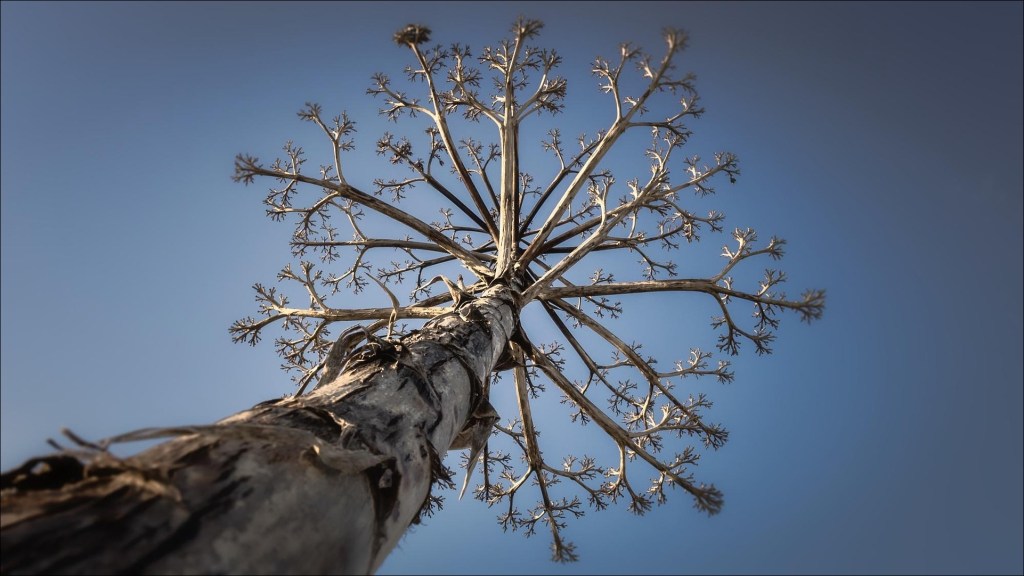
My eyes opened. I lay on my back looking up at a tree with strange, fractal limbs embedded in an achingly blue sky. The tree had no leaves, though it wasn’t cold so it didn’t seem to be winter. I didn’t remember what time of year it was. I didn’t know how I’d gotten here. I tried to sit up and failed. My arms and legs wouldn’t move. I strained every muscle but couldn’t even turn my head.
Scream! No sound came from my mouth, but I heard something—a slithering. Needle-sharp stabs pierced my back and legs. Roots gone rogue? My mind went nova; I struggled as I’d never struggled before. My eyes were the only things to respond, roiling wildly. Fluid began to burble, began to drain. From me!
My cheeks grew hollow; my belly shrank until it touched my spine. The trunk of the tree flushed pink; the pink spread upward. Muscles and organs inside me began to liquify. Like a tire with a slow leak, I deflated, while the tree unfurled healthy leaves and beautiful blooms. The leaves were a wet, fresh green but the blooms were red, red, red—the color of a man’s life being leached away.
Under the Fractal Tree Miriam H. Harrison
Angering the gods was always dangerous. Cliffs and eagles, hills and boulders—their punishments were known to be equally cruel and creative.
He pondered this as he sat in his place, chained to the fractal tree. Each thought led to another, churning on and on with anxieties and uncertainties. His restless mind had brought him here; his ceaseless questions of the gods had forged his chains.
And so he sat here—as he did each day, as he would forever—watching the branches of the fractal tree grow out above him, reaching like unending questions, like racing thoughts, like a restless mind that knew no peace.
Big Stick Chapter One Harrison Kim
A giant vegetable stick grows from my stomach and everywhere I go I yell “Stay back!” because I don’t want to hit a stranger with my protruding organic matter.
My local grocery clerk and amateur naturopath Jilly Van Loon says the plant is a delusional consequence of my diet. “Not that there’s anything wrong with that,” she says. “You’re a truly green guy.”
That’s for sure, I’ve been eating only salads for years.
Jilly insists I need protein “eat more beans” but look at me now, a healthy companion veggie stick always with me. If it keeps growing, I won’t ever have to search for shade. The main trouble is the measurement. Just a foot last week, now it’s four and I keep it covered with a blanket and carry it about in a wheelbarrow. At the health food store, I transfer it to a shopping cart, and use another one for the groceries.
The security guard approaches and I tell him why I need so many wheels.
“There’s no veggie stick there, man, nothing there at all,” says the big guy.
I understand his concern, but I’m not a crazy person.
“You can’t see it because you don’t feel it,” I tell him. “I know from my lived experience what is real.” “Well, if it’s real and getting that big, don’t you think it’s almost time to harvest?” he says.
Good point. This thing is becoming truly cumbersome.
Tonight I will stand in the shower, with a knife in my hand. I’ll strike down, slice into my veggie stick, and feel the weight drop.
But the more I think, to really cut it out, I’ll have to go into the roots.