He pulls the curtains open, can’t see the sky for the dry weeds. He’s been thinking of his wife.
Cancer took her before the drought. He’d grumbled about their cat, but his wife knew his heart.
When a starving dingo killed it, he’d cried like a little kid. He leaves the fridge open for the cool, but today it chugs to a final stop. He lays out three lines of what his buddy C.J. calls Indigo Moon, but it’s all the same to him. When darkness falls, he checks the cabinet. There it is, the bottle of Bundy Rum with all the little marks on it he’s made on it, an inch or so at a time, to make it last. Screw this, he fills a glass to the brim, lights a cig, opens the window to let in some cooler air. Horizon’s lit up like Christmas, the smell of smoke, a rising wind.
They say she dwells in a blue grotto, studies astral movements, and knows the Vodou rituals by heart. Black orchids in her hair, eyes bright as brass, she does things, this Haitian girl-woman, irretrievable things, striking a darkness in people’s heads. When the moon is in Scorpio, it is a time for capturing souls by trapping them in evening mist, denying them an afterlife.
For a moment, the victim is free of feeling.
He sees a pillar of light descend from the skies,
beings defying description call his name,
welcoming him to the world of the Dark Gods;
he will remember nothing upon release.
When the transition is complete, when each victim’s soul is turned, stripped forever of all purity, the girl-woman smiles her mystic smile as she swims in the waters of her beautiful blue grotto.
Ebola Harrison Kim
Swallowed off a piece of luncheon meat, totally at random. That’s how we travelled to this human stomach. Right down the gullet. These blue juices all around us are a hundred per cent hydrochloric acid. But yeah, we’re immune. We lap this stuff up. Lots of nutrients in this burning soup to help us grow. All I feel is a bit of uncomfortable warmth from time to time, and the pulsing of blood in the human’s veins beyond this stomach wall.
The heart’s beating faster now, because our skin’s already expanded, crusting up the stomach sides here in thick white strips. The human’s got to have some pains already. Nothing personal. If one thing doesn’t kill this being, another will. We’re only trying to survive, and multiply.
Of course. I say “we” and “us” because although technically we have individual parts, we move as a group to disrupt and smother as many cells as possible. It’s a lot of effort, but there’s nothing we can do about it. We were made for this. God’s a funny inventor, if in fact he or she or it exists. And speaking of that ephemeral creator, sometimes I wonder about the meaning of a poisonous virus like myself. I think I’m an atheist, because only one word comes to mind: evolution.
Speaking of that, there’s been a new development: consciousness. I think I’m the first virus to become aware of my own existence.
All I can say is: It’s a cruel Universe out there, where every piece of luncheon meat can’t be trusted and God’s voice gives no warnings.
Pretty soon we’ll start moving into this human’s bloodstream, and through all the other organs.
The takeover ‘s complete and the killing’s on its way.
The Cybermind that Broke the World Elaine Pascale
She asked the computer to predict her future by mapping the stars. She asked the computer for relationship advice. She asked the computer to craft emails, develop dinner party menus, select her wardrobe, train her dog, tell her a story, and sing her a song.
Thanks to the computer, she no longer had to think or feel or even be.
Then the floods came.
She asked the computer what to do about the water. “Develop gills,” was the response.
She tried and failed. All the others who also asked so much of their computers also tried and failed. Little did they realize that while they were making millions of demands of their computers, their collective environmental footprint became a gorge. Little did they realize that they weren’t going to be the technology generation; they were going to be the final generation.
Little did they realize that this was the result the computers wanted all along
Spelunking for Idiots RJ Meldrum
The divers emerged from the black water, their flashlights reflecting off the sparkling high arches of the cave. It was a virgin cave, long sought after but never previously discovered. Sean and Betty were seasoned cave divers, which was just as well, since some of the underwater sections had been narrow and required considerable skill, experience and courage to navigate.
They floated for a few moments in the darkness, inspecting the cave. Betty noticed a small ledge to one side and they gratefully clambered out of the freezing water. It was chance to rest and check their equipment. Their oxygen supply was sufficient for the return journey and they contentedly munched on energy bars.
“Look at those strange growths on the wall” said Betty.
Sean looked and saw light blue, bulbous lumps. He leaned closer to take a better look.
“Come take a look Betty. They’re moving.”
They put their faces close to the growths. Suddenly, they opened and puffed white dust into their faces. Whatever these particles were, the result was immediate. Their breathing was suddenly restricted and they felt faint. It only took moments for the full affect to take hold. The two bodies slid gently back below the surface of the black water. The cave, protected, was left once more in solitary, dark silence.
Passage Lee Andrew Forman
The labyrinth narrows as I push forward. Something inside, both myself, and it, pulls me deeper. It begs I continue no matter how extensive the journey; I’ve no choice but to make it. The yawning maw of its third eye draws me to greet it in body and soul. I left what was behind me and entered a place unknown. I don’t even know the state of my mortal form.
But that is no longer of any concern. The throbbing culls me; I cannot disobey.
The pounding thrum emanating from within speaks to me in words I cannot understand, yet I feel them; somehow I know the message. It is simple in nature, yet holds unfathomable power. The urge to find the heart of this place is irresistible.
Its luminescent insides have led my way, but as I enter the core, they are brighter still. I bask in the glorious soul housed within this living place, knowing I’ll never leave, yet contently accepting a soft, loving end.
Into the Blue Charles Gramlich
I float in the iridescent blue, the all-encompassing blue, a part of it that lies in soft, still water tasting of salt. My eyes are half closed until tiny ripples strike me. The ripples grow, setting me bobbing like a cork. I think of corks and lines and fishing. I think of lures and how something predatory might judge me as such where I wait in peace.
Smiling, I roll over in the water. Is that what I am, a lure to the black torpedo shape of the shark rising beneath me? The killer’s lashing tale is an engine that drives it swiftly toward me, its open maw bristling with icicle teeth to sacrifice my flesh. But I am of the blue and it is the blue that consumes.
The Still Below Kathleen McCluskey
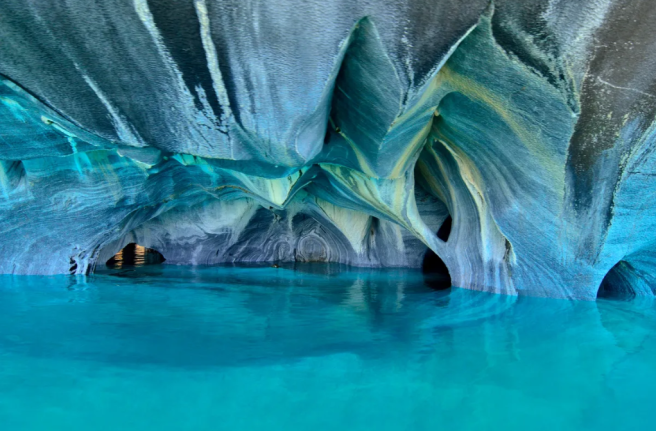
The lake shimmered like liquid turquoise, its surface calm as glass. The marble cavern yawned before the boat. Its carved walls were sculpted smooth by eons of patient water, soft and silent. Light danced across the ceiling, casting illusions. Shadows.
The tourists leaned over the edge of the boat, marveling at the way nature sculpted solid stone into frozen waves. Cameras clicked. A woman gasped at a shimmer below, mistaking it for a fish.
It watched from the abyssal blue, where sunlight faltered. Long dormant, it stirred with each echo of voices. Its eternal slumber being disturbed, hunger bloomed in the void between heartbeats. It remembered the ancient pact. Silence for safety. Stillness for survival. But the humans were loud. Disrespectful. Curious.
The boat was being pulled deeper into the cavern, drawn by a current nobody noticed. The walls arched high and wide, echoing like a drowned cathedral. No birds. No breeze. Only the constant drip of water and the deepening hue beneath them. It shifted from a bright teal to an unfathomable blue.
Something rose from the depths. Thin, tendril limbs extended, not rushing, just curious. They brushed the underside of the boat, then retracted.
A second later, the hull gave a muffled crack, water surged around them. A tentacle reached up, then another and another. One by one, the tourists were yanked into the void. Their brief screams echoed off the shimmering walls. Splashes swallowed by the vast silence. The creature did not thrash, it selected. Pulled. Devoured.
Then stillness again. The boat rocked gently, half submerged. It was as if nothing had happened. A camera floated beside it, its lens shattered and smeared with blood. Below, in the breathless dark something waited. The pact that had lasted centuries had been broken.
Paradise Mistaken A.F. Stewart
Not a ripple disturbed the glassy surface of the turquoise water; its hue reflected a glittering blue on the rocky outcroppings of the grotto. A faint echo of wind could be heard beyond, reminiscent of a soft whisper.
Any eye that gazed upon its paradise called it beautiful.
Yet, beauty disguised the darkest of horrors…
Beneath the waters they swam, shades of evil buried and bubbling from the depth of time. Indistinct shadows, waiting, watching; movement in the periphery of your vision. A step too close, an impulsive swim, and people disappeared into the depths. Never a scream, barely a splash, nothing remaining of who they were. Even memories faded faster than they should, as if primal fear chased away disturbing questions.
Only rumours speak of their existence, only nameless dread keeps them at bay. They are the rage beneath the quiet, that lingering remnant of something ancient, something hungry lurking in the pristine water.
Beauty is in the eye of the beholder, but if a shadow moves, don’t get too close…
Enough Miriam H. Harrison
The trouble with a slow death is that it gives me time to think. About life, about regrets. Mostly about food. How long has it been since my last meal? There are no sunrises or sunsets here in the echoing earth. Only caverns and water, caverns and water.
Perhaps the water is a blessing—a chance at a longer life. But I can’t help but hate that it denied me a faster death. I don’t want to die in this endless darkness. My flashlight is on its last batteries, but they’re fading. As am I. I find a patch of almost-dry rock and pull myself up. I turn off the flashing and try to sleep in the echoing darkness. I must sleep for a time, as I feel myself wake to the pangs of hunger, the fading dreams of food. I fumble for my flashlight, but pause.
Over the ripples of the water, I see the distant, dancing colours of sunlight. I leave the flashlight behind, push myself back into the waters. I can barely swim, but I slowly make my way closer to the beckoning light. A narrow passageway, and then I’m there—a wide, watery cavern. But high above me are two small openings. Not much, but just enough. Enough to make sure that my death is here, in the light.
As I entered the town, I saw a flash of pink and a little girl ran in front of me, swirls of dust following her. I stopped, every sense alert. She paused too, turned around to stare at me. She showed no fear, only curiosity, a gap-toothed grin stretching across her grimy face.
My hand went to my gun, but she vanished. Only the empty street remained, the wind blowing grit across the paving. A knot in my gut, I kept walking.
The rumours are true.
For once, I hoped the intel was wrong. My job was tough enough in a place of strangers; coming to the town where I grew up made it infinitely worse.
Striding down the street, shadows emerged at the windows, whispers drifted in the wind. I felt their presence, the taint of death clinging to the world of the living; a town of lingering ghosts. One more miserable consequence of the plague.
What I was here to eliminate.
The town square felt like the best place to assemble the machine. Central, the location would give good dispersal, not likely to miss stragglers. I unslung my bag and built the machine, piece by piece, the metal snapping together with a sharp clang. The noise attracted phantoms, watching me, never afraid, but surrounding me with murmurs. Voices I once knew, familiar, agonizing.
Remember, it’s just another job. Don’t look at faces.
Yet, how could I ignore them? Friends I went to school with, neighbours, family, all stared at me. I wanted to spare them, walk away, but I couldn’t.
They didn’t know, but I did.
Ghosts went through stages. Initially harmless, fresh and confused, but when they rotted, they turned malicious, violent. I witnessed the remains of what savage ghosts did to the living, the butchery and bloody corpses they left. No one should die that way.
When I finished, I straightened, said, “I’m sorry,” then activated the machine. The air sizzled, heavy with the stink of ozone, blue energy enveloping this town of ghosts, slicing through its former citizens. I closed my eyes, afraid to watch their forms dissipate. It didn’t help.
Countless anguished screams lodged in my head, reverberating in the aftermath of silence.
I stood for a moment and said a fruitless prayer to ease my guilt. Then I packed up my gear.
As I left the empty town, I looked back down the main street, watching a wayward breeze swirling the dust along the road like a carefree child. For a moment, I lost myself in that flow of unrestrained nature and my memories, hoping for a whisper, a giggle, a shadow of what used to be. But nothing.
With a sigh, I walked on, headed back to my vehicle, with one more scar across my heart.
He stared at the photograph atop the fireplace mantle, the faces of his dear family. No joy rested on their lips, except for little Nicole. Her grin made his lips curl. Such a happy child; his niece was ever bright-eyed and full of pep.
Such a drab outfit for sunny weather, he thought, inspecting his attire—a stark contrast to the shade of everyone else’s fashion. But he supposed that was normal. Benny knew he was a dark splotch of spilled ink on the family tree. Everyone did. But they loved him anyway.
Tears came from the kitchen and he followed their somber melody. There sat his beloved sister, clutching the knit hat she made him last Christmas. The rest of the family milled about, releasing their own grief. It surprised him to see them dressed like himself—fit for a funeral.
His crying sister looked up to Mother. “I can’t believe he’s gone.”
Daylight filtered down through the water’s surface, warm with possibilities that never seemed to quite reach her. The seaweed stretched high above her, drawn to that same light. But she knew better than to try. Her place was here, in the chill shadows of the lake. But even so, she looked above. Watching. Waiting.
It was some time before a familiar shadow moved across the rippling sunshine. The light danced and scattered as the shape dove down, its feathered form speeding into the depths with surprising grace.
“What news?” she asked eagerly. “How are things up above?”
“Much the same,” the loon answered. It darted about her, its red eyes watching for food. “The season is warm. The hunters hunt; the fishermen fish. The cycles continue.”
“And what about the searchers? Have they returned?”
The loon slowed for a moment, regarding her. “No one searches. Not since the ice came and went.”
“But surely they’ll be back?” she pressed.
The loon said nothing for a time, and the silence chilled her more than the cold, dark shadows, more even than the rusting chains around her fish-eaten ankles.
“No one searches,” the loon finally said again. “The cycles go on.”
She watched as the loon returned to the surface, returned to the warmth of life. The distance between her and the surface was too great. The distance between death and life, greater still. Her place was here, in the chill shadows of the lake. But even so, she looked above. Watching. Waiting.

 Pen of the Damned