They huddled together under tattered blankets, a mother and daughter hidden in the shadows of the abandoned building. Outside, the wind rattled against the walls and howled through the cracked windows; the noise drowned the rumblings of their hungry bellies. Weeks of running left them exhausted, yet neither slept. Fear kept them awake.
The girl whispered, “Was there ever a better world than this one, Mama? Grandma said there was. A place where we didn’t always run, didn’t hide. Where daddies and raiders never hunted and hurt us.”
Her mother squirmed. “Perhaps, sweetie. Once. I have vague memories, but they might be only dreams. If it existed, it was a long time ago and it’s never coming back.”
“Like Grandma?”
An intake of breath, a pause, and then, “Yes. Like Grandma.” There was a soft sigh. “What happened to Grandma is why we run, why I teach you. Now tell me the three rules.” She patted her daughter’s hand.
“Yes, Mama. Rule 1: Never trust anyone, not even if they’re nice to you. Rule 2: Try to be kind, but be cruel if you have to.” Her lip quivered. “Like we were with Grandma when we left her?”
“Exactly. She couldn’t keep up and leaving her behind distracted those raiders. Now what’s rule 3?”
“Rule 3: Don’t be weak. The strong live. The strong make it to the Promised Land. The strong dodge the raiders. The strong will be free. No masters, no daddies. No one to hurt us.”
“Good.” She tousled her daughter’s hair. “Never forget those rules. Never break them. If we’re smart, we’ll escape. Now get some sleep. We move out with the sunrise.”
“Tell me about the Promised Land, Mama. It helps me sleep.” The girl snuggled against her mother, burrowing into the blankets.
Words drifted on the darkness. “The Promised Land is a safe place, a place without raiders, or masters, or cruelty, where the fear of engines doesn’t exist. Women don’t have to worry there, don’t fear being hurt, or killed, or enslaved. We won’t have to run, or hide, or go hungry. It’s where we can be happy. Where we don’t have to live by the rules of men.”
The girl closed her eyes, dreaming of a beautiful land as she fell asleep. Her mother kept watch over her, listening for the sound of the raiders’ engines…
Weeks later, their long journey behind them, they left the wasteland and found a place of grassy scrub and a cracked road leading north. Taking her daughter’s hand, the mother squeezed and murmured, “We’re almost there, sweetie. Almost to the Promised Land, to safety.”
Two more days found them outside a neglected settlement, overgrown with vegetation and vacant of life. A broken fence surrounded rustic, disused houses and buildings. As they drew closer, they noticed an open gate crookedly swinging on rusting hinges. Walking inside, a faded sign greeted the pair, mocking them with the ruined, peeling letters: P R O I S M E D A N D.
The girl looked around and tugged at her mother’s sleeve. “Is this it, Mama?”
“Yes.” The word cut cold in the air and held despair in its depths.
“But it’s empty, Mama. Where are the people? Where’s the Promised Land?” She stared at her mother, watching the woman’s expression harden. “Are we safe yet?”
“No.” The sound almost choked in her throat. “It’s gone. It’s all gone. There is no Promised Land, no safety. They destroyed it too.” She looked at her daughter as the sound of engines roared in the distance. “It was all a false dream. It was all for nothing.”
She bent down and tilted her daughter’s chin, staring into her eyes. “There’s one more thing to learn, sweetie.” Her other hand reached into her travelling bag. “Rule 4: Everyone lies. Even me.”
“I don’t understand.”
“I know, sweetie.” She brushed her daughter’s hair with her fingers and straightened. “I’m sorry, but there’s nowhere to run and hide anymore and I can’t go back.” She smiled at the confused child. “I’m so sorry.”
From her bag, she pulled out a pistol and shot herself in the head, blood spraying her daughter’s upturned face. The nearing sound of engines mixed with the girl’s screams.
She sat on the steel-framed bed, the texture of the rough linen sheets under her fingertips and her legs dangling off the edge, toes touching the floor. Inhale, exhale, and then she whispered, “Four walls, a ceiling, a locked door. Good.” It’s a box. Trapped in a box. Doubting words slithered around her mind. Inhale, exhale. “Stay in the box. A box is safe. ” Is it? What’s that sound? She stiffened, straining her ears. Footsteps. Her fingers tightened into the mattress. “Don’t come in. Don’t come in. Stay out of my box.” Yanking her legs up, she curled into a ball, listening until the thump, thump noise faded away. Inhale, exhale, and her breath softened. “They’re gone now. Alone the in box. Safe.” For now. She closed her eyes, pain creeping past her temples. “No one will come.” Laying down on the bed, knees still pressed against her chest, she focused on the quiet and the dark. Inhale, exhale, don’t remember…It’s secure in the room, no one would come, the door would never open. She concentrated on the lies to avoid screaming. Until the itch scrabbled at the back of her thoughts like scratching claws, thrashing through her mind and growling at her consciousness. Wake up, wake up, wake up. “Shush. Leave me alone. I need to be alone, alone, alone.” Laughter echoed in her head. That’s the biggest lie of all. You can’t hide, you can’t stop it. Her eyes fluttered open, and her stomach churned. “Why?” More laughter. “I’m never going to be free, am I?” No. Sitting now, she dangled her legs off the edge of the bed, toes touching the floor. The texture of the rough linen sheets under her fingertips grounded her thoughts, but she stared at the door, waiting. Inhale, exhale. Every moment savoured, knowing it wouldn’t last. When the footsteps returned, she braced herself, whimpering as the lock turned and the door swung open. Scratching claws ripped through her self-control and consumed her will. The demon that shared her mind and body had control. It whispered in her ear. Told you. The prey is here, and it’s time for my fun. She closed her eyes as the creature sped her body across the room and leapt on the orderly. Trapped inside her own flesh, she hummed to herself, ignoring the taste of copper blood in her mouth and the screams in her ears… Inhale, exhale. Try to forget that no one is safe from me…
I dream of her, my phantom, her haunting face stretched taut with pale skin, wispy white hair falling limp around her red-rimmed eyes. She stares, blind and bleeding, her lips mouthing silent whispers against the aether. Somehow I know she is pleading, screaming, her words drowning inside whatever hell has claimed her. I tremble when she reaches out to me, her fingers inches from my cheek… That is when I awake from my nightmare, drenched in sweat. I should be relieved, the night terrors banished by the sun. Yet, my torment continues throughout the daylight hours, for she never leaves me. She is my shadow in the light, the ghost that haunts my waking hours and bleeds me dry for peace. A manifestation of primal fear and my eternal pity, my personal apparition. Her existence instills both the desire to flee and the need to save her. Am I mad? I have no answer to that question. Perhaps I might welcome insanity. The waking world now threads around me unfinished in shades of grey and gloom, with no vibrancy of colour save red; it taints everything, everywhere. I long for sleep and my nightmares. I long for her pale face and crimson eyes. Each night I sink deeper beneath the surface of my dreams and she draws closer to me; my skin craves her touch now, and it is harder to wake in the morning. I never leave the house and barely eat, often staring at my bed, forcing myself to stay awake. What if I close my eyes and never wake up? Would I finally be with her? The uncertainty of it all anchors me to this world. Will she bring my oblivion or will I be her deliverance? I don’t know. The not knowing drives me, swirls my mind in frantic visions and terrors. Yet, I feel I will understand soon, for her siren’s song becomes harder to resist. When her fingers caress my face, I will have my answer. Only then will my nightmare end. At least I pray it will.
She ambled along the path to the lake, soaking in the lovely spring day, walking alone, but enjoying the tranquillity of the gentle breeze and the smell of pine from the trees. She needed some peaceful reflection after the break-up.
Brad never wanted to reflect on anything, always engrossed in work, work, work. She felt ignored, especially lately, like he barely noticed her. That’s why she planned this getaway, but it fell apart from the beginning…
The fuss he made coming to the cabin. She barely got him into the car. At least he was quiet on the drive. From the start, he spoiled the whole weekend retreat.
And now he was gone. It had only been a couple of hours, but she missed him already.
Oh, Brad, why did you have to treat me like that?
She loved him from the moment she saw him, with that wonderful smile, those kind eyes. Being near him made her feel so safe. Yet, he turned out like all the rest.
Men were so mean.
Denying he knew her. Or that he loved her. Yelling for her to untie him. Brad even pretended not to know her name.
After all she did for him, all he meant to her.
She showed him her journals, where she detailed all their encounters. The day he casually brushed past her in the street, touching her sleeve. The numerous times they stood together in line at his favourite coffee shop. All those nights she watched him through his windows. She reminded him of other things, too. Hadn’t she arranged that accident for his work rival? Scared off that slut who flirted with him? She bared her heart and declared her love.
He looked at her as if she was insane. That hurt.
Why couldn’t he see it?
They were meant to be together. They had a connection. The cabin was supposed to be the start of their future. He was supposed to be the one. Yet Brad rejected her, after all the weeks they spent together. Men always rejected her, no matter how hard she tried to please them.
I never want to hurt them, but I get so angry… She sighed. They’re the ones that make me do the awful things.
She chose a knife this time. Brad sneered when she picked it up and threatened him. Sneered until she slashed him. Then he cursed at her, called her awful names, and threatened to go to the police. She couldn’t let him do that, so she started stabbing.
That’s when he screamed, and I saw the fear in his eyes. I always see the fear at the end.
She sighed. She never enjoyed remembering the break-ups. Always so messy.
I suppose I better head back. There’s still a lot of work to do. Bodies don’t dispose of themselves.
Entombed in the embrace of the soot-black night, the frigid snow caught the eternal edge of the waning moonlight. Pristine, yet jagged, its frozen surface shimmered in an iridescent sheen, poised like the steel jaws of a trap waiting for the unwary; its beauty was undeniable but deadly.
For the mortals that lived in its grip, winter ruled the world and waited.
A northern gale rustled down from the high mountains, bouncing against the village; layers of ice cracked, flexing the cold’s wicked bite throughout the empty streets. Not a breathing soul stirred in the night air; the living huddled inside around meagre fires. Those fated few trapped outside had long since perished, left as the offerings.
Sacrifices were necessary.
For Winter took its price. Better the chosen, than the innocent.
And always the question remained: How many days this year? Last season the village barely survived. Only a change in the weather, a surprise thaw, saved them all. That year the weather lingered longer.
What would happen this season? Would more die before spring? Would they all die?
It wasn’t something they could fight.
They could only prepare for what was coming…
Claws skittered against the glacial snow. Heaving pants of breath threaded white vapours on the wind. A soft whine wormed its way through miniscule cracks and people shivered. Louder noises followed; the crunch of ice, bone and frozen flesh. Some villagers silently wept. Here and there, a looming shadow passed the shuttered windows, breaking the warm light of the fires. Sometimes, when the children whimpered, they heard scratching at the doors. No one could leave, and no one spoke, save in whispers.
On certain nights, when mood and moon strike a perfect balance, things beyond actuality stir. Forces shift along the winding winds of autumn—the ones chasing indistinct half-whispers through forest leaves—before they settle. Where and when you can never be sure, but tonight a derelict house becomes the chosen place. An overgrown decrepit structure, a relic of eras forgotten or romanticized, it drips in an ideal ambience of uncanny echoes filtered through endless history.
An indistinguishable groan shudders through the bones of the house and a chill gust of air swirls tiny circles in its layers of dust, sliding down the moonlight streaming in from the broken windows. The breeze prances along the floor in time to heavy reverberating footsteps; another strange distortion in the sedentary grime of an empty hallway. A rustle of weighty wings follows the footsteps and a long black shadow creeps over the moonlight, as the doors to an abandoned ballroom creak open.
The silence of the next moments extend, waiting like a predator, until…
“It is time.”
The atmosphere sizzles with a hiss, an alteration in the dim light, and a blurring of mortal existence. A scent of sulphur morphs into the stench of decay and cigars welcoming the soft breath of something unseen. Slowly, an oozing green mist permeates the room’s stale air. The filmy haze squelches into diaphanous skeletal forms, transfiguring into recognizable shapes and limbs, giving substance to ghostly corpses. Ashes swirl scattered grey patterns across the floor, that now resounds with the click of heels and the squeak of leather shoes.
Brassy strains of music waft around the room, an orchestral waltz slightly out of tune, and laughter trails the melody, cackling from cracks and corners. As the ethereal instruments play, they dance with the clatter of bones and the swish of tattered gowns, sweeping the rotting decadence of unholy death in a morbid semblance of joy and art. Tirelessly they whirl, hour upon hour, far beyond the chime of the midnight clock, until the dawn pushes its tendrils into the sky breaking the spell.
Only then do they stop, sighs of unfulfilled longing swirling around the ballroom, before the revelry falls silent. Daylight skips across the floor from cracked windows and spectres morph back into mist as the ripple of death reclaims its own. Dark wings shiver the air and a black shadow cuts past the morning sunshine. Leaden footsteps echo down the hall until the dust settles into the quiet beginning of a new day.
A soft mist tangled through the trees past the haunting of midnight, as the wind rustled a few dead leaves still clinging to the branches. One crooked gravestone leaned under the shifting moonlight, its crumbling edges and rough surface slowly losing the fight against time and the elements. The winter-tinged breeze swirled the detritus on the ground in crinkles and crunches as if someone was walking across the grave, bent on disturbing the mouldering remains of one Jebediah Osbourne. A rich man in life, the last of an ancient family, Jebediah embraced the esoteric and eccentric, shunning polite society. In death, society had abandoned him to a dark eternity alone in the woods, buried and forgotten. Well, perhaps not entirely forgotten. The box appeared with the full moon, on that October 31st in 1913, summoned by the rumblings of a war beginning across the ocean. The faint drum of a heartbeat reverberated from inside, inexplicably echoed by the corpse interred below the earth. Thump, thump. Thump, thump. A pulse vibrating along the earth, sinking its rhythm into the soil and intoning through the trees until they trembled with the cadence. Sensing the unnatural disturbance, an owl screeched in the distance, The forest screamed in response as the dirt quaked and shifted, as streams of blood poured from the deep bowels of nightmares. Thump, thump. Thump, thump. And then a click. The box opened. Not with a shriek or a howl. With a soft, lingering chuckle. And the hand of dead Jebediah Osbourne broke free of its grave, reaching for the night sky.
On the lower steps, you could just barely see him. A gray smoke. A whirl of ghostly gnats and ashes. Faintly glowing. On the move. Adrift but seeking. Rising up from the cellar’s darkness.
In the light. In a narrow place. Beneath the rococo wall of gold, he became invisible. And he waited. To take a lover. To kiss the first mouth that passed through him. To sup upon a soul and become manifest. To feast upon life so that he might return to flesh, and become a god.
Knock on Wood Marge Simon
I return to the house of my youth, where the newel post still stands at the foot of the stairs. Dear memories of childhood, that staircase with its banister, the game of Knock-on Wood. Down and around we children used to slide. At the landing, knock on wood, then change directions, plunging onward shrieking to the very bottom stair. There, we’d touch wood once more at the newel post, then scramble up to do it all again. The fastest one would take the win, such a lark in bygone days!
All too well, I remember Cousin James, who too often won the game. How he’d crow about his win, until the day I’d had enough, and pushed him downstairs to his death. I tell myself I’d meant no harm; it was just a game gone wrong. I go to leave, but a whuff of chill air stops me in my tracks. Suddenly afraid, I turn to see that newel post knows otherwise, a fiendish leer within its carved design. And, after all these years, there’ll be the devil to pay.
After Dark Nina D’Arcangela
In darkness there is patience, a quiet that waits; a moment pregnant with pure malevolence.
I lay in the dark, sheet tucked to my chin on this sweltering night. The small bulb fixed to the tin wall barely a beacon, let alone a source of comfort. I can hear the crick of the wooden stairs as it stealthily begins the climb. Eyes shuttered tight, breath fetid by fear, my muscles seize — I feel it watching me. Minutes pass as I count slowly in my mind. Finally, I hear it turn, I hear its bones and crepe paper skin as it scrapes the railing and planks. I hear the slight squeal of the hinge as it opens the hatch set into the stairwell. I let out a small sigh and immediately regret my mistake. As I throw the sheet over my head, the thing pounds back up the treads and across the room; bones slamming every surface it passes. It leaps onto the bed, and in a frenzy, begins to pound and slash at my body; the bruising from the last assault not yet healed. Both of us scream. Mine, a high-pitched shriek of terror; its, an unholy wail that splits the night.
Abruptly, the onslaught stops. As I lay panting beneath the torn and bloodied bedclothes, it retreats to the stairs once more. In the near silent room, I hear the latch click as it pulls the door shut behind it.
Locked-In with Dreams Louise Worthington
I eagerly wait for a new day inside my cold cell, even when the sun’s face is ready to give up on me. As usual, the sheets are unhappily twisted around me, hiding imprints from the vigour of my dreams. My secret light pollution. Only I can see them travelling on the train of my life going by, cabin by cabin. On waking, they are water spewing from a hose until it’s cut off mid-stream.
I am thirsty. So very thirsty.
Today I imagine myself escaping from a tower. I have grown my hair, and I lower myself down gently to the ground like precious cargo.
Outside, free from walls, stairs, and doors, I build a new country out of mirrors that heal fragmented reflections, like Picasso. I steal silver foil like magpies to protect my skin.
I skip stones across the pond – one, two, three – and bury seeds in the garden and water them in, then secure trellis for black-eyed Susans and ivy to spread over the ugliest and roughest of brickwork until this house disappears.
The precious things which I have lost shower like cherry blossom, and gusts of wind blow the soft-scented petals indoors, dispersed like breadcrumbs up the stairs, along the dark landing, to confetti beneath my locked bedroom door. If I try hard, I can catch their sweet scent.
Rebirth Lee Andrew Forman
Each footfall echoes with unnatural intensity as I ascend. The newfound light draws me, body and soul—this first dawn to repel the suffocating darkness in which I exist, is irresistible. The edge of all my eyes have witnessed have been no more than shadows and illusions of the psyche. I climb, against all struggle, into the blinding gleam, to flee this domain of suffering and feast on all that is within my grasp. I hunger for more than the rotten scraps the cold metal tube provides. As I reach the barrier I’ve never dared near, I wonder how their flesh will taste—the mother who expelled me from her womb as though I were pestilence, and the father who scorned all I am.
In My Darkness Miriam H. Harrison
The first time I saw her, she was little more than shadow. Walking through our sleeping city, she was a companion in my insomnia. A hope in my darkness. We had many more sleepless nights together, but the sunrises are what I remember best. The daily glow of warmth and colour filling her smile.
That was before the sickness came. Before it drained away her colour. Before all warmth faded to chills and aches. Still we spoke of our sunrises, but she was too weary to see new dawns rise. And without her, I saw no beauty in the light.
The longest, darkest night was when the sickness won. I dreaded the light of a new day, the start of my first day without her. But then, just before dawn, I saw her.
That last time I saw her, she was little more than light. Glowing like a sunrise in my home. Like hope in my darkness.
The Upper Room AF Stewart
He lived in a small room on the top floor of the monastery. A small space beyond narrow winding stairs that smelled of sour, musty age. The upper room they called it, at least the monks that spoke of it at all. Few wished to acknowledge its existence, nor the presence of its occupant.
“A holy man,” they sometimes murmured.
But no one truly knew. No soul saw him, not even the monks that brought him food, slipping it inside his darkened space. After all, who would wish to disturb a hermit lost to silent mediation and prayer?
Strange how the truth can be distorted over time. Equally strange how no one questioned the occasional missing traveller or how dissenting monks sometimes disappeared. Sin calls to sin after all.
For the creature that lived in the upper room was no holy man, nor even a man. Not any longer. Once perhaps, a devout monk seeking enlightenment, seeking the divine. But pride drove him beyond sense and he found only demonic secrets. Ones that devoured his soul. Now he waits in the upper room, a prisoner, consuming the sins of occasional fools that venture too far inside his lair.
But he knows one day someone will make a mistake. They will forget to replenish the wards, or he’ll devour enough sins to break his bonds.
He knows one day he will escape.
Stairwell of the Liquid Souls Harrison Kim
Edema steps up and down, up and down the stairs between the walls, under the light that never turns off. At the top, Edema cannot turn the corner because there is no corner. She can’t go through a door because one doesn’t exist. No turning, because her forehead’s becoming larger, her belly too, and her knees. Her body’s filling with liquid, what sort of liquid, she doesn’t know, all she does know is it is heavy and thick, seeping through from the walls, and it sloshes inside and slows her movements. Within her ears she hears a wailing, a crying in despair,
For God’s sake, get us out of here!
Her heartbeat thumps faster as the wailing rises, a heart that slops and slips as she climbs the stairs ever more slowly, hoping she may escape to freedom if she hits the walls hard enough, in this sick brown coloured stairwell with no night or day. Her forehead droops, her belly sags.
It’s her knees that first drag on the floor, her huge liquid filled knees. Then it’s the belly that drops, and now the forehead, pulling her head down, its creases lie flat on the upper stairs, her feet on the lower ones. Edema’s fluid engorged body fills the entire stairwell, a swampy miasma of skin, liquid soul and bones, she can’t climb any more though her legs continue in spasm. In her head the only thought is “For God’s sake, get me out of here!” how much time does her body lie there… ten days, a month, in stench and stink, seeping into the wood and plaster. Afterwards, the only indication that anything filled the empty space is a slightly brighter light atop the hallway of the liquid souls, an alabaster shimmering in the wall.
The Clearing RJ Meldrum
They parked, grabbed their gear and headed down the trail. Walking for about a mile, they reached a fork. Peter consulted the map. He was unfamiliar with the area, but their destination lay to the east, so he decided to follow the trail heading in that direction. Compared to the path heading west, this one was overgrown with grass and other foliage. It was clearly rarely used. Amanda was worried they were literally leaving the beaten path, but he had the map. Her instinct was correct; he’d chosen the wrong trail. It led to a remote, unpopulated part of the forest.
After an hour they entered a clearing. In the middle sat a ruined cabin. The lumber had decayed into indistinct piles. Only one part remained; a flight of stairs. In perfect condition, they climbed to a floor which no longer existed.
The sight was so incongruous, Amanda just had to take a closer look. She touched the bannister, but quickly withdrew her hand. It had vibrated. Peter placed his hand on the wood too, but felt nothing.
She started to climb the stairs. Her eyes were glazed and distant, as if she was seeing something Peter couldn’t. She reached the top and extended her hand. Her fingers mimicked opening a door. She stepped forward. Peter shouted she was about to fall. Instead, she simply disappeared. He ran up the stairs, but there was nothing. He had to get help. He headed back down the trail.
In the clearing, the ruined cabin sat quietly. The fresh varnish on the stairs reflected the evening sun, sending shafts of light to sparkle amongst the green leaves of nearby trees. There was a sense of calm and tranquility. The offering, although unexpected, had been acceptable.
The Servants’ Staircase Elaine Pascale
“I keep dreaming about the stairs.”
“The servants’ stairs?” Clay asked even though he knew the answer. His wife had complained of being haunted by the narrow staircase ever since they had been forced to relocate. She said there was bad energy trapped in the stairwell. He had caught her performing a ritual at the foot of the stairs.
“I wish you wouldn’t call it that…” Julia sighed.
“It’s historically accurate. Besides, neither of our families could have afforded servants. We have a clean slate.”
“Then explain the dreams.”
He tapped his forehead. “Your witchy brain, my dear.”
She frowned. “Can you try opening that weird cubby again? Maybe if I see the inside, the dreams will stop.”
“I’ve tried. It’s sealed shut.”
“Break the seal,” she pleaded.
Knowing that the landlord would not be thrilled with the act of vandalism but wanting his wife’s superstitions to stop, Clay tried the small door again, only to find that it opened easily.
“See, nothing—” Clay stopped when he spotted what looked like a sapphire ring peeking out of the dirt. “How did your ring get in there?”
Julia shrugged. “I bartered.”
Clay was confused. “Bartered? For what?”
As Julia swung the hammer at his forehead, Clay saw that the ring was garnishing a gnarled hand.
“Your life insurance policy.”
The hand grabbed Clay’s shirt just as the pain set in.
The last thing he heard was Julia say proudly, “Thank god for my witchy brain.”
A quiet neighbourhood like any other, with rows of unchanging houses tucked away from the main bustle of the city. The sound of squeaking bicycle wheels and laughing children echoed along streets that held the slight scent of oatmeal cookies and apple pie. The neighbours threw weekend barbeque parties and traded recipes, carpooled and arranged playdates for their children. A picture-perfect slice of suburban heaven.
At the end of a cul-de-sac, nestled back from the road, sat a small, nondescript house. Painted its uniform white with blue trim, boasting a quaint porch and a rocking chair, and a welcome mat by the front door. An older man lived there, retired from dentistry on the back side of fifty. Now he spent his time sipping tea in his porch chair, waving and grinning at the street’s residents.
His neighbours jokingly referred to him as Dr. Smiles.
The quietest of neighbours, polite, well-groomed, always ready with a cheery hello. He never failed to pat the dogs that might wander into his yard, or toss an errant soccer ball back to the rambunctious children. Yes, everyone loved Dr. Smiles.
Except the people in the basement.
They were the outsiders that didn’t quite fit in, the disruptive influences, names slipped to Dr. Smiles by long-time residents. He efficiently removed them, tucking them away to feed his own cruel amusements. After all, who would suspect a kindly old man of violence?
Lined up in neat rows, strapped tightly into his chairs, he took care to keep the unwilling patients alive as long as possible. Specimens could be scarce sometimes, and he enjoyed putting his dental tools to new uses. Occasionally, they disturbed the neighbours when they screamed too loud, but Dr. Smiles would then apologize before gagging their cries. He was nothing, if not a considerate neighbour.
The mating time was brief this year. Our women sang notes like floss on the wild-wind plains. A human came who forced his seed on sweet Ala of the Yellow Eyes. We went on, saying not a word, bent to harvesting our Caddo root.
Afterward, Ala wasn’t the same. She cut her marvelous hair which had been dark and long, grown down below her knees. She wandered off to the Darklands, heavy with child and none to celebrate. We mourn her fate. If she survives, she’ll not return. She’ll raise his spawn alone. She was the envy of us all. When the child is born, she’ll burn his father’s image in the sands of our dead oceans. The human sits on our sacred stones. He preens his beard and leers at females, with no more thoughts to waste on Ala; he never even knew her name.
Come burrow season, we prepare, sharpen our talons on the Caddo root. When the freezing gales begin, the human will demand sanctuary, as his kind always does. We bring him the rich sap of our Caddo root, watch his flabby face turn pale as the winter moons. We will confirm his welcome with the strewing of his bones.
Petrified Wishes A.F. Stewart
“Round and round the tree, who will it be? One wish for you, none for me.” But don’t get too close. “Forever you may find, is far too unkind.” Forever… don’t think about that. “In a circle we dance, now only two. One wish for me, none for you.”
“Footsteps, footsteps, roundabout. Sure with the pacing, never in doubt.” One little slip… Nancy slipped. Oh god, poor Nancy. And Deidre. Can’t think, have to keep moving. Finish the song. It’s the only way. “Complete the circle, one by one. Pay the piper, single survivor. The wish is yours when the song is done.”
Why did we come here? Wishes? Fortunes? Happiness? It was only supposed to be silly fun. Grandma warned me. I didn’t believe her. Foolish tales. I never thought it could be… Not this… Cara, did she? Yes, Cara stumbled. I’m going to survive!
Just to be certain, I helped my friend to her death with a push, watching the tree consume her flesh, until nothing remained but a petrified corpse. Then on trembling legs, I made my wish and whispered the last line of the song.
“To the one left standing, a wish granted you see. The others have fallen, now part of the tree…”
Passing Time Lee Andrew Forman
Time uncounted passed since the radiance of our love ended. We adored that barken pillar and its canopy, the shade it provided from the fury of a summer sun. Blankets lain and baskets aplenty carried by lovers’ hands, words of angels and moments of bliss born into existence—each an expanding universe of our contentment.
But these years, so soft and kind, turned bitter and dealt spite upon our miracle. An affliction came upon her, and through its vile nature, her lips ceased to smile. All they had to offer was a cold, passionless touch. I wept over her body until my nostrils could no longer stand the scent. Only then did I begin the work of finding and putting to use a shovel.
What more fitting place than at the foot of our favorite tree to bury her emptied vessel. I sat with her daily. I spoke the words I would have, had she lived. I picnicked with fine cheese and her favorite wine. With each passing year, the roots grew; they twisted as slowly as grief.
With each new moon, the hair upon my scalp grayed, and I smiled knowing we’d soon be together again.
Survival Charles Gramlich
Only dirt, a patch of grass, and one tree survive. Besides black and white, the only colors left here are gray and green and shades of brown. Everyone worried about nuclear war, or the coming of AI. They worried about pollution and overpopulation, about new plagues and old, about the revenge of plants, or insects, or birds, or the frogs, or mutated beasts. They worried about climate change and super storms. No one worried about the thing that actually killed us, that left earth a corpse world. It happened when useless, meaningless words began to proliferate from the mouths of idiots. When bloviating fools talked and talked and talked and talked. And words lost their meaning and strangled all thought, and then all life. Until only this one patch of grass and a tree are left. For now.
Transformation RJ Meldrum
She went to the forest. It was the place she always visited when her heart was broken. Another failed romance; perhaps her standards were too high, perhaps the boys she chose were just assholes. She drifted along trails, leaves speckled with sunlight. She was heading to the tree. It was her place of peace, her thinking tree. She often visited it, when she was happy but also when she was sad. There was just something about the oak, as it towered a hundred feet into the air above her. She sat and rubbed the bark.
“Just you and me again. I wish I had a heart like yours. A wooden heart can’t be broken.”
She closed her eyes and drifted off to sleep, lulled by the warm, scented summer breeze. She woke to coolness. The sun had shifted. Her hand was stiff and dead. Must have slept on it funny and cut off the circulation. She tried to lift it but found herself unable to. Looking down she screamed. Her hand had all but disappeared into the wood of the tree. The skin on her forearm was no longer skin, instead it was scaly and brown. Like bark. She realized with increasing horror she was unable to escape. A whispering came from above her. The wind in the leaves serenaded her.
Sleep, it will soon be over. Soon be better. You will have a wooden heart and that can never be broken.
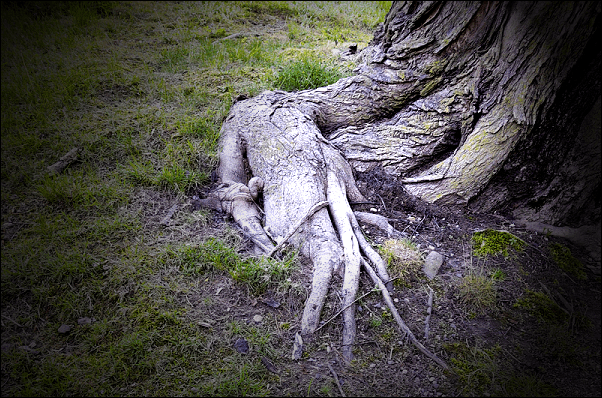
She understood. Her tree was trying to protect her. She laid back, her head against the wood. She listened as the tree absorbed her, turning her into wood. Her consciousness joined the others. After her transformation, she simply resembled a long, knobby, albeit strangely shaped root.
Escape Miriam H. Harrison
I could not escape. Not when you lured me with gentle words, not when you wooed me with practiced charm, not even when I first saw your anger flash red. No, your wrongs were terrible, but you always knew how to make them right. You knew how to be sorry—oh so sorry. You knew how to bare your vulnerable heart, cry your misunderstood tears, until I would forget who had hurt whom.
I remember now. I remember now that it’s too late.
I could not escape you then. Now, you will not escape me. I will be all you see. Look to the clouds, and I will be there, bleeding red sunsets. Look to the stones and you will see my broken bones. Look to the trees and I will look back, reaching to you with roots and branches, reminding you of what you will never escape.
Cradle Nina D’Arcangela
Barely able to see, I clamored on, climbing as quickly as I could. Passing the first bisected limb, I struggled further—not to the second, but the third. It was rumored the higher the elevation, the greater the enlightenment that would be achieved. I lay down and began to pant, my body slick and exhausted. The cradle of the tree welcoming. I chose this as my birthing place.
I began the arduous task at hand. Gaining my feet once more, I leaned my back against the main trunk and began to slough the mucus like cocoon that encased my body and hers. More than once, I had to readjust my stance for stability. With most of the shedding complete, I reached down to embrace the babe now laying at my naked feet. She was beautiful – as raw skinned as I, but still the most exquisite thing I had ever seen. A slight error in judgment as I leaned forward to bite through the umbilical, and I was airborne, until I wasn’t. Lying on the ground, I watched as my brothers made the same climb I had, but for a different purpose.
Broken and shattered, I could do nothing but watch as my siblings cleaned the ancient tree of the ichor I’d left behind. In their haste, they didn’t notice the small bundle among the discarded tissue. My broken body unable to speak, I lie at the base of the tree and watched as she plummeted to the ground, landing in the cook of my arm.
Nameless Louise Worthington
Only when she is dead will it stop coming for her. Only under the earth, when air is no longer a tormenter, will she be free to rest her weary head. There is no place that she can hide. No place where she can be who and what she is – was – is without it eating neurons. No matter the distance. No matter the country. She has no memory: no family or home. No roots. Earthbound: trapped and homeless inside a shrinking head.
‘There is no one to say goodbye to, is there?…’
She thinks it’s the ancient tree moaning in the autumn breeze and to soothe it, she places a frail hand on the bark grown thick and strong with every passing year. Her skin is as thin as paper.
‘No, I don’t think so.’
What fantasy can a splintering woman have, except to lie beside the stolid tree as though nature is her friend, too?
The Squid Man Harrison Kim
I float above old root veins holding a petrified body, legs decayed to squid like bits. The roots suck onto the body from beneath the ground. The condemned youth’s blood flowed thick, sustaining this mighty tree, with its bark foot inching forward, finding ways to grasp. Months ago, in the reflection of the water, and above it, from this mighty fir, this young man was hung from a rope, then his body cut down, left in these woods to rot and decay, as is the custom here. Around his corpse, leaves fall like the years, and the summer grass turns a weak green colour, with the autumn rains. The young man became a squid creature fallen, the tree feasting on his blood, a tree with a foot like an elephant’s, thick and strong. The young man, decapitated, the fall from the rope so powerful his head released and fell yards away, where it became a petrified ball.
I have this dream night after night, viewing the young man’s arm pulled off and his head and body decaying beneath the tree, and every night I want to cut his squid arm free, but it’s too late, it is fused to the roots. Headless corpse here, dry and drained, the living tree under which the young man was condemned possessing the body with its roots. A tree mighty and powerful, thrusting skyward strong where this man was hung for his crimes. My dreaming soul floats above the desiccated corpse in a forever dream. Beneath the earth, where I cannot see, the condemned man’s blood now absorbed by the fir roots. The nutrients still circulate here, bringing strength and life.
Waiting to Fall Elaine Pascale
You never loved me more than when you were dying,
nestled in your noose, waiting to fall.
I watched. I watched you die.
At your last breath, I fainted into the cold earth beneath your feet.
It was good there. It was good in the cold and dark.
I returned every night after your body had been taken down;
after your body had been disposed of
without ceremony
without any indication that you had ever lived.
The tree became a memorial.
I offered myself to it.
Offered my love to it, to you.
And you took it,
so that each night I grew weaker.
Your restless spirit sought sustenance from mine.
Your mouth, your lips, your teeth, they took
as I lay beneath the tree craving more darkness as you craved more light.
Before my eyes failed, I saw you shimmering,
draining me so that you could become more substantial.



 Pen of the Damned