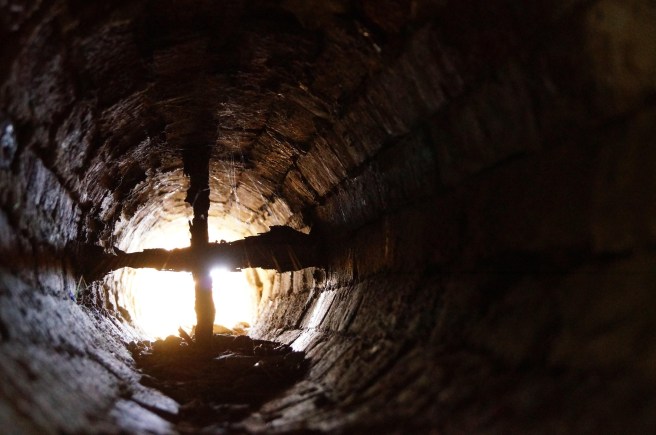
They come through the tunnels of Hell into the sunlight, wearing rusted armor astride horses of gore. Ancient swords hang at rotted hips and over decaying shoulders. Some carry morning stars, or battle axes upon which the blood of old wars has dried so hard it has bonded to the steel.
In dark madness they come, up fiery slopes of magma toward the snow-capped mountains of heaven. But the holy gates are shut against them and only earth is left to abide their time.
Unshriven. Unforgiven. No Heaven or Hell will have them.
Fortunately, they find that humans are both filling and taste great.
In the time of the hallowed moon, in the season where the chill lingers, the world grows still, and waits. Alone at campfire, I sit, wanting to burn. The firelight draws a sorcerer’s protective sphere around me; I dare not turn my head to see what lies outside. The darkness squirms.
Behind me, the forest exhales. Ashes in the fire swirl into embers, ghost upward into a vampire sky that sucks them gray again. The embers are a surrogate for my soul, fragmented, blackened, lit only by a semblance of heat that leaches quickly away.
I look to the stars. Perhaps they will comfort. Their light cannot be consumed by any earthly hunger. They care not for the concerns of carbon. But their icicle twinkling reminds me too much of cruel laughter. Shrinking, I coil in upon myself.
Nearer laughter swells. It howls in the trees. It cackles in the shadows. The night puts on a cloak of thorns. I close my eyes but my ears are open and stung. A visitor is coming, stalking on tenebrous limbs. I feel the weight of his presence, the surge of air that he pushes before him.
My heart hammers a heavy rhythm; my mouth tastes of venom and brass. Blood drums like the hooves of horses beneath my skin. Sweat crawls like freshly birthed roaches. Stench overwhelms—mold and fungi, toads and spittle-bugs, spider webs painted with tincture of silver.
And now he whispers at my shoulder. Gooseflesh arises as he cajoles me to spurn the light, to gaze upon him, to own his words. He promises a balm for sad fear—if I join him. Perhaps I will accept. Why cling to fire-glow when black-shine offers honeyed freedom from all concerns? Of course, the visitor is lying. Nothing sweet gilts the freedom that he offers.
They say she dwells in a blue grotto, studies astral movements, and knows the Vodou rituals by heart. Black orchids in her hair, eyes bright as brass, she does things, this Haitian girl-woman, irretrievable things, striking a darkness in people’s heads. When the moon is in Scorpio, it is a time for capturing souls by trapping them in evening mist, denying them an afterlife.
For a moment, the victim is free of feeling.
He sees a pillar of light descend from the skies,
beings defying description call his name,
welcoming him to the world of the Dark Gods;
he will remember nothing upon release.
When the transition is complete, when each victim’s soul is turned, stripped forever of all purity, the girl-woman smiles her mystic smile as she swims in the waters of her beautiful blue grotto.
Ebola Harrison Kim
Swallowed off a piece of luncheon meat, totally at random. That’s how we travelled to this human stomach. Right down the gullet. These blue juices all around us are a hundred per cent hydrochloric acid. But yeah, we’re immune. We lap this stuff up. Lots of nutrients in this burning soup to help us grow. All I feel is a bit of uncomfortable warmth from time to time, and the pulsing of blood in the human’s veins beyond this stomach wall.
The heart’s beating faster now, because our skin’s already expanded, crusting up the stomach sides here in thick white strips. The human’s got to have some pains already. Nothing personal. If one thing doesn’t kill this being, another will. We’re only trying to survive, and multiply.
Of course. I say “we” and “us” because although technically we have individual parts, we move as a group to disrupt and smother as many cells as possible. It’s a lot of effort, but there’s nothing we can do about it. We were made for this. God’s a funny inventor, if in fact he or she or it exists. And speaking of that ephemeral creator, sometimes I wonder about the meaning of a poisonous virus like myself. I think I’m an atheist, because only one word comes to mind: evolution.
Speaking of that, there’s been a new development: consciousness. I think I’m the first virus to become aware of my own existence.
All I can say is: It’s a cruel Universe out there, where every piece of luncheon meat can’t be trusted and God’s voice gives no warnings.
Pretty soon we’ll start moving into this human’s bloodstream, and through all the other organs.
The takeover ‘s complete and the killing’s on its way.
The Cybermind that Broke the World Elaine Pascale
She asked the computer to predict her future by mapping the stars. She asked the computer for relationship advice. She asked the computer to craft emails, develop dinner party menus, select her wardrobe, train her dog, tell her a story, and sing her a song.
Thanks to the computer, she no longer had to think or feel or even be.
Then the floods came.
She asked the computer what to do about the water. “Develop gills,” was the response.
She tried and failed. All the others who also asked so much of their computers also tried and failed. Little did they realize that while they were making millions of demands of their computers, their collective environmental footprint became a gorge. Little did they realize that they weren’t going to be the technology generation; they were going to be the final generation.
Little did they realize that this was the result the computers wanted all along
Spelunking for Idiots RJ Meldrum
The divers emerged from the black water, their flashlights reflecting off the sparkling high arches of the cave. It was a virgin cave, long sought after but never previously discovered. Sean and Betty were seasoned cave divers, which was just as well, since some of the underwater sections had been narrow and required considerable skill, experience and courage to navigate.
They floated for a few moments in the darkness, inspecting the cave. Betty noticed a small ledge to one side and they gratefully clambered out of the freezing water. It was chance to rest and check their equipment. Their oxygen supply was sufficient for the return journey and they contentedly munched on energy bars.
“Look at those strange growths on the wall” said Betty.
Sean looked and saw light blue, bulbous lumps. He leaned closer to take a better look.
“Come take a look Betty. They’re moving.”
They put their faces close to the growths. Suddenly, they opened and puffed white dust into their faces. Whatever these particles were, the result was immediate. Their breathing was suddenly restricted and they felt faint. It only took moments for the full affect to take hold. The two bodies slid gently back below the surface of the black water. The cave, protected, was left once more in solitary, dark silence.
Passage Lee Andrew Forman
The labyrinth narrows as I push forward. Something inside, both myself, and it, pulls me deeper. It begs I continue no matter how extensive the journey; I’ve no choice but to make it. The yawning maw of its third eye draws me to greet it in body and soul. I left what was behind me and entered a place unknown. I don’t even know the state of my mortal form.
But that is no longer of any concern. The throbbing culls me; I cannot disobey.
The pounding thrum emanating from within speaks to me in words I cannot understand, yet I feel them; somehow I know the message. It is simple in nature, yet holds unfathomable power. The urge to find the heart of this place is irresistible.
Its luminescent insides have led my way, but as I enter the core, they are brighter still. I bask in the glorious soul housed within this living place, knowing I’ll never leave, yet contently accepting a soft, loving end.
Into the Blue Charles Gramlich
I float in the iridescent blue, the all-encompassing blue, a part of it that lies in soft, still water tasting of salt. My eyes are half closed until tiny ripples strike me. The ripples grow, setting me bobbing like a cork. I think of corks and lines and fishing. I think of lures and how something predatory might judge me as such where I wait in peace.
Smiling, I roll over in the water. Is that what I am, a lure to the black torpedo shape of the shark rising beneath me? The killer’s lashing tale is an engine that drives it swiftly toward me, its open maw bristling with icicle teeth to sacrifice my flesh. But I am of the blue and it is the blue that consumes.
The Still Below Kathleen McCluskey
The lake shimmered like liquid turquoise, its surface calm as glass. The marble cavern yawned before the boat. Its carved walls were sculpted smooth by eons of patient water, soft and silent. Light danced across the ceiling, casting illusions. Shadows.
The tourists leaned over the edge of the boat, marveling at the way nature sculpted solid stone into frozen waves. Cameras clicked. A woman gasped at a shimmer below, mistaking it for a fish.
It watched from the abyssal blue, where sunlight faltered. Long dormant, it stirred with each echo of voices. Its eternal slumber being disturbed, hunger bloomed in the void between heartbeats. It remembered the ancient pact. Silence for safety. Stillness for survival. But the humans were loud. Disrespectful. Curious.
The boat was being pulled deeper into the cavern, drawn by a current nobody noticed. The walls arched high and wide, echoing like a drowned cathedral. No birds. No breeze. Only the constant drip of water and the deepening hue beneath them. It shifted from a bright teal to an unfathomable blue.
Something rose from the depths. Thin, tendril limbs extended, not rushing, just curious. They brushed the underside of the boat, then retracted.
A second later, the hull gave a muffled crack, water surged around them. A tentacle reached up, then another and another. One by one, the tourists were yanked into the void. Their brief screams echoed off the shimmering walls. Splashes swallowed by the vast silence. The creature did not thrash, it selected. Pulled. Devoured.
Then stillness again. The boat rocked gently, half submerged. It was as if nothing had happened. A camera floated beside it, its lens shattered and smeared with blood. Below, in the breathless dark something waited. The pact that had lasted centuries had been broken.
Paradise Mistaken A.F. Stewart
Not a ripple disturbed the glassy surface of the turquoise water; its hue reflected a glittering blue on the rocky outcroppings of the grotto. A faint echo of wind could be heard beyond, reminiscent of a soft whisper.
Any eye that gazed upon its paradise called it beautiful.
Yet, beauty disguised the darkest of horrors…
Beneath the waters they swam, shades of evil buried and bubbling from the depth of time. Indistinct shadows, waiting, watching; movement in the periphery of your vision. A step too close, an impulsive swim, and people disappeared into the depths. Never a scream, barely a splash, nothing remaining of who they were. Even memories faded faster than they should, as if primal fear chased away disturbing questions.
Only rumours speak of their existence, only nameless dread keeps them at bay. They are the rage beneath the quiet, that lingering remnant of something ancient, something hungry lurking in the pristine water.
Beauty is in the eye of the beholder, but if a shadow moves, don’t get too close…
Enough Miriam H. Harrison
The trouble with a slow death is that it gives me time to think. About life, about regrets. Mostly about food. How long has it been since my last meal? There are no sunrises or sunsets here in the echoing earth. Only caverns and water, caverns and water.
Perhaps the water is a blessing—a chance at a longer life. But I can’t help but hate that it denied me a faster death. I don’t want to die in this endless darkness. My flashlight is on its last batteries, but they’re fading. As am I. I find a patch of almost-dry rock and pull myself up. I turn off the flashing and try to sleep in the echoing darkness. I must sleep for a time, as I feel myself wake to the pangs of hunger, the fading dreams of food. I fumble for my flashlight, but pause.
Over the ripples of the water, I see the distant, dancing colours of sunlight. I leave the flashlight behind, push myself back into the waters. I can barely swim, but I slowly make my way closer to the beckoning light. A narrow passageway, and then I’m there—a wide, watery cavern. But high above me are two small openings. Not much, but just enough. Enough to make sure that my death is here, in the light.
I was crossing the University of Arkansas campus at Fayetteville with my wife, Rachel, when a young male student approached us and said something weird. It was Saturday and there weren’t many people around. Just a few moments before, I’d found an odd-looking pencil on the sidewalk and some impulse made me pick it up. It was lime green and about twice the length and heft of a regular #2 pencil. I figured it might belong to an artist or something and still had it in my hand when the kid made his comment.
“Looks like you could stab someone with that thing,” he said, pointing at the pencil. “Do some serious damage.”
Now, Rachel and I were older than your average college kid and both of us were dressed well. I wore a jacket and tie. Surely the kid would have thought of us as parents or perhaps considered us faculty. What student says that kind of thing to parents or to faculty members he doesn’t recognize?
The comment clearly made Rachel uncomfortable, so I just ignored the guy and walked on. We were here to see Rachel’s son and within a few moments found his dorm room and began our visit. A little while later I had to use the dorm’s bathroom and was standing at the sink washing my hands when the same young man came up beside me.
“Stabbed anyone with that pencil yet?” he asked.
Irritated, and not eager to have an uncomfortable discussion with a strange young fellow in the bathroom, I snapped, “No! And it’s not in my plans for today.”
He smiled crookedly. “Look,” he said. “I know you’re a psychopath. I recognize you because I’m one too.”
I sighed, then reached beneath my coat and drew out the silenced 9-millimeter I generally carried in a shoulder holster. Quickly placing the business end of the pistol against the young man’s chest just over the heart, I pulled the trigger.
“Phfhfft.”
The kid’s eyes widened but my movements had been too swift for him to react. He collapsed slowly to the floor, like a blow-up doll deflating. He kept looking up at me as life fled him.
“When psychopaths meet, it’s best for one to kill the other immediately and get it over with,” I told him.
Holstering the pistol, I left the bathroom. I kept the pencil. The kid was right. It was a great tool to put through someone’s eye into their brain. On a college campus like this, I felt sure it wouldn’t be long before the perfect target presented itself.
She had told them something was wrong. Time and again she had said that she wasn’t quite herself, that things were getting worse, that something needed to be done. First they said it was her weight, and told her to come back after a diet. Then they said it was her cycles, as though discomfort was the price of femininity. As her cycles ebbed, they said it was merely old age, as if the concerns hadn’t gone back to her youth. When at long last they opened her up, they were surprised to see what was left of her. Rust and dust and cobwebs filled the space where her heart and hopes should be. It was too late, they said, shaking their heads as if she were the one who let the clock run dry. Wheezing, creaking, rattling, she laughed as she left them. After an invisible lifetime, it was a relief to be seen.
The Operator Lee Andrew Forman
With blackened hands, The Operator approached the ancient mechanism; a rusty toolbox hung from one arm. After placing it on the cold floor he rubbed his palms together. He opened the top of his rectangular companion with care, splaying the trays apart on squeaky hinges. From within he retrieved an iron handwheel. With careful eyes he inspected its every surface. He blew the dust from its threaded center, then raised it above his bowed head. A symphony of desperate cheers resounded behind him.
The crowd quieted while he aligned the wheel with its intended place, and carefully screwed it tight. Silence made the room itself sweat. Then, a low hum came from deep within the machine. Its dormant innards turned and life surged through its pipes. The room creaked and shuttered as the bygone contraption was reanimated from its slumber.
The vents in the ceiling opened, and in flowed exactly what they wished and waited so long for.
The Eliminominator Marge Simon
It was a rusty old useless piece of machinery, that was obvious. Why we had to keep it in our one spare room was a mystery, but since it belonged to Grandpa, nobody dared suggest we get rid of it.
I grew up despising the thing. I wanted my own room and it wasn’t fair that this thing of Grandpa’s had priority. We weren’t even supposed to touch it. I waited years for the opportunity to destroy it. One summer, I had just turned twelve and everyone was gone on a picnic. I said I would be swimming with friends, and nobody questioned it. When they’d departed, I took a sledge hammer to it, whacked it up and down hard as I could. Nothing happened. I may as well have been using a feather.
After that, it had my full attention for other reasons. In fact, I actually tried to get Grandpa to tell me what it was for. To my surprise, he grinned really big like he was tickled I asked. Since he’d not spoken or smiled – or even moved from his bed since before I was born, that was a surprise. He motioned me close and whispered how it was a Eliminominator. Said it was his first and only invention and what it could do. He told me how to start it up, but he made me promise never to turn it on.
Okay, you probably think I didn’t keep my promise to Grandpa. You think I maybe tried it out on my stupid kid brother Bobby, the one I had to share a room with, right? You think I made Bobby lie down at the juncture where the knives popped up on the wheels after I’d placed a bucket for the blood in the space provided, don’t you? Well? Don’t you?
Programmed RJ Meldrum
Long after the end, the machines kept moving. The factory was fully automated and the machines, only artificially intelligent, had no sense their creators were gone. The factory was hermetically sealed so it took years for rust and decay to have an impact. Eventually it did and most machines ground to a halt, parts seized by rust or lack of lubrication. One machine kept running, mechanically building cardboard boxes for the product and after the supplies dwindled to nothing, simply going through the motions. Its arms mimicked the action of folding and sealing.
The human burst through the door onto the factory floor. The disease had destroyed humanity, but some had remained alive. They were here to loot. There was metal here, aluminum and other rare metals to trade. Electronic eyes followed them as the human moved down the manufacturing line, gathering precious material. The human stood in front of the only functioning machine, its arms blindly moving in obedience to its programming. The human craned over to get a better look and in doing so, stepped over a red line on the floor. The human, born after the disaster, had no sense of impending doom. The machine, similarly unaware, simply picked up the new raw material and did as it was programmed to do. It folded.
The Drip Kathleen McCluskey
The pipes hadn’t been touched in decades. Hidden deep within the crumbing asylum, they snaked through the walls like veins of a corpse, rusted and forgotten. The maintenance crew avoided the lower levels, muttering about sounds, the whispers and the dripping that nobody dared investigate.
Until tonight.
Evan, desperate for overtime pay, descended into the dark. His weak flashlight barely cut through the heavy air. It smelled like old blood and wet iron.
The pipes groaned, too, an organic sound. Evan told himself that it was just stress, fear. Nothing more. He found the main valve, rusted and covered in cobwebs, and reached for it. The metal was slick, greasy, almost sticky.
Drip.
Drip.
The noise was coming from behind him. He turned, shaking. Nothing but the endless pipes. He yanked on the valve, it didn’t budge.
Drip.
Drip.
It was coming from the pipes, like something trapped inside bleeding out. Evan leaned closer. In the cone of his flashlight, he saw that it wasn’t water.
It was red. Thick and warm.
The valve shuddered violently in his hand, the pipe screamed. A wet, gurgling shriek echoed from the metal. A skeletal hand clawed free, its fingers wrapping around Evan’s throat before he could scream. Rust covered nails punctured his skin, dragging him down against the pipe. As Evan thrashed, more arms slithered out, pulling him inside.
His last breath was a bubbling choke, swallowed by the twisted mass of metal and bone.
Above the asylum’s walls trembled as more pipes burst.
Deep below, something ancient laughed, and was still hungry.
Torn Asunder Elaine Pascale
More than anything, Clara wanted to discard the old relic that was rusting away in her attic. She thought she had discarded her family years prior, but her recently deceased Aunt Sophie’s lawyer had found her and bestowed the industrial fossil on her.
There was a belief, set forth by great-great grandfather Silas, that the iron shafts and gears preserved from the family’s first factory was what bound them together. “Anything happens to it, and the family is torn asunder,” Cara had been told many times when she was young.
“It didn’t bind me to anyone,” she muttered, frowning at the rusted albatross. It had come with a note, but the note was far too faded to read. She could make out the words “torn asunder” and she assumed the note contained more warnings about keeping the object.
At least I can clean it up a bit, she thought, get rid of some of the dust and cobwebs. She grabbed a towel and proceeded to rub the gears.
A puff of smoke emanated from the relic and a large shadow darkened her attic.
“Who dares to wake me?” A djinn asked, his voice ominous.
Cara was too frightened to speak.
The djinn eyed her. “You didn’t read the note?”
“N-no. I couldn’t.”
“I warned Silas that a note was not the best way to prevent disaster.” The djinn glared at her. “He promised me eternal rest in that.” He pointed to the factory piece. “And I would grant your family wealth.” He scowled, “But you defied the conditions and woke me.”
“It doesn’t matter, the family is already torn apart,” she insisted.
The djinn’s scowl transformed into a smile. “You misunderstood. You get wealth, which will bind the family financially. Whoever wakes me, will be torn asunder…literally.”
Just Like Her Father A.F. Stewart
Daddy lived and died in the company of machines.
It was what he loved, the purr of a good engine, the turn of a crankshaft. He was a first-rate mechanic, working shifts at different jobs over the years from garages to factories. He always called it his passion.
It wasn’t his only passion, though. Drinking ranked just as high.
He never took a sip on the job, he saved it all for home. A mean drunk too, swinging his fists, slamming me and mom against the wall, the floor, splitting our lips, giving us black eyes. Mom had enough when I was ten and walked out, leaving me alone with his rages.
At least that’s what I thought. Until the news showed the recovery of a buried skeleton wearing a gold necklace. Mom’s necklace. Then I knew what he had done…and what still needed doing.
Have you ever wondered what a running engine does to a face?
Daddy found out the day he died.
All it took was one quick shove and slamming the hood down with my body weight. Then it was over except the screaming.
A Wheel A Rollin’ Harrison Kim
Ezekial saw a wheel a rollin’ way in the middle of the air. This one’s stopped except for a single fresh screw with a shining thread. All out there alone in the Universe rusty and dead on the outside. That single oily protuberance pokes out, that last forlorn hope. Curiosity as Ezekial the space walker bobs near, a tiny, suited soul examining this humungous rusty thing…. attached cameras beaming back to earth what is discovered. He’s a fly on the rust, a piece of white dust against the brown, as he uses X rays and close microscopic focus, as he burns and parts the surface with his blowtorch. We must find out what’s inside everything, it is like that with all of us humans always looking for more, thinks Ezekial, he was a suicide case after the death of his wife that’s why they sent him up there, a disposable volunteer for this risky job, and he wanted it! The change in his life a miracle, and now to go out doing something interesting, his brain implanted with new attitude changing electrodes, he’s life loving now but it’s for the whole planet not just himself. He will go out doing something important for everyone. His welding torch opens the pipe, funny the hole widens so easily, becoming the face of his now-dead wife. How miraculous! He peers closer and inside the face he sees his whole existence inside that eye everything from his birth to his death…as that eye blinks and covers him. His space suited body and soul absorbed by that shape shifting mass blinking just under the rust on the wheel. After Ezekial disappears the screw extends out further and becomes slightly shinier. It’s found one more drop of oil and Ezekial has joined his loving wife.
The Pipe Charles Gramlich
“See that rusty pipe?” I asked my victim.
“What? Why are you showing me that?” he asked in his irritating whine.
“Because I’m going to chain you to it and leave you there.”
“No! Why…would you do that?”
“Too many reasons to name,” I said.
“Please, you can’t. I’ll starve to death.”
My chuckle echoed. “Oh, you won’t have time to starve.”
“What do you mean?”
“You can’t see them but that pipe is full of microfractures. Should have been replaced years ago but it’s still in use. And every day…. Several times a day, they pump boiling water through it. Those fractures are going to give way any time now.”
“That’ll cook me! Burn me alive!”
“Preach it, brother.”
“I didn’t know you hated me so much.”
“Hate isn’t a strong enough word. I can’t take another day trapped inside your sad, putrid, useless form.”
“Please!”
“Shut it,” I said.
I looped the chains I’d brought around the pipe, then fitted the manacles on my wrists and snapped them closed. A few jerks against the constraints showed that I—that we—were solidly bound. And already the sound of boiling water gushed through the pipe toward me. Would this be the moment when the pipe ruptured? Or next time? Or the one after? The sooner the better.
I should never have possessed this disgusting sack of human flesh. I’d never imagined how clingy a desperate mortal could be. But once the flesh and muscle boil away, the bones won’t be able to hold me. This devil will go back to Hell. It hadn’t been that bad a place. This time, I’ll appreciate it more.”
Mater has me cloistered in her potting shed. I’ve screamed until my throat is raw, but no one comes. Christ, she’s a bitch supreme. Tis true, I fed her stupid prize rose to the goat. The thing appeared to be a cross between a mushroom and an avocado, truly revolting to behold. Anyway, it was only for a lark, but the old bat took it seriously. Starlight sifts through the cracks between the boards. If I crane my neck, I can see the moon. That sluggish golem servant she’s made is a mess, with sand for brains. He brings me a crust of bread, a lump of stinky cheese. Now off he goes to gather kindling for our hearth. But wait, he’s not going to the house. Instead, he’s piling it high around my shed. I hear the scratching of a match …
The Eye Charles Gramlich
An eye opened in the forest, a red fleshy eye. Then another. And another. No one realized what they were, or what they promised. Just nature’s oddities, humans thought. People went about their business, using the world as they saw fit. But now the world was watching. It had been asleep for a few billion years but that long nap was over. How long before it opened its mouth too—and began to feed?
My Little Flower Lee Andrew Forman
Homemade medicine drops between your lips at my discretion. You are ill, that I know. No doctor need visit. One drop, two drops, don’t cry. Your beauty shines too brightly, attracts too many flies. Your protector I was, still am. I’ll make sure they can’t get to you, my dear.
The concoction, a recipe not my own. I paid in a back-alley shop, only known by rumor. Bones dangled from the ceiling and candles moved shadows.
I visit daily since you passed, watch this strange flower grow. I wonder if you hear me there, praying to your ghost. I stroke the petals and think of you—my little flower, how I loved you then, now, and forever.
The Blooming Kathleen McCluskey
The jungle swallowed him whole, the dense foliage closing in like living walls. Sweat clung to his skin as he pushed deeper, following the rancid stench that thickened with every step. Then, he saw it. A monstrous bloom, red and fleshy. It was huge, sprawled against the base of a gnarled tree. Its petals, speckled like diseased flesh, pulsed so slightly as if breathing. The center gaped open, a cavernous maw lined with slick, ridged folds. The air soured farther, thick with decay. Flies buzzed around something lodged within the gaping cavity. A bone, yellowed and splintered, jutted from the depths.
His stomach clenched. The camera in his hands trembled, the lens trained on the grotesque marvel. He had found it! His colleagues had mocked him, now here he stood in front of it. He raised his camera, sweat rolling down his fingers. The moment the shutter clicked, the petals twitched. A wet, sucking noise oozed from within.
A spray of warm, gooey fluid hit his arm and face. Searing pain flared across his skin, burning, eating through his flesh like acid. He staggered back, his vision tunneling as his nerves ignited in agony.
The petals unfurled and surged forward, grabbing him, pulling his collapsing body closer. Enveloped in the wet, pulsating petals, he writhed while needle-like spikes protruded from the fleshy walls. They pierced his skin and anchored him in place while the flower’s insides began to constrict. His scream barely escaped before the flower slammed shut. Muffled sounds of feasting echoed through the jungle.
By morning, the jungle was silent. The flower sat motionless, its petals gleaming. The only sign of what had transpired was the faintest smear of red on the tree roots.
The Flower Ear Harrison Kim
My flappy flower ear can hear everything, the tiny tendrils quivering, taking in all you say. There are millions of my listeners everywhere, as everyone knows by now. My spotted flesh and eardrum ring sit planted at the side of every dwelling and business, subway entrance and even on the trees in the park. All whispers caught. All words taken in and all discussions acquired. You might think you are saying nothing wrong, but fear not, I will decide for you. As my flaps flap and my circle thickens and thins over all my millions of ears, I ponder the value of your existence. Shall I approve of all the things you said and did? No, that is impossible. But there are minor sins and venial sins. Sure, if you embezzled a few dollars, ate all the red smarties, or cheated on your wife, more power to you. You’re a person after my own heart. But If you talked against me personally there can be no forgiveness. I have to say “that’s not very nice,” and show you the consequences.
If you see my flappy ear shimmering over your bed at night, you know it’s judgement time. Rise and clasp the blossom to your heart before it strikes. That way, things will go easier for you. Then the flower will either penetrate, gentle but keen as a razor blade, and become part of you as well as me, or it will suck its ring around your red centre and pull the organ out, chewing and absorbing your treacherous fleshy soul.
Red Spores A.F. Stewart
A starless night, black as pitch, so the red streak lit up the sky in brilliance and when it landed, the fireball exploded and engulfed half the woods in flames. Sirens screamed as fire trucks and police swarmed the scene, people yelling and pushing everyone back to clear the area.
In the morning, the black SUVs came with the scientists and the quarantine.
Then people started dying.
It happened swiftly, before anyone understood. The cough came first, lungs filling with blood, choking folks on their own fluid. Then the skin shrivelled, dehydration creating a thirst no amount of water could quench. The last stage was the bloating, where the abdomen swelled to twice its size before bursting, spewing putrid guts and crimson spores into the world.
But that wasn’t the worst.
Where the spores landed, plants grew within hours. Giant pulsing leathery flowers, spotted red, emitting a hypnotic hum, enticing people with their siren call. No one resisted, no one protested; we were willing prey. Yet, everyone watched in horror as it happened. The crunch of bone, the blood, their screams, your eyes fixed on your neighbours being eaten alive, knowing your turn was coming. I watched my mama die and it’ll be me soon enough.
I want to run away, to shriek, but I can’t. I stay in line waiting to be devoured.
The best I can do is record our story and hope someone finds it…
Once in a Lifetime Richard Meldrum
It was an invitation-only event. The rich, the well-connected and a rabble of assorted ‘influencers’ were asked to attend the blooming of the century plant. No riff-raff were allowed.
It was held at the Botanic Gardens, an elegant Victorian glass and steel structure housed in one of the city parks.
The invitees flocked to the event, despite the lack of canapés and champagne. This really was a once in a lifetime opportunity. The clue was in the name, the plant produced a single flower every eighty to a hundred years.
The cream of local society crowded round the huge plant, cell phones in hand, waiting expectantly for the glistening bulb atop the massive leaves to burst open in a cacophony of color and spectacle. The staff discreetly left the area and made sure the doors were closed.
Standing outside, they listened with muted glee to the ‘oohs’ and ‘ahs’ from within. Then there was silence. After a judicious period, they opened the doors to see the pile of bodies. It was a well-preserved secret that the bulb released an air-borne toxin on opening.
The Bloom Miriam H. Harrison
She had first encountered it in her dreams. On those nights, the bloom spread wide and waiting like a lover. She was no stranger to the pleasures of the forest, of course. She knew the cold, slick touch of the naiads, the rough, knotty embrace of the dryads, the sensuous whispers of wisps beyond her touch. But this beckoning bloom was different, promising a singular experience, and she was woken each morning by goosebumps and anticipation.
So began her days scouring through the forest, sure that the bloom itself was more than mere dream. Journeying in and out of the forest soon seemed inefficient, so she gave up on returning home, sleeping amid the trees and stars, hoping that her dreams might draw her closer. And in those dreams the bloom waited, hinting at mystery and possibility.
Her life was lived between dreaming and searching. It was a strange sort of half life. But she did not fear death—she only feared giving up on the search. The search for something more. Something beyond the limits of her life as she had known it.
And so when she finally found it, it only seemed fitting that the bloom would smell of death. Not a threat, but a promise. As she gave her tired self over to its embrace, she felt the singular relief of yielding to the timeless unknown.
Le Fleur Elaine Pascale
One day, when the Little Prince was tending to his rose, he noticed another plant sprouting. “This is no baobab,” he confirmed, “it’s a seed from who knows where.”
The plant asked for a moment to ready itself, and the Little Prince dutifully turned his back. When the plant announced that it was ready, the Little Prince turned to see the most startling and strange blossom. Its petals resembled tentacles and its core looked like a widely opened eye.
The Little Prince could not help but fall in love.
The Little Prince said, “You should be careful, there’s a war on my planet between sheep and flowers.” The Little Prince examined the plant carefully. “And you don’t have thorns.”
“I don’t need thorns,” the plant sniffed, “I have teeth.”
“And what is the purpose of teeth?”
“It’s not a matter of importance,” the plant replied.
The Little Prince was confounded. For a flower, there was nothing more important than its thorns. Certainly teeth, being so rare, ranked even higher.
“My rose is not going to like this.”
The plant craned its petals to get a better look at the rose.
“She seems mean.”
“Flowers can’t be mean, they’re vulnerable. For instance, while I am talking to you, she could be eaten by a sheep.” The Little Prince wanted to look away from the new plant, but he was captivated.
“Or by me.”
The Little Prince found he had no choice. He was compromised by his affection for both of his plants. He began traveling the galaxy, bringing visitors back with him, to satiate the new plant and keep his rose safe.
Travelers beware: if you find yourself in a desert landscape and meet a child with golden hair and laughter like bells, run as fast and far as you can!
Always, the man traveled, first away from his home in the country, then away from the city, then away from Earth, the sun, the solar system. Ever onward, ever outward. At nearly the speed of light, which didn’t seem fast enough. He called himself an explorer, never a coward. In the coldest, deepest depths of space between stars, he came upon a derelict spaceship floating silently. But not emptily. He went aboard.
The other pilot in his seat was long dead. He wasn’t human but the man felt a kinship with him. This being, too, had been a traveler, an explorer. And somewhere along the way he’d despaired and opened his space suit to a vacuum he’d let into his own ship. He’d left a last recorded log. The button to play it rested under one thin tentacle.
The man pressed the button. And he understood the message. These aliens must have had some kind of translator that connected directly to the man’s brain waves and turned strange gibberish into language. The words said:
I ran until I couldn’t run anymore. If you’re hearing this, go home. In the end, there’s nothing but home.
The man began to weep. He thought of the family he’d left behind, the lovers he’d spurned, the children he’d never had. He went back to his own ship and turned it around. He blasted for Earth. He yearned for the blue marble; instead, he found a dirty brown cue ball. The traveler had forgotten one thing in his urge to flee his past—time dilation. He’d aged a few years in his journey; the earth had aged millions. There was no home to go to.
Before opening his suit helmet to the air, and his ship to the vacuum, the man recorded a message for whoever might find it, though he knew it would be useless: “You can’t go home again. The only thing to do is never leave!”
No moon. A sky flecked like mica with stars. I had my Harley redlined, the V-Twin burning between my legs. It’s always dangerous riding fast at night. But since the change I had nothing to lose, no one to care if I lost it. Then I saw her, lying across the blacktop.
Dead, I thought.
But she moved when I swerved to avoid her. I got the bike stopped, u-turned, winced as I saw… Her back was broken. I hung the bike on its kickstand, the headlight painting her, refracting jewels from her liquid eyes. I rushed to her, knelt.
She opened her mouth but made no sound. How could she be alive? How could she breathe with a chest half crushed? What was she doing so far from town? What sick fate had sent a vehicle to rendezvous with her at this lonely spot? There were no signs of burnt rubber. Whoever hit her hadn’t even slowed down.
I tried to force, “It’s OK,” through my lips. The meaningless words wouldn’t come.
Then she looked past me toward highway’s edge. I turned, saw some shadowy movement. When I turned back she looked like she was sleeping but her chest no longer rose and fell. My feet followed where her gaze had led, and I saw why she’d been crossing the road. Saw what she was returning to. Or running from.
Her puppies had been born dead. But in this new world they hadn’t stayed that way. They smelled me, and squirmed toward me through their mother’s afterbirth, their baby teeth stark and white and gnashing.
I backed away, then screamed as a sudden flashing agony lanced through my legs. I fell, rolled instinctively away from the pain. The mother hound’s mouth was flecked with foam and blood. My blood. Her eyes had been reborn as scarlet hells.
I tried to get up, found she’d torn out my Achilles tendons. Still screaming, I scrabbled away along the highway. The hound growled and hitched herself toward me, her paws slapping at the asphalt. Intestines unraveled behind her. I laughed hysterically as I realized the mother’s broken spine would keep her from catching me.
Then I saw the puppies. On the road. They couldn’t walk either. But they were crawling faster than I was.
The alien spacecraft slipped into Earth orbit. It looked like a giant saucer, as too many movies had predicted. No writing or symbols appeared anywhere on the hull. It glowed mysteriously.
The world governments learned of it quickly and would have preferred to keep it from common knowledge, but there were too many eyes in the sky. People found out and began to panic or rejoice, depending on their particular mindset.
The governments kept their missiles trained on the craft and kept their militaries on high alert. But then nothing happened. The thing just floated there. That increased the panic.
No one knows for sure who launched the first nuclear warhead at the UFO. Probably one of the smaller countries. But the spaceship used some kind of gravity weapon to slap the missile away. It crashed not far outside Moscow and grew an ugly radioactive toadstool.
Russia, figuring it was China or the US taking advantage of the distraction to attack them, launched a retaliation. China and the US responded with their own retaliations. France, Britain, Israel, Pakistan, and India joined the fray. No one shot any more missiles at the UFO, only at each other.
A week after it arrived, the massive alien craft slipped out of orbit. There were no eyes in the sky to notice. And not many left on the ground either.
With no place left for me among the people, I fled to the mountain, my face wet with tears. Better to be alone than tormented. But on the fourth night in the forest, I heard God growling in the darkness and knew I was saved.
I climbed from my tent and stood swaying under the midnight moon. For days I’d eaten only mushrooms and drunk rainwater trapped in puddles and stumps. Sleep had been elusive. I was tired and emptied of everything inside of me from four days ago. And yet, I felt peace for the first time in my life.
God snuffled amid the trees beyond my fire. I heard him cracking sticks and digging at hollow logs. I heard his incisors sharpening themselves as he chewed at some sacrament forbidden to me. I knelt and prayed. I asked his forgiveness; I asked his love. He did not answer
Perhaps, I thought, my fire kept him away. I doused it to blackness. I lay on my back and spread my arms as if crucified, opening myself in invitation. And God came to me. He wore a hair shirt like the ancient saints; he smelled of cedar and hot sweat; his breath was full of meat and blood.
I lay stiff and still. God sniffed my body, between my legs, up my chest, across my face. His tongue was rough when he kissed me. And I put the knife in his throat and ripped it across.
He did not cry out, not with his windpipe severed. His attempt at a roar birthed itself in a dark and sticky rheum that flooded my mouth. The great spirit reared onto his legs and clawed silver streaks in the ebon sky, then collapsed on top of me. His weight was like the kingdom of heaven. I thought I would die from lack of breath.
But I did not die. I lay for a long while beneath him, until the warmth of his body cooled. Then I peeled off his shaggy coat and pulled it around my own shoulders. It leaped and twitched with life. In past times I might have named that life as fleas and ticks, but I knew now they were angels, which live always on the body of God. And so now they lived on me. For I had ascended to my rightful place.
Far down the mountain below me, I saw the lights of the village I’d fled so recently. It made a place of emptiness, of great loneliness. Just as, a few days before, I had been lonely myself amid its crowds.
I took off the ex-God’s hands and fitted them over mine, with their long, curved black claws. I pulled his sharp white teeth and placed them in my own mouth, though I had to cut my jaws wider to accommodate their majesty.
I would go to the village now, clad in glory. And they would believe. They would know how foolish they’d been not to recognize the God inside me. For that, they must be punished.