The alien spacecraft slipped into Earth orbit. It looked like a giant saucer, as too many movies had predicted. No writing or symbols appeared anywhere on the hull. It glowed mysteriously.
The world governments learned of it quickly and would have preferred to keep it from common knowledge, but there were too many eyes in the sky. People found out and began to panic or rejoice, depending on their particular mindset.
The governments kept their missiles trained on the craft and kept their militaries on high alert. But then nothing happened. The thing just floated there. That increased the panic.
No one knows for sure who launched the first nuclear warhead at the UFO. Probably one of the smaller countries. But the spaceship used some kind of gravity weapon to slap the missile away. It crashed not far outside Moscow and grew an ugly radioactive toadstool.
Russia, figuring it was China or the US taking advantage of the distraction to attack them, launched a retaliation. China and the US responded with their own retaliations. France, Britain, Israel, Pakistan, and India joined the fray. No one shot any more missiles at the UFO, only at each other.
A week after it arrived, the massive alien craft slipped out of orbit. There were no eyes in the sky to notice. And not many left on the ground either.
With no place left for me among the people, I fled to the mountain, my face wet with tears. Better to be alone than tormented. But on the fourth night in the forest, I heard God growling in the darkness and knew I was saved.
I climbed from my tent and stood swaying under the midnight moon. For days I’d eaten only mushrooms and drunk rainwater trapped in puddles and stumps. Sleep had been elusive. I was tired and emptied of everything inside of me from four days ago. And yet, I felt peace for the first time in my life.
God snuffled amid the trees beyond my fire. I heard him cracking sticks and digging at hollow logs. I heard his incisors sharpening themselves as he chewed at some sacrament forbidden to me. I knelt and prayed. I asked his forgiveness; I asked his love. He did not answer
Perhaps, I thought, my fire kept him away. I doused it to blackness. I lay on my back and spread my arms as if crucified, opening myself in invitation. And God came to me. He wore a hair shirt like the ancient saints; he smelled of cedar and hot sweat; his breath was full of meat and blood.
I lay stiff and still. God sniffed my body, between my legs, up my chest, across my face. His tongue was rough when he kissed me. And I put the knife in his throat and ripped it across.
He did not cry out, not with his windpipe severed. His attempt at a roar birthed itself in a dark and sticky rheum that flooded my mouth. The great spirit reared onto his legs and clawed silver streaks in the ebon sky, then collapsed on top of me. His weight was like the kingdom of heaven. I thought I would die from lack of breath.
But I did not die. I lay for a long while beneath him, until the warmth of his body cooled. Then I peeled off his shaggy coat and pulled it around my own shoulders. It leaped and twitched with life. In past times I might have named that life as fleas and ticks, but I knew now they were angels, which live always on the body of God. And so now they lived on me. For I had ascended to my rightful place.
Far down the mountain below me, I saw the lights of the village I’d fled so recently. It made a place of emptiness, of great loneliness. Just as, a few days before, I had been lonely myself amid its crowds.
I took off the ex-God’s hands and fitted them over mine, with their long, curved black claws. I pulled his sharp white teeth and placed them in my own mouth, though I had to cut my jaws wider to accommodate their majesty.
I would go to the village now, clad in glory. And they would believe. They would know how foolish they’d been not to recognize the God inside me. For that, they must be punished.
The spaceship jarred as it landed. The computer had brought me down safely from orbit, but I was half dead, choking for breath, mind spasming from lack of oxygen. The recycler had broken down. Even my space suit was nearly bled dry of air. Somehow, I made it to the airlock. I didn’t know this planet. Was the atmosphere breathable? I had no choice but to find out. The outer hatch opened under my desperate palm. I staggered through, fell to hands and knees, slapped my helmet release.
A breath shuddered into my chest. Warm. Languid. It fed me. My lungs filled; my body drank the air like nectar. I coughed myself back to life, then forced myself to my feet. The view froze me. A low mist coiled around my legs, as if I stood on a cloud. But up through the fog thrust metal trees, of copper, black iron, gleaming platinum. Their leaves chimed in a zephyr breeze. Above me, the sky was clear and golden, like melted butter.
And in that sky drifted a silver city. I heard trumpets belling, and rising over the city’s spires swept a flock of beings. They were white, blindingly white, with feathered wings.
For an instant I wondered if I had died, or if I lay dreaming with a brain damaged from oxygen loss. But I’d always understood the difference between fantasy and reality, and the reality was that the creatures who dove toward me were angels. They began to sing. My heart swelled with the beauty. I lifted my own voice to join theirs.
The angels swirled before me in diaphanous glory, with luminous eyes honed and piercing. Their wings beat the mist. Their voices lifted higher and higher. For a moment I knew the harmonics of heaven. Then my voice faltered; I couldn’t match theirs. No human throat could capture this music. No human body could contain it. My heart hammered and hammered. Again my breath labored. The angels swarmed closer.
I wondered why they pointed at me as they sang? Why were their sweet lips drawn back over sharp, sharp teeth? Only when my ears and nose and eyes begin to bleed did I understand. This song was no song at all. In a rage of laughter, the angels of God tore me apart.
Spot is my pet and I love him. My daddy brought him home last week, but already we’re inseparable. He sleeps on the floor by my bed and I feed him scraps from the table when no one is looking.
I love my daddy, too. And not just because he brought Spot home after my dog, Rover, died. Daddy knows everything. He teaches at a major university and is a doctor, though I’m always sposed to remember he’s not a “med doctor” but a doctor of Sperimental Psychology. He says med doctors are just plumbers.
I’m eight years old and one thing that worried me at first about Spot was that he was older than me. So was Rover. But when I asked Daddy if he thought Spot might die soon from old age, he said not to worry, that Rover had died from barking too much and Spot doesn’t bark.
Spot plays all the games I like, as long as I give him clear orders. I especially like to play fetch with him, and he never gets the ball all slobbery like Rover did. The only thing I don’t like is that he’s not as much fun to pet as Rover. Part of it is that he doesn’t have Rover’s soft fur, but I think a lot of it is the ugly black box attached to his head. It gets in the way a lot.
Daddy says the box is really important, though. He says it has lectrodes that control Spot, and that without it Spot would run away. I don’t want that, so I’ll just have to live with the box, I guess. I sure wouldn’t want to see Spot’s picture on a milk carton like those other lost kids.
Alkali dust under the white blaze of a Mexican sun. Riders are coming. To a village standing idle on a ghostly quiet day. Or so at first it seems.
Then, from the bell tower of the adobe church a lone guitar chord rings out. Quick fingers pluck a haunting tune. From one blank window comes a wink of silver. From another a click-click snap. Men are waiting: good, honest men who are aware only that an old hatred is sweeping across their land.
The riders drift into the village square, long gray coats flapping in the dry wind that moves the dust. There are five of them. Known men. Wanted men who covet what doesn’t belong to them. Men with strange, dangerous names like Doc, Clay, Jesse, Ringo, Sundance. Their eyes are black, colder than the single-action Colts at their hips. The leader is Jesse. He dismounts, spurs chinking on the paving stones that mark the square.
Jesse’s movements are a signal. The guitar clashes, strings shredding with sound. From the windows of the town rifles speak smoke, and the rolling crack of gunfire hammers the brilliant sunshine. Bullets tug at gray dusters. A horse drops, and another, their riders leaping free, hands diving for pistols, coming up belching fire.
Jesse takes a shotgun slug to the chest, a .44 round through his shoulder. But his own guns are banging. Splinters and glass fly from the building above him. A man tumbles through a broken window, crashes through fleeing pigeons to the street.
The villagers are outmanned. This is not the predictable evil they had expected. Their bullets tear holes in flesh and tattered gray, but it is only the defenders who fall, until they all lie crimson and still against a canvas of light and stark shadow.
But the gray riders? They do not bleed. They will not lie down. Though dirt has been their friend before.
On the lower steps, you could just barely see him. A gray smoke. A whirl of ghostly gnats and ashes. Faintly glowing. On the move. Adrift but seeking. Rising up from the cellar’s darkness.
In the light. In a narrow place. Beneath the rococo wall of gold, he became invisible. And he waited. To take a lover. To kiss the first mouth that passed through him. To sup upon a soul and become manifest. To feast upon life so that he might return to flesh, and become a god.
Knock on Wood Marge Simon
I return to the house of my youth, where the newel post still stands at the foot of the stairs. Dear memories of childhood, that staircase with its banister, the game of Knock-on Wood. Down and around we children used to slide. At the landing, knock on wood, then change directions, plunging onward shrieking to the very bottom stair. There, we’d touch wood once more at the newel post, then scramble up to do it all again. The fastest one would take the win, such a lark in bygone days!
All too well, I remember Cousin James, who too often won the game. How he’d crow about his win, until the day I’d had enough, and pushed him downstairs to his death. I tell myself I’d meant no harm; it was just a game gone wrong. I go to leave, but a whuff of chill air stops me in my tracks. Suddenly afraid, I turn to see that newel post knows otherwise, a fiendish leer within its carved design. And, after all these years, there’ll be the devil to pay.
After Dark Nina D’Arcangela
In darkness there is patience, a quiet that waits; a moment pregnant with pure malevolence.
I lay in the dark, sheet tucked to my chin on this sweltering night. The small bulb fixed to the tin wall barely a beacon, let alone a source of comfort. I can hear the crick of the wooden stairs as it stealthily begins the climb. Eyes shuttered tight, breath fetid by fear, my muscles seize — I feel it watching me. Minutes pass as I count slowly in my mind. Finally, I hear it turn, I hear its bones and crepe paper skin as it scrapes the railing and planks. I hear the slight squeal of the hinge as it opens the hatch set into the stairwell. I let out a small sigh and immediately regret my mistake. As I throw the sheet over my head, the thing pounds back up the treads and across the room; bones slamming every surface it passes. It leaps onto the bed, and in a frenzy, begins to pound and slash at my body; the bruising from the last assault not yet healed. Both of us scream. Mine, a high-pitched shriek of terror; its, an unholy wail that splits the night.
Abruptly, the onslaught stops. As I lay panting beneath the torn and bloodied bedclothes, it retreats to the stairs once more. In the near silent room, I hear the latch click as it pulls the door shut behind it.
Locked-In with Dreams Louise Worthington
I eagerly wait for a new day inside my cold cell, even when the sun’s face is ready to give up on me. As usual, the sheets are unhappily twisted around me, hiding imprints from the vigour of my dreams. My secret light pollution. Only I can see them travelling on the train of my life going by, cabin by cabin. On waking, they are water spewing from a hose until it’s cut off mid-stream.
I am thirsty. So very thirsty.
Today I imagine myself escaping from a tower. I have grown my hair, and I lower myself down gently to the ground like precious cargo.
Outside, free from walls, stairs, and doors, I build a new country out of mirrors that heal fragmented reflections, like Picasso. I steal silver foil like magpies to protect my skin.
I skip stones across the pond – one, two, three – and bury seeds in the garden and water them in, then secure trellis for black-eyed Susans and ivy to spread over the ugliest and roughest of brickwork until this house disappears.
The precious things which I have lost shower like cherry blossom, and gusts of wind blow the soft-scented petals indoors, dispersed like breadcrumbs up the stairs, along the dark landing, to confetti beneath my locked bedroom door. If I try hard, I can catch their sweet scent.
Rebirth Lee Andrew Forman
Each footfall echoes with unnatural intensity as I ascend. The newfound light draws me, body and soul—this first dawn to repel the suffocating darkness in which I exist, is irresistible. The edge of all my eyes have witnessed have been no more than shadows and illusions of the psyche. I climb, against all struggle, into the blinding gleam, to flee this domain of suffering and feast on all that is within my grasp. I hunger for more than the rotten scraps the cold metal tube provides. As I reach the barrier I’ve never dared near, I wonder how their flesh will taste—the mother who expelled me from her womb as though I were pestilence, and the father who scorned all I am.
In My Darkness Miriam H. Harrison
The first time I saw her, she was little more than shadow. Walking through our sleeping city, she was a companion in my insomnia. A hope in my darkness. We had many more sleepless nights together, but the sunrises are what I remember best. The daily glow of warmth and colour filling her smile.
That was before the sickness came. Before it drained away her colour. Before all warmth faded to chills and aches. Still we spoke of our sunrises, but she was too weary to see new dawns rise. And without her, I saw no beauty in the light.
The longest, darkest night was when the sickness won. I dreaded the light of a new day, the start of my first day without her. But then, just before dawn, I saw her.
That last time I saw her, she was little more than light. Glowing like a sunrise in my home. Like hope in my darkness.
The Upper Room AF Stewart
He lived in a small room on the top floor of the monastery. A small space beyond narrow winding stairs that smelled of sour, musty age. The upper room they called it, at least the monks that spoke of it at all. Few wished to acknowledge its existence, nor the presence of its occupant.
“A holy man,” they sometimes murmured.
But no one truly knew. No soul saw him, not even the monks that brought him food, slipping it inside his darkened space. After all, who would wish to disturb a hermit lost to silent mediation and prayer?
Strange how the truth can be distorted over time. Equally strange how no one questioned the occasional missing traveller or how dissenting monks sometimes disappeared. Sin calls to sin after all.
For the creature that lived in the upper room was no holy man, nor even a man. Not any longer. Once perhaps, a devout monk seeking enlightenment, seeking the divine. But pride drove him beyond sense and he found only demonic secrets. Ones that devoured his soul. Now he waits in the upper room, a prisoner, consuming the sins of occasional fools that venture too far inside his lair.
But he knows one day someone will make a mistake. They will forget to replenish the wards, or he’ll devour enough sins to break his bonds.
He knows one day he will escape.
Stairwell of the Liquid Souls Harrison Kim
Edema steps up and down, up and down the stairs between the walls, under the light that never turns off. At the top, Edema cannot turn the corner because there is no corner. She can’t go through a door because one doesn’t exist. No turning, because her forehead’s becoming larger, her belly too, and her knees. Her body’s filling with liquid, what sort of liquid, she doesn’t know, all she does know is it is heavy and thick, seeping through from the walls, and it sloshes inside and slows her movements. Within her ears she hears a wailing, a crying in despair,
For God’s sake, get us out of here!
Her heartbeat thumps faster as the wailing rises, a heart that slops and slips as she climbs the stairs ever more slowly, hoping she may escape to freedom if she hits the walls hard enough, in this sick brown coloured stairwell with no night or day. Her forehead droops, her belly sags.
It’s her knees that first drag on the floor, her huge liquid filled knees. Then it’s the belly that drops, and now the forehead, pulling her head down, its creases lie flat on the upper stairs, her feet on the lower ones. Edema’s fluid engorged body fills the entire stairwell, a swampy miasma of skin, liquid soul and bones, she can’t climb any more though her legs continue in spasm. In her head the only thought is “For God’s sake, get me out of here!” how much time does her body lie there… ten days, a month, in stench and stink, seeping into the wood and plaster. Afterwards, the only indication that anything filled the empty space is a slightly brighter light atop the hallway of the liquid souls, an alabaster shimmering in the wall.
The Clearing RJ Meldrum
They parked, grabbed their gear and headed down the trail. Walking for about a mile, they reached a fork. Peter consulted the map. He was unfamiliar with the area, but their destination lay to the east, so he decided to follow the trail heading in that direction. Compared to the path heading west, this one was overgrown with grass and other foliage. It was clearly rarely used. Amanda was worried they were literally leaving the beaten path, but he had the map. Her instinct was correct; he’d chosen the wrong trail. It led to a remote, unpopulated part of the forest.
After an hour they entered a clearing. In the middle sat a ruined cabin. The lumber had decayed into indistinct piles. Only one part remained; a flight of stairs. In perfect condition, they climbed to a floor which no longer existed.
The sight was so incongruous, Amanda just had to take a closer look. She touched the bannister, but quickly withdrew her hand. It had vibrated. Peter placed his hand on the wood too, but felt nothing.
She started to climb the stairs. Her eyes were glazed and distant, as if she was seeing something Peter couldn’t. She reached the top and extended her hand. Her fingers mimicked opening a door. She stepped forward. Peter shouted she was about to fall. Instead, she simply disappeared. He ran up the stairs, but there was nothing. He had to get help. He headed back down the trail.
In the clearing, the ruined cabin sat quietly. The fresh varnish on the stairs reflected the evening sun, sending shafts of light to sparkle amongst the green leaves of nearby trees. There was a sense of calm and tranquility. The offering, although unexpected, had been acceptable.
The Servants’ Staircase Elaine Pascale
“I keep dreaming about the stairs.”
“The servants’ stairs?” Clay asked even though he knew the answer. His wife had complained of being haunted by the narrow staircase ever since they had been forced to relocate. She said there was bad energy trapped in the stairwell. He had caught her performing a ritual at the foot of the stairs.
“I wish you wouldn’t call it that…” Julia sighed.
“It’s historically accurate. Besides, neither of our families could have afforded servants. We have a clean slate.”
“Then explain the dreams.”
He tapped his forehead. “Your witchy brain, my dear.”
She frowned. “Can you try opening that weird cubby again? Maybe if I see the inside, the dreams will stop.”
“I’ve tried. It’s sealed shut.”
“Break the seal,” she pleaded.
Knowing that the landlord would not be thrilled with the act of vandalism but wanting his wife’s superstitions to stop, Clay tried the small door again, only to find that it opened easily.
“See, nothing—” Clay stopped when he spotted what looked like a sapphire ring peeking out of the dirt. “How did your ring get in there?”
Julia shrugged. “I bartered.”
Clay was confused. “Bartered? For what?”
As Julia swung the hammer at his forehead, Clay saw that the ring was garnishing a gnarled hand.
“Your life insurance policy.”
The hand grabbed Clay’s shirt just as the pain set in.
The last thing he heard was Julia say proudly, “Thank god for my witchy brain.”
Sunlight fogs the clearing where the dying trees watch; nothing stirs. But the quiet will soon break. Riders are coming from north and south, and before them fly the ravens. They come in flocks, light spilling dark from flashing wings. Their cries rasp the sky. A wind moves with them.
The ancient oaks shiver as the black birds settle raucously in their branches. The ravens’ agate eyes spark with red as they turn their heads in the sun. The grass stirs now, whispering with gossip as the wind arrives. And there is a rumble in the distance that might be thunder but which the ravens know as the pounding of iron-shod hooves.
Up the last hills toward the clearing the riders come, their thunder shaking the earth now, shaking the trees and stirring the birds into a frenzy. Light ripples off armor, off the heads of lances and the bright pennons that snap with eagerness.
The sky roars with sound, then falls nearly silent as the armies draw to a halt facing each other. In the trees, the ravens preside. And the charge comes, as the birds expect. Battle is joined. Carnage riots in the clearing.
First blood soaks the earth, moistens the dry soil. More crimson follows. Buckets of it. It’s what the dying oaks have waited for. It’s why they’ve been sending hate over the years into weak human minds, urging them toward war, urging them toward this moment and this place.
Quietly, the oaks begin to bloom. And in the trees’ awakening hunger, the ravens are the first to be devoured.
The mating time was brief this year. Our women sang notes like floss on the wild-wind plains. A human came who forced his seed on sweet Ala of the Yellow Eyes. We went on, saying not a word, bent to harvesting our Caddo root.
Afterward, Ala wasn’t the same. She cut her marvelous hair which had been dark and long, grown down below her knees. She wandered off to the Darklands, heavy with child and none to celebrate. We mourn her fate. If she survives, she’ll not return. She’ll raise his spawn alone. She was the envy of us all. When the child is born, she’ll burn his father’s image in the sands of our dead oceans. The human sits on our sacred stones. He preens his beard and leers at females, with no more thoughts to waste on Ala; he never even knew her name.
Come burrow season, we prepare, sharpen our talons on the Caddo root. When the freezing gales begin, the human will demand sanctuary, as his kind always does. We bring him the rich sap of our Caddo root, watch his flabby face turn pale as the winter moons. We will confirm his welcome with the strewing of his bones.
Petrified Wishes A.F. Stewart
“Round and round the tree, who will it be? One wish for you, none for me.” But don’t get too close. “Forever you may find, is far too unkind.” Forever… don’t think about that. “In a circle we dance, now only two. One wish for me, none for you.”
“Footsteps, footsteps, roundabout. Sure with the pacing, never in doubt.” One little slip… Nancy slipped. Oh god, poor Nancy. And Deidre. Can’t think, have to keep moving. Finish the song. It’s the only way. “Complete the circle, one by one. Pay the piper, single survivor. The wish is yours when the song is done.”
Why did we come here? Wishes? Fortunes? Happiness? It was only supposed to be silly fun. Grandma warned me. I didn’t believe her. Foolish tales. I never thought it could be… Not this… Cara, did she? Yes, Cara stumbled. I’m going to survive!
Just to be certain, I helped my friend to her death with a push, watching the tree consume her flesh, until nothing remained but a petrified corpse. Then on trembling legs, I made my wish and whispered the last line of the song.
“To the one left standing, a wish granted you see. The others have fallen, now part of the tree…”
Passing Time Lee Andrew Forman
Time uncounted passed since the radiance of our love ended. We adored that barken pillar and its canopy, the shade it provided from the fury of a summer sun. Blankets lain and baskets aplenty carried by lovers’ hands, words of angels and moments of bliss born into existence—each an expanding universe of our contentment.
But these years, so soft and kind, turned bitter and dealt spite upon our miracle. An affliction came upon her, and through its vile nature, her lips ceased to smile. All they had to offer was a cold, passionless touch. I wept over her body until my nostrils could no longer stand the scent. Only then did I begin the work of finding and putting to use a shovel.
What more fitting place than at the foot of our favorite tree to bury her emptied vessel. I sat with her daily. I spoke the words I would have, had she lived. I picnicked with fine cheese and her favorite wine. With each passing year, the roots grew; they twisted as slowly as grief.
With each new moon, the hair upon my scalp grayed, and I smiled knowing we’d soon be together again.
Survival Charles Gramlich
Only dirt, a patch of grass, and one tree survive. Besides black and white, the only colors left here are gray and green and shades of brown. Everyone worried about nuclear war, or the coming of AI. They worried about pollution and overpopulation, about new plagues and old, about the revenge of plants, or insects, or birds, or the frogs, or mutated beasts. They worried about climate change and super storms. No one worried about the thing that actually killed us, that left earth a corpse world. It happened when useless, meaningless words began to proliferate from the mouths of idiots. When bloviating fools talked and talked and talked and talked. And words lost their meaning and strangled all thought, and then all life. Until only this one patch of grass and a tree are left. For now.
Transformation RJ Meldrum
She went to the forest. It was the place she always visited when her heart was broken. Another failed romance; perhaps her standards were too high, perhaps the boys she chose were just assholes. She drifted along trails, leaves speckled with sunlight. She was heading to the tree. It was her place of peace, her thinking tree. She often visited it, when she was happy but also when she was sad. There was just something about the oak, as it towered a hundred feet into the air above her. She sat and rubbed the bark.
“Just you and me again. I wish I had a heart like yours. A wooden heart can’t be broken.”
She closed her eyes and drifted off to sleep, lulled by the warm, scented summer breeze. She woke to coolness. The sun had shifted. Her hand was stiff and dead. Must have slept on it funny and cut off the circulation. She tried to lift it but found herself unable to. Looking down she screamed. Her hand had all but disappeared into the wood of the tree. The skin on her forearm was no longer skin, instead it was scaly and brown. Like bark. She realized with increasing horror she was unable to escape. A whispering came from above her. The wind in the leaves serenaded her.
Sleep, it will soon be over. Soon be better. You will have a wooden heart and that can never be broken.
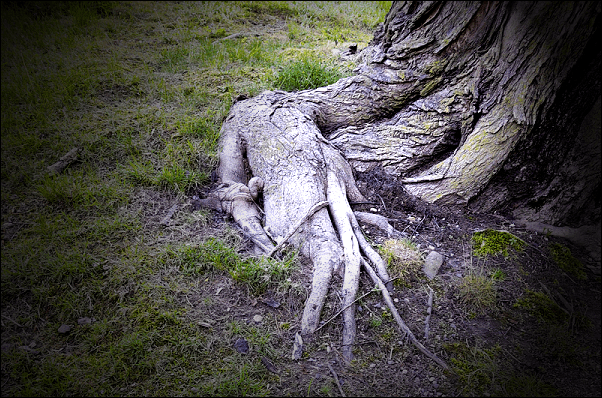
She understood. Her tree was trying to protect her. She laid back, her head against the wood. She listened as the tree absorbed her, turning her into wood. Her consciousness joined the others. After her transformation, she simply resembled a long, knobby, albeit strangely shaped root.
Escape Miriam H. Harrison
I could not escape. Not when you lured me with gentle words, not when you wooed me with practiced charm, not even when I first saw your anger flash red. No, your wrongs were terrible, but you always knew how to make them right. You knew how to be sorry—oh so sorry. You knew how to bare your vulnerable heart, cry your misunderstood tears, until I would forget who had hurt whom.
I remember now. I remember now that it’s too late.
I could not escape you then. Now, you will not escape me. I will be all you see. Look to the clouds, and I will be there, bleeding red sunsets. Look to the stones and you will see my broken bones. Look to the trees and I will look back, reaching to you with roots and branches, reminding you of what you will never escape.
Cradle Nina D’Arcangela
Barely able to see, I clamored on, climbing as quickly as I could. Passing the first bisected limb, I struggled further—not to the second, but the third. It was rumored the higher the elevation, the greater the enlightenment that would be achieved. I lay down and began to pant, my body slick and exhausted. The cradle of the tree welcoming. I chose this as my birthing place.
I began the arduous task at hand. Gaining my feet once more, I leaned my back against the main trunk and began to slough the mucus like cocoon that encased my body and hers. More than once, I had to readjust my stance for stability. With most of the shedding complete, I reached down to embrace the babe now laying at my naked feet. She was beautiful – as raw skinned as I, but still the most exquisite thing I had ever seen. A slight error in judgment as I leaned forward to bite through the umbilical, and I was airborne, until I wasn’t. Lying on the ground, I watched as my brothers made the same climb I had, but for a different purpose.
Broken and shattered, I could do nothing but watch as my siblings cleaned the ancient tree of the ichor I’d left behind. In their haste, they didn’t notice the small bundle among the discarded tissue. My broken body unable to speak, I lie at the base of the tree and watched as she plummeted to the ground, landing in the cook of my arm.
Nameless Louise Worthington
Only when she is dead will it stop coming for her. Only under the earth, when air is no longer a tormenter, will she be free to rest her weary head. There is no place that she can hide. No place where she can be who and what she is – was – is without it eating neurons. No matter the distance. No matter the country. She has no memory: no family or home. No roots. Earthbound: trapped and homeless inside a shrinking head.
‘There is no one to say goodbye to, is there?…’
She thinks it’s the ancient tree moaning in the autumn breeze and to soothe it, she places a frail hand on the bark grown thick and strong with every passing year. Her skin is as thin as paper.
‘No, I don’t think so.’
What fantasy can a splintering woman have, except to lie beside the stolid tree as though nature is her friend, too?
The Squid Man Harrison Kim
I float above old root veins holding a petrified body, legs decayed to squid like bits. The roots suck onto the body from beneath the ground. The condemned youth’s blood flowed thick, sustaining this mighty tree, with its bark foot inching forward, finding ways to grasp. Months ago, in the reflection of the water, and above it, from this mighty fir, this young man was hung from a rope, then his body cut down, left in these woods to rot and decay, as is the custom here. Around his corpse, leaves fall like the years, and the summer grass turns a weak green colour, with the autumn rains. The young man became a squid creature fallen, the tree feasting on his blood, a tree with a foot like an elephant’s, thick and strong. The young man, decapitated, the fall from the rope so powerful his head released and fell yards away, where it became a petrified ball.
I have this dream night after night, viewing the young man’s arm pulled off and his head and body decaying beneath the tree, and every night I want to cut his squid arm free, but it’s too late, it is fused to the roots. Headless corpse here, dry and drained, the living tree under which the young man was condemned possessing the body with its roots. A tree mighty and powerful, thrusting skyward strong where this man was hung for his crimes. My dreaming soul floats above the desiccated corpse in a forever dream. Beneath the earth, where I cannot see, the condemned man’s blood now absorbed by the fir roots. The nutrients still circulate here, bringing strength and life.
Waiting to Fall Elaine Pascale
You never loved me more than when you were dying,
nestled in your noose, waiting to fall.
I watched. I watched you die.
At your last breath, I fainted into the cold earth beneath your feet.
It was good there. It was good in the cold and dark.
I returned every night after your body had been taken down;
after your body had been disposed of
without ceremony
without any indication that you had ever lived.
The tree became a memorial.
I offered myself to it.
Offered my love to it, to you.
And you took it,
so that each night I grew weaker.
Your restless spirit sought sustenance from mine.
Your mouth, your lips, your teeth, they took
as I lay beneath the tree craving more darkness as you craved more light.
Before my eyes failed, I saw you shimmering,
draining me so that you could become more substantial.
My neighbor killed his girlfriend. I’m sure. For three weeks she was a regular visitor to his house. Then she came over one night and didn’t go home in the morning. She never went home.
For days I watched closely, phone set to record, in case I saw him carrying wrapped up body parts to the trash. I saw nothing, and his trash remained the usual junk any young man living alone throws out—beer cans, pizza boxes, dirty mags. She must have still been in the house, maybe buried under the floorboards like Poe’s “Tell-Tale Heart,” or probably stuck in a freezer in the basement. I’d have called the police but I couldn’t prove anything. Besides, I’d been warned about making “false accusations.”
An idea finally hit me, something to shake my neighbor up and make him crack so everyone could see his crazy. I still had mannequins around from my days in retail, and various clothing and wigs. I dressed a mannequin in a blonde wig, stockings, and heels. I didn’t have the short, white silk dress the girlfriend had been wearing on her last visit so I ordered one from Amazon. It arrived two days later and my plan was ready.
My neighbor worked. He kept his house locked up tight, with a security alarm set, but while he was out I snuck across and put the dressed-up mannequin on his porch by the door. Then I waited. I had a directional mike to record with at a distance so I set up a stakeout in my front room where I could look directly at his porch. He came home. Man, it was a surprise. But not the kind I expected.
“Leslie!” he shouted when he saw the mannequin. “Leslie! My God! I thought you’d left me. I thought I’d never see you again.” He took her in his arms, hugged her tight. “I’m so glad you’ve come home to me. You’ll never have to leave again.” He picked her up like a bride and carried her across the threshold into his house.
For the next few days, whenever my neighbor was gone, I’d see “Leslie” standing in the kitchen, or maybe reclining on the couch with a glass of wine nearby, or perhaps leaning hipshot next to the open blinds in the upstairs bedroom as she stared down toward my place. I wanted to scream but I couldn’t think of a thing to do. My neighbor was clearly insane, and I wasn’t feeling too good myself.
Two days later, my doorbell rang. I assumed it was Amazon delivering packages so I threw open the door. Leslie stood there in her white dress, which was uncomfortably stained by now. “What do you want?” I blurted, without thinking.
She answered. She answered! “I wanted to make an omelet for my hunny when he gets home but I only have one egg. Can I borrow a couple from you?”
My heart pounded. Something had to give in this insane situation. I strove to sound normal as I said, “Of course. Come on in the kitchen.”
She followed as I went, her feet clunking on the floor the way real human feet do not. I took a dozen eggs out of the fridge and opened them on the counter. “Take whatever you need.”
She smiled, and I grabbed a butcher knife from the block on the counter and stabbed her through the chest. She didn’t scream as she crumpled to the floor, only wheezed as if air were escaping her hollow form. I taped her up in two black trash bags and threw her out back by the garbage bins.
The next day she was gone, and I was more worried than ever. Because I’d left the knife in her chest when I threw her out. I don’t know where she’s at. And now she’s got a weapon.
The forest is full of mirrors that reflect the thirteen angels of the land. It is the only safe way to gaze upon them. To see their glory directly would hammer one to silence. It would chain a throat with despair.
The first angel is the angel of moss. She has long hair that drips gray from the limbs of oaks. Her wings are invisible but you can feel them in the breeze as they stroke your sweat to coolness. On hot days I sit beneath her perch, though I dare not sit too long. She might notice.
The angel of leaves wears many colors, changing them with every season. Green is her favorite but sometimes her silks flame red and yellow. At other times they are threadbare, showing the branching of her veins. In the cold, damp winter they are rotted black.
The angel of stone has pitted eyes that glitter like mica. Those orbs watch the little creatures wandering past. They study those who squirm and crawl and hop the forest floor. They decide who to sacrifice and who to spare.
There is another angel who lives in the hives of bees. Striped in black and yellow, she has feelers upon her head. It is said that her coat of pollen is an aphrodisiac. I believe that is true though I have never chanced a taste.
The angel of owls sweeps in silence through the tangled woods. Nothing hears him in flight, but everything flees when he calls. I have heard this piping on eldritch nights—and remain haunted.
The misted angel wears a diaphanous gown. She is cool to the touch. Through the darkest hours, she pants wetly with want. But in the dawn she floats in innocence to heaven. Do not bother to wave. In return she will offer naught.
The river angel’s wings are white in the rapids, deep and green in the pools. Like a child, he chuckles and laughs as he plays. But do not make him angry. He thrashes against his banks then. He turns the world to shambles.
The angel of light glitters like a hoard of gems. She dances with the mirrors, preening for the trees. I suspect she is vain. But why shouldn’t she be? She is more lovely than the sweet face of the moon.
The wings of the ninth angel make a gate. It opens and closes like a bellows. Sometimes things come through. Awful things. Monstrous things. They hide in the light; they stalk the night. Even though they may know your name, do not make them your friend.
The angel of wicked dreams leaves his feathers scattered on the forest floor. Never seek them. Their promise is honeyed; their taste is foul. They often resemble mushrooms and toadstools. Sometimes they follow you home and beg to come inside and bleed.
Even the worms have an angel. He is small and ugly and his pinions are lost. He crawls on his belly in the soil. He has no throat with which to scream. But listen close and you still may hear him. Pray that you don’t.
I once knew the angel with the dirty wings. We were lovers in a snake’s embrace. She left me a gift when we parted, half of one of her fangs broken off in my heart. The thirteenth angel is the worst. Or the best. If you should look right at him, you’d only see yourself. He is a mirror all his own. He would laugh when you laugh, cry when you cry. But in the end he’d eat your soul with a wink.



 Pen of the Damned