The flea market had become a ritual. Greg and Lydia rarely found anything, but when they did, it was heralded as monumental. They called their excursions “fossil hunting,” and many of their finds were truly relics.
Some of the vendors at the flea market were regulars and the couple barely gave their wares a glance. Their apartment only had room for a certain number of salt and pepper shakers or crocheted toilet paper concealers. They focused on the new vendors, and this week the nostalgic display in the corner captured their attention.
“This is so 80s,” Lydia whispered with reverence. She fingered a rack of fluorescent jelly bracelets.
Greg picked up a semi-inflated basketball. “Watch this,” he said, trying to spin the ball on his finger. He managed to nearly clear the trinkets from a nearby table as the ball wobbled and he shifted to center it.
As Lydia was deciding between the lime green fingerless mesh gloves and the argyle leg warmers, Greg called to her, “Remember this?” He was elbow-deep in a bin of records. He pulled an album from the stack and held it up for them both to see. The cover was a hypnotic spiral. Staring at the spiral and relaxing one’s eyes would make the name of the band appear. “This is trippy.”
“That was the first one with a ‘Tipper Sticker’.” Lydia tried to remember what had been so offensive about it. But offensive was as bound to time and place as any other concept.
Greg lowered his voice, “Playing it backward would make a demon appear.”
She laughed. “Right.”
“Seriously. That is what happened to them. To the band.”
Lydia rolled her eyes. “They died because their cocaine was poisoned with strychnine or something.”
“Where do you get your information? They were torn apart, long slashes on each of their bodies. Strychnine doesn’t do that.”
He dug in his pocket for some money while she typed into her phone. She turned the screen toward him. “Google says ‘poison’.”
“That’s what they want you to believe. You really think they would publish stories about honest-to-God demons?”
She shrugged “There is nothing honest about it. Just urban legend, but you do you.”
He turned the album over in his hands, inspecting the cover from all angles. “I am getting it.”
“We don’t have a record player.”
“Doesn’t matter. It’s a relic. When archeologists uncover our apartment from beneath the meteorite that will crush us, I want them to find this psychedelic specimen and know that we were true connoisseurs.”
By the time they returned home, he had scrutinized every inch of the album. Each time he had a new idea about the Escher-esque cyclone on the cover. “That would be what a demon’s lair looks like, right?”
“I guess.” She tilted her head. “Looks like a demented fan with warped blades.
He nodded appreciatively. “That might be what got to the band: warped blades…something made those gashes on their bodies.”
“If you believe that rubbish.” She sighed. “It’s a shame that good old fashioned overdosing has lost its glamour.” She went into the kitchen to make them sandwiches for lunch. “Why would a band play their own album backwards?”
“Because they were in that sophomore slump. They needed another hit; they needed to keep the train rolling.” He pulled the vinyl from the cover. “Watch this,” he said as he spun the record clockwise on his finger while humming the theme song of the Harlem Globe Trotters.
“Wow. They should sell you at a flea market. Your references would be the oldest thing there.”
He began to spin it counterclockwise. “Bet I can make it play if I spin fast enough.” He gave the vinyl a few hard spins before putting his fingernail into a grove.
High decibel screeching came from the album.
“If that doesn’t call a demon, I don’t know what would.” He laughed, but she did not join in.
She felt clammy and dizzy. She began to saw through the hardened bread faster, believing her blood sugar level was dropping.
“Watch this,” he called again, spinning the album faster and making it wail with the placement of his fingernail.
“I…” She grabbed the counter with one hand, fearing she would fall to the floor without its assistance. She heard odd words coming from the record. The words were compelling; the words ordered her to do horrible things.
“Almost sounds like a chant,” Greg said, not noticing the change in Lydia. If he had, he might have been able to save himself.
The words built into a frenzy, a confusion of chaos, the verbal version of the album’s psychedelic cover. Her glowing, red eyes were focused on the knife she had been using on the bread. The chant was about the knife. It told her what to do with the knife.
“This is messed up.” Greg shook his head, believing this was all in fun.
Lydia could no longer remember who Greg was or what he meant to her. She could no longer remember where she was. Her mind was consumed with the knife and with the voices that were imploring her to use it.
The album whirled and the voices wove a powerful, insistent, and necessary story. Her hands felt far away and as if someone else were now in control of them. A part of her waged a war to keep the knife on the bread.
As the album continued to shriek, she lost the battle.
Hugo watched from his bedroom window as his wife stuffed something into the garbage receptacle he had dragged to the curb hours before. It was 3:15am and she had done this on four subsequent trash nights.
The following morning he decided to ask her about her jaunt to the trash can. Having lived with her for nearly 30 years, he knew he could not speak to her before her first sip of coffee. She had a superstition about it. “Have you been having trouble sleeping? I woke to go to the bathroom and you weren’t in bed.”
She pretended to be concerned with cracking the shells on their eggs. “Hmm? What was that, honey?”
“Sleep. Are you sleeping well?”
“You know I’m going through the change. It complicates everything. It’s hard to sleep, eat, or find a comfortable temperature.”
That didn’t satisfy his curiosity about her weekly pilgrimage to the trash cans.
“Maybe we switch sides? I sleep closer to the door and you sleep next to the window…for the breeze.”
“Oh no, it’s bad luck for a couple to swap sides after so many years. We were just talking about that at book club.”
He stirred his coffee thoughtfully before responding. “I thought you talked about books at book club.”
She laughed. “We talk about all sorts of things.”
“Mostly complaints about husbands?”
“Of course not.” She appeared focused on flipping the eggs with precision. “We are supportive of each other’s marriages; we don’t want to promote negativity.”
He saw her spoon a powder onto the skillet. “That’s not salt…”
“Nope. Remember, I told you that Jody Hunter came back from the Amazon. She had an amazing trip.”
“And she brought you back seasoning?”
“Not just seasoning, this is a type of mushroom that is good for women of our age. It helps with mood and clarity.” Her eyes narrowed. “I am adding some to your eggs, too, as you seem to need a brain boost…you don’t remember us talking about this at all? About how she brought back some powders and tinctures and…spiritual icons.”
“Spiritual icons?” Hugo snorted. “She is filling you with nonsense.”
She didn’t answer but stared out the window at the utilities truck that had come to receive their collection.
***
The following week Hugo got up at 5:00 AM and went to the garbage bin as his wife snored soundly in bed. He pulled out several large bags; one had a pinhole leak that dribbled onto his slippers like a dotted line.
At the bottom of the bin was a small blue marble.
Is that what she has been hiding? Where did the marble come from and why did she need to throw it away in the dark of the night?
He took the marble and planned to question her over breakfast.
He waited for her to finish her morning affirmations; she had a strong belief that saying them influenced the outcome of her day. He noticed that she read from a notebook while reciting quietly to herself. She had been adding many new rituals to her routine.
“You know when I was a boy I collected the darndest things.” He began, watching her sip her coffee.
She nodded. “I know you had those matchbox cars. And the coins from when your dad travelled.”
“And marbles. Did I ever tell you about my marble collection?”
She raised an eyebrow. “No. That’s funny, I can’t remember you talking about a marble collection.”
He slapped his knee as if this were all a good joke. “Really? All these years and I never mentioned it?”
“Mustn’t have been a very good collection.”
“Au contraire! It was really something. I had marbles everywhere. Stashed away in jars and bottles. My favorite were the blue.” He pulled a marble from his pocket. “Like this.”
Her jaw dropped. “Where did you get that?’
“Why did you throw it away?”
“You can’t have that.” She snatched the marble from his hand and raced to the door. From the window he could see her looking down the street at the utility truck that had just taken their garbage and was driving away.
She was frantic, pacing in the street and rolling the marble between her hands.
When Hugo went to the door to tell her to come back inside, she rushed past him into the house and grabbed the car keys. Moments later, she pulled out of the driveway, with no concern for the fact that he needed to get to work and they shared a car.
Thirty minutes later, she returned.
“Don’t ever do that,” she snarled as she threw the keys to him. He had lived with her long enough to recognize when she was furious.
***
The next week, as he tried to fall asleep on trash night, he found her staring at him. “You did something very bad,” she said in a voice that was completely unfamiliar. “You need to learn a lesson.” She showed him a red marble. She then left the room. From the window, he could see her burying it in the trash.
The following morning they consumed a silent breakfast. Hugo went to work as usual, but by late afternoon, he felt sick, feverish. He took to his bed for days.
When he was finally able to leave his bed and go to the breakfast table, it was trash collection day again. He could not believe that he had lost an entire week. He scolded himself for being nearly as superstitious as his wife.
“I hope you’re happy,” he told her. “You planted that idea in my head of the red marble having meaning.”
She peered at him over her half-consumed cup of coffee. “Count your blessings. It could have been a black marble.”
“You’re crazy. I am not listening to any more of this.”
She shrugged. “Marjorie Baker put a black marble in her trash last night.”
He lifted a piece of toast, noting that the trash had already been picked up. “I give. What does black—”
His question was both cut off and answered by the sound of sirens racing to the Baker house.
“That’s adorable and it fits you like a dream,” Anna exclaimed with enough enthusiasm to equal her reaction to the last twelve dresses Tammy had tried on.
Tammy was not as easy to convince. “I just wish I weren’t a size 16.”
“What does the size on the label have to do with how it looks?”
Tammy rolled her eyes. “Easy for your child-less body to say. I’d still be a size 8 if I had stopped at two.”
“And miss out on the incomparable Miss Bliss? What would the world be without her!” Anna was often in the position of cheerleading for Tammy. “Some cause happiness, others impede it,” Anna’s mother used to say. Tammy was of the impeding nature. She would seek misery and wallow in it for as long as she could. Anna always prayed for a change in Tammy, or an end to their friendship that wouldn’t require Anna to do the dumping, whichever came first.
Tammy frowned at her reflection. “Bliss gave me an apron of fat…”
Anna had grown tired of her friend’s dour mood. She had offered to take Tammy shopping and buy her a new dress for her birthday. Anna had even hired a sitter. She hadn’t expected her generosity to be repaid with complaints.
She decided to move away from Tammy and walk about the store before she said something she would regret. She stopped at the rack that was the furthest from the dressing room and pushed through the hangers to alleviate her frustration. When she felt her composure return, she grabbed a handful of dresses in size 16 and returned to the dressing room.
“Maybe one of these?” Anna held her breath, hoping that Tammy would find something suitable so they could leave.
Tammy rifled through the garments, barely glancing at any of them. She was scowling and muttering and Anna feared they would be stuck in the store all afternoon.
Anna’s fears dissipated when Tammy gasped. “Where did you find this? I’ve been through every rack in here.”
“I know,” Anna muttered as Tammy hurried behind the curtain to try on the dress. When Tammy emerged, she had a large grin on her face.
“This one, right Anna? It’s perfect.” She ran her hands over her hips and squealed, “Pockets! It even has pockets!”
“That’s convenient.” Anna agreed. Pockets were indeed the Holy Grail of women’s fashion. Anna was currently rocking a fanny pack due to wearing jeans that had decorative stitching in place of pouches for stashing a debit card and cell phone.
“It’s so slimming.” Tammy continued to admire herself and Anna didn’t have the heart to tell her that the color was hideous and that it looked like a shapeless sack on her body. She was so relieved to finally be done with the shopping excursion that she believed there was no harm in allowing Tammy to see something different in the mirror.
***
The next time they met, Tammy was wearing the dress. They ran some errands at the mall and decided to grab lunch in the food court. Tammy stood in the middle of the horseshoe of food stands, hands stuffed in her pockets and said, “I don’t know what I want.” Anna was accustomed to this ritual, it usually consisted of a discussion of calories over flavor and a list of the prior month of meals Tammy had eaten. This was followed by wallowing in misery that they could no longer eat whatever they wanted. This time, Tammy added, “I wish someone would just tell me what to eat.”
The moment she finished speaking, a man from the kabob stand approached with a tray containing two plates full of food. “Excuse me, ladies,” he said, “we need to swap out our grill; this is what was left. We have to discard the food that no one has ordered, but I was wondering if you would like it…on the house.”
Anna’s jaw dropped as Tammy thanked the man and took the tray. “You just wished for food.”
Tammy nodded. “It’s been happening a lot. I put my hands in my pockets and then I get what I wish for.”
“Have you tried asking for money?” Anna joked.
Tammy’s expression changed. “I did. But I got something else, instead.” She nodded toward an empty table. “Let’s eat before it gets cold.”
When it was time to leave, they could not find their vehicle. Tammy had driven so Anna had relinquished responsibility of remembering where they had parked.
“Don’t worry,” Tammy assured Anna and then put her hands in her pockets. “I wish I didn’t have to be bothered.”
Anna was about to remark on the vagueness of the wish when a man pulled up. “You called an Uber?” he asked.
“—No,” Anna began but Tammy was already climbing into the vehicle.
Instead of being her usual, miserable self, Tammy proceeded to flirt with the driver the entire trip. Anna was fed up and ready to leave once they arrived at Tammy’s house, but Tammy insisted she come in.
“Your behavior was crazy,” Anna scolded as she stepped over the threshold.
“What? That was harmless.”
Anna was about to remind Tammy that she was married when she saw the inside of Tammy’s house. There was a new large screen TV and a full-wall fish tank with exotic fish. The furniture was also new and clearly expensive.
“Where did this come from?” It was no secret that Tammy usually struggled to pay her bills.
“John.”
“He got a raise?”
“He died.”
For the second time that day, Anna’s jaw dropped. “What do you mean, he died?”
“I told you I wished for money, but then…”
Anna could not believe what she was hearing. “You made a wish and he died. And you did nothing? You told no one? You didn’t even have a funeral?”
Tammy shrugged. “I didn’t have to. I just put my hands in my pockets—”
Anna had heard enough. She went down the hall to the kids’ rooms, expecting to see luxury there as well. Instead, the rooms were cleaned out as if no one had ever lived there.
“Tammy…where are the kids?”
Tammy blushed. “It’s not really my fault. I made a wish…”
“To get rid of them?” Anna felt sick.
Tammy shook her head. “To be free of this burden.” She gestured to her body, circling her abdomen.
“You have to be careful! Your wishes are horrible. Stop wishing, and get your hands out of those pockets!”
Tammy’s face grew red with anger. She yelled, “For once I wish I could just be left alone! I wish you would go away so I could be as miserable as I want to be.”
Anna did not get the chance to look before she hit the floor, but she guessed that Tammy’s hands had been in her pockets.
Typically, their exchanges were memes that mutated into gifs that advanced to snarky comments that evolved into competitive complaints about family obligations, traffic, and the weather. This simple, plaintive word was cause for alarm.
Lana tried Facetiming. Then she tried calling. There was no answer. The last time they had been together had been only a few days before when they had returned from a girls’ trip. They had chosen a short cruise, all inclusive. Clara had wanted a few days of not having to cook or clean or worry about calories. Lana had wanted fresh air and stimulation that came from anything other than the fluorescent light above her cubicle and the hold music she so often faced during business calls. Most of all, they wanted time together, uninterrupted. An ocean voyage had checked all boxes and they had packed together on Facetime, approving each other’s choices of vacation-wear.
They had planned to “twin” for their final dinner on board. This was a tradition they had begun over two decades before. At that time, they would twin for school, linking arms and walking the halls as if conjoined. They would infuriate their teachers by going to each other’s classrooms and they drove their parents crazy with insisting that they have twin sleepovers, often squeezing into a shared and strained sleeping bag.
For their twin dinner, they had packed matching dresses, barrettes, purses, and shoes. Physically, they looked nothing alike, yet their twin costume announced to the world that they were inseparable. As they were applying their finishing touches, Clara pulled out a tube of lip gloss from her makeup bag.
“Where did you get that?” Lana eyed the tube that looked naked without a label.
“My evil stepmother.” Clara laughed. “The witch finally did something right.”
“The first time in what…when did he marry her? Fifteen years ago? Twenty?”
Clara smacked her lips together, the gloss adding a coral sheen. “Feels like forever ago. She put a spell on him, a curse on the rest of us.”
“Especially us crusty foulers.” Lana wore the name given to them by Clara’s stepmother with pride. The woman accused them of being barnacles: overly attached to each other and a discomfort to others. She, more than any other, hated their twin games and would often mutter curses beneath her breath as they strolled around arm in arm.
“She talks like a longshoreman.”
“Smells like one, too.”
As Clara’s stepmother never failed to share her disdain for their friendship, this present for their vacation was completely unexpected.
Clara handed the gloss to Lana and watched her apply it. “The funny thing is she said it was created especially for my skin tone. But it works on you, too, and we are opposite ends of the color palette.”
Lana shrugged. “Black magic.”
***
They had both cried when it was time to leave the ship. They had been sad about having to return to their stressful lives, and stressful jobs, and stressful commutes. They had been saddest about having to separate again. In the days after returning, Lana had felt a matchless form of loneliness. Then she had received the mysterious text.
Lana wished she could spend more time trying to reach her friend, but she had to get ready for work. As she showered, she noticed a pain beneath her breasts. When she tried to investigate with her hand, she was met with a surface so sharp that it lacerated her fingertips. Panicked, she rushed to the bathroom mirror, wiping the steam away, to see barnacles beneath each armpit and under her breasts.
“This is crazy,” she whispered. She could hear the stepmother’s voice, dripping with vitriol as she said “crusty foulers.” How could they have been so stupid, believing the woman had given a gift with good intentions.
Lana knew she had to see Clara; she had to confirm that the symptoms were real, that she wasn’t losing her mind.
As she drove the short distance between their homes, she saw the skin on the backs of her hands shift from smooth to crusted with protuberances.
Lana smacked her palms on Clara’s door, calling for her friend. It felt as if it took hours for Clara to answer, but it had only been minutes.
“Lana!” Clara’s face was swollen from crying. She flung herself into Lana’s arms. “I am so sorry. I should have known. That witch. I should have known.”
“We only called her a witch to be mean, we didn’t really think—”
“I did,” Clara murmured into Lana’s neck, which was now wet with tears. “I always suspected…the things that went on in that house, the way my dad changed. I just never had proof and now…” She pulled back as if to examine her chest but found that their torsos were fused tightly together.
“Oh my god, pull,” Lana instructed. She tried sliding a hand between them to see if she could unhook them the way a cat’s claws could be unlatched when snagged on material.
“I can’t,” Clara was able to take a step back with her right leg, but her left had fastened to Lana’s. “It’s getting worse.”
“I am going to push you and it might hurt,” Lana warned uselessly, as her right hand had become affixed to Clara’s back. She had an odd recollection of playing Twister when they were younger, and how they had toppled to the floor, tangled together and laughing. As children, they had wanted to be together always. They hadn’t imagined it would be this hazardous.
Lana tried to take a deep breath, but it was difficult as Clara’s chest weighed against her own. When she tried again, they fell, landing heavily and unable to do more than squirm against the carpet.
Their bodies were becoming less and less distinct as they combined into one crusty shell.
Clara’s forehead melded into Lana’s nose. “Remember how we didn’t want to leave the cruise ship? We didn’t want to say goodbye?” Clara asked, her lips still able to move.
“Yes,” Lana responded, but it was more of a last breath being expelled as their faces attached.
Millie swept the sizeable bug onto the lawn that grew along the cottage. There was no movement from the insect, not even the twitch of an antenna. By all signs it was dead.
She noted that the bug looked like it was sleeping. Just as they say bodies in coffins, before eternal interment, look to be sleeping.
With her foot, she pushed the bug beneath the rose bushes that her grandmother had tended for decades. Greta had been spotted in her garden longer than the next oldest person in the village had been alive. No one knew exactly how old Greta had been at the time of her recent death. There had been a trio of birth certificates issued in her name, all with different dates of birth listed.
Recent death was the correct term, Millie thought. It was never clear if the woman had actually died during previous episodes or if they had only been “scares.” There had been times when the woman had stopped breathing. Her skin would grow cold, her body as hard as a stone. Her spine would appear to curl in on itself, just like the bug beneath the roses. Minutes would pass, sometimes an interval so long that she had to have crossed through the gossamer curtain between worlds. Then her breath would boldly return. Her eyes would flutter as if she had only awoken from a short nap. She would appear rejuvenated, revitalized. Some smirked and said that death was becoming on her. Some did not smirk and claimed she had sold her soul to the devil.
Millie gave the bug another shove and watched as it fell into a hole that had been crafted by a critter.
“Bon appetite,” Millie whispered to the snake or mole that was hidden in the hole, not knowing if it would accept an offering that was already dead.
Millie rubbed the scab on her hand before returning to her chores. She decided that it was perfectly proper to not offer a burial for a bug that she had only known as dead. It had been the appropriate effort: no words, no sentiment. The flowers from the bush would be enough of a tribute.
There had been a far greater tribute for her grandmother. Everything had been to her specifications.
“Not everything,” Millie whispered, rubbing her hand again. There was one aspect of the ceremony that her grandmother would never have agreed to. Then again, her grandmother had put her children and grandchildren through trials and tortures that they had never agreed to.
It wasn’t that the ceremony had been lavish, but it had been unusual. They had been granted a bed burial, even though those had gone out of style when ancient Greta’s great-great-greats had been above ground. The family had received permission solely because the town wanted to close the lid, so to speak, on the woman who had outlived all expectations, and also outlived the patience of all around her.
Greta’s bed had been handcrafted by her father and it was the one possession she had wanted to take with her. The bed had been lowered, by ropes and pulleys, into the massive hole first, its occupant lowered after. The sheet that had been wrapped around Greta had been the mechanism for gliding her into the earth. When the wind caught it, it fluttered like angel wings.
“What a devil,” one of Millie’s uncles had said, wiping his forehead with a handkerchief as he stepped back from the open hole where his mother now resided. Millie did not know if he was talking about the energy required to bury her or about the woman herself.
A beautifully stained piece of wood was balanced between the elaborate ends of the sleigh bed so that Greta would not be visible for the remainder of the ceremony. The family members took turns approaching the hole and dropping dirt on top of the bed.
When they had returned to their seats, Millie’s youngest cousin whispered. “The bed squeaked.”
“The dirt landed on it; the dirt put weight on the mattress,” Millie explained.
“No, it squeaked, like when she would hear us whispering at night and get up to grab the switch,” Millie’s younger sister said.
“Hush, little one, it is all in your head,” Millie assured her.
“And there was knocking,” another cousin chimed in. “I heard her knocking on the headboard, just like she did when she wanted her tea in bed.”
“Hush now, that is grief talking.” The scar on Millie’s hand began to burn, just as if she were being branded by a hot iron. Again.
“If the tea was late, or not hot enough, it was the switch again.”
“Let’s not talk of that anymore,” Millie consoled,” those days are behind us.”
“That rap…her knuckles on the board, she pounded just as hard as any man. Just as hard as…”
“…the devil himself.” Millie hid her hand beneath her skirt, the seal that she had been branded with was glowing like live coals. Millie knew that the littlest ones were not imagining things. There had been sounds coming from the bed.
Greta’s final episode had been particularly lengthy, and Millie had been left in attendance. Millie had checked and rechecked vitals. She had held the mirror beneath the woman’s nostrils. She had felt the waves of coldness, ebbing and surging. And she had kept one eye on the switch on the wall, vowing that it would never be used again.
Millie knew what she knew, and she knew when it was time to alert the family. She also knew, when she saw the old woman’s finger twitch as she was being covered with the sheet, that it was time to make the offering.
She had also anticipated the children noticing sounds; she had anticipated the adults ignoring them.
While Greta was capable of making noise on her own, it wasn’t the old woman who had made the springs squeal and the headboard knock. It was the minion that had come to claim the offering Millie had made. She had made it, knowing it would not accept an offering that was already dead.
He stood and walked to her. “It’s you. It’s coming from you.” He sniffed the air around her. “Definitely you.”
“Thanks. Tell me more about how I stink.”
He lifted her arm and brought it to his nose. “It’s the shirt. The shirt stinks.”
She pulled her arm back, insulted. “I just bought this shirt.”
“Well, it smells…like you got it off a dead body.”
“I got it at the thrift shop. That one on Gulfspray.”
“Then it probably did come off a dead body.” He started to go to the kitchen but stopped in his tracks. “There isn’t a thrift store on Gulfspray. That’s a residential area.”
Lydia rolled her eyes. “Such a gaslighter. If there is no shop, then how did I get this shirt?”
He shrugged. “Smells kinda like you pulled it out of Satan’s ass.” He knew he was right about Gulfspray, he drove by it every day on his commute.
He looked at the shirt again. He had thought it was a red and brown tartan pattern; now it looked orange and tan. “You washed it right?”
“Of course, I washed it!”
“Well, it smells.” He whispered the next part, “And it changed colors.”
“I don’t smell it, you’re crazy.”
As Ben walked into the kitchen, he considered that he might be crazy. It wouldn’t be the first time that he had seen something, heard something, or sensed something that Lydia was oblivious to. He had never had an olfactory hallucination and he took medications for the others. Lydia preferred to live a pharmaceutical-free life and she sometimes disassociated to the point of disappearing. There were times when he would not know where she was or what she was doing and she would return, tight lipped and cementing psychic walls of privacy. He had learned to respect that, and he respected that their relationship was one of feast and famine in terms of intimacy. At the moment, he had little respect for someone calling him crazy or a gaslighter when they were seeing mirages in the form of thrift shops. “It’s in here now. The smell, it’s following me.”
“You’re crazy,” she repeated.
Crazy or not, the smell permeated the house despite the warfare enlisted. Ben tried incense, perfume, and sage. The windows and door were propped open. Nothing made an impact and Ben swore that he could taste the smell. It made it so that he had to skip dinner and that was unheard of for him.
That night, Ben dreamt of spoiled food, rotting carcasses, and noxious garbage dumps. Each hour brought an increase in the olfactory assault, and his mind conjured images in accompaniment.
When he woke, he found Lydia in front of the bathroom mirror, clad only in the shirt that now appeared to be purple and crimson. He rubbed his eyes, hoping to reset the colors, but it still appeared with different hues than the day before.
“You’re wearing that shirt again?”
“It’s my shirt.” She was standing at the bathroom sink, looking at her mouth in the mirror. She was sticking her tongue out as if a doctor were waiting with a tongue depressor.
“What’s wrong with your tongue?”
“nhuthin,” she replied, keeping the tongue on display.
Reading her body language, Ben went to make his coffee and give her some space. The sound of his ancient Keurig was overwhelmed by Lydia’s coughing. “You alright?” he called, bringing the cup of coffee close to his nose in the hopes of quelling the odor. It didn’t work and he was tempted to toss the coffee out and purchase a latte on the way to work, but those coffee pods were expensive, and he hated to waste one.
From the other room, Lydia’s coughs graduated to a throaty gag.
“Lyd? You ok?”
“Fine.” Her voice was raspy and phlegmy to the point of being difficult to listen to. In fact, it was almost the auditory version of the smell. Almost.
Once he was ready to leave for work, Ben gave Lydia a kiss on the forehead. As he pulled away, she whispered, “Spider tonsils.”
“What’s that, Lyd?”
She made eye contact, but the person behind the eyes was far away and Ben recognized this as his cue to exit. If he pressed, she would grow agitated, and her isolation would last longer than he was comfortable with.
She lowered her head and picked at the thread of a loose button. “Spider tonsils,” she repeated.
Ben wanted to ask which one of them was crazy now, but he knew that was insensitive to her very real mental health issues. Experience had taught him that she would snap out of it, and he was looking forward to putting in hours at the office as a respite from the odor.
When he returned home, there was no Lydia and no note. There was only the shirt, crumpled on the floor in the bathroom. It was damp and sticky.
The smell was as strong as ever, but the shirt was no longer the source. The shirt, now blue and green, had no odor at all.
He tracked the scent like a bloodhound. All he found for his troubles was an old candy wrapper and a large, long-legged spider weaving a fresh web in their closet. Without hesitation, he put the spider out of its misery.
Leaving the closet to start dinner, he realized that the smell had disappeared.
Ben ate alone and in peace. He made a plate for Lydia in case she returned hungry. He then showered, finding pleasure in the pleasant fragrances of his hygiene ritual. He was sure that Lydia would return home by the time he was ready for bed.
His instincts had proven wrong, and he slid beneath their scent-free sheets alone. He left one voice message and one text for Lydia but reasoned that more than that would look like he was not respecting her boundaries, and he knew that upset her. Now that his world was without noxious fumes, he could grant Lydia a great deal of grace.
The next morning, Ben pulled a shirt off the hanger in his closet. It was a shirt he had no recollection of buying. The tag was still on it, and it was from a thrift shop. Lydia must have bought it as a surprise for him. He would google the name of the store later, to find out where it was truly located.
Ben felt guilty that he had not given her the chance to give him the shirt; he had been so focused on obsessing over the invasive smell. When she returned, he would be sure to apologize.
This shirt did not smell. And it fit perfectly. He decided to work from home so that he could be there when Lydia returned. She was not answering her cell and it was unlike her to be out of contact for so long. Ben didn’t want to alarm her family, but he resolved to contact them if he hadn’t heard from her by lunch.
The thought of lunch made his stomach rumble, even though he had just eaten breakfast. He tried placating his appetite with a strong cup of coffee, but as he brought the mug to his lips, his stomach recoiled.
He dropped the mug, gagging as the fumes from the spilled coffee entered the small space.
As he cleaned up the mess he had made, he was overcome with a coughing fit. He coughed until his throat felt ragged. Then he gagged. It wasn’t nausea causing him to gag; there was something lodged in his throat.
Moving to the bathroom mirror, he opened his mouth and peered at his throat. Directly behind the uvula, there was a dark shadow. Ben made a low growl in his throat, seeing if the shadow would move. As he watched, a long, spindly spider leg crawled onto the back of his tongue.
He now knew what “spider tonsils” meant and he knew what had happened to Lydia.
The celebratory ball had been planned years prior, at a time when he had been a child playing “castle” with little Ella who was brought to the courtyard by her nanny. Current day Prince Charming wanted to scream at his parents for being so blind. Didn’t they realize he did not want to marry, or at least, he didn’t want to marry a princess? Did they need a more obvious hint than his always insisting he was the queen of the castle when he had played with Ella?
Ironically, the ball was considered a “coming out.” It was meant for the debutantes to be offered as if they were impersonal wares instead of daughters that were cherished.
At the ball, the maidens were paraded in front of him, each one growing more unappealing than the one before. Finally, Prince Charming signaled that it was time to dance, and his parents reluctantly conceded. They had hoped he would select a bride prior to drinks and dancing.
Prince Charming managed to avoid contact with the slavering single ladies as he swayed alone in a corner. Then he saw her.
He hadn’t seen Ella since her mother had died and her father remarried. He strolled across the dance floor and asked her to dance. She was perfect: no one remembered her, no one was chaperoning her, no one would interfere. Furthermore, her sense of style was flawless. As they twirled, he ran a hand over her back.
“Silk?”
She winked. “Magic.”
“It is some sort of magic that made you appear.” He smiled. “We used to have such fun together; we were quite the pair.”
Ella could not match his smile. “I believe that is the last time I ever had fun, and the last time I was ever called by my real name.” After some gentle nudging, she recounted the abuse she had suffered since she had last seen him. She confided that she had to sleep on a bed of ashes and that her meals were the spilled food she secretly scavenged from the burning coals of the fire. “If I were to remove these gloves, you would see nothing but scars.”
Prince Charming’s heart broke for his old friend. “No one helps you? What about that kind nanny?”
“She was fired when my father remarried. There is no one comforting me except the feral animals I have befriended. My stepmother and stepsisters take turns beating me; it is how they find enjoyment.”
Prince Charming considered this sad information throughout the next song and then he told her, “I could help you escape, but you would have to live a different life than you may have expected.”
Without hesitation, she said, “Any life would be preferable to the one I live.”
“Then I have an idea. I noticed your beautiful shoes that are unlike any others I have ever seen…”
She leaned closer, “I told you; my outfit is magic.”
“I fully believe it and we will need more magic to get away with my plan. What I was thinking was…”
The two hashed out the details while deflecting the envious looks of those who wanted a turn to dance with the prince. At midnight, as planned, the girl accidentally left one of her glass slippers behind. The prince dramatically swept up the shoe, held it aloft, and proclaimed he would marry any girl who could fit the slipper. He said he would go from house to house the following day, until he found the maiden with the right shoe size.
Also as planned, he only visited one house.
When the door opened, Prince Charming realized that two of the ugliest eligible bachelorettes from the night before were Ella’s stepsisters. The women were beside themselves when he entered their home. They knocked each other with their elbows, pushing so that they could be the one closest to their visitor.
“You are here about the shoe?” a stepsister asked.
“Indeed, I am,” the prince said loudly. He knew that Ella was waiting for her cue. “May I ask how many maidens live in this home?”
“Just the two of us,” the other stepsister answered.
This lie made it easy for the prince to follow through with the plan. “Then please be seated on the sofa.”
The women perched on the edge of the cushions, kicking off their large satin shoes.
The prince handed a shoe to one sister followed by the other, confident the dainty slipper would never fit their large, calloused feet.
The stepsisters grunted and struggled, but the glass construction would not give. They fought over the shoe, believing they could make it fit. Each woman panted and cried, “I can make this work, give me a minute…”
The prince scoffed, “I don’t think either of you really wants to be a princess. If you did, you would make the shoe fit.”
Both stepsisters sobbed and wailed, “I do! I do want to be a princess!”
“Those sound like magic words,” the prince announced, and Ella appeared.
“What is she doing here?” the women scoffed.
“Just this.” Ella put her fingers to her mouth and whistled loudly. A mischief of rats ran into the room and the stepsisters pulled their feet up onto the cushions; their squeals and squirms rivaling that of the rodents.
“More magic,” the prince exclaimed. Ella looked alarmed but he had made a solemn promise to keep her secret.
What happened next was far outside of the realm of courtly decorum. The rats were not shy about attacking the women’s feet, devouring toes and heels quickly.
When the stepsisters fainted from blood loss, the prince called loudly, “Is there no other woman in the house to try the shoe? Even a widow who might like to live in the palace—”
Ella’s stepmother ran down the stairs and looked from Ella to the prince expectantly.
“We have a special shoe for you to try,” the prince explained. Ella pulled the iron shovel from the fire.
“That’s for scooping ashes,” the stepmother noted.
As their plans had not included touching the abusers directly, Ella whistled, and two large hawks landed on her stepmother’s shoulders, forcing the woman to sit on the sofa.
“That shovel has many purposes,” the prince assured her as the rabbits Ella had called forth pushed the shovel onto the soles of the woman’s feet, scorching the skin with a sizzle that could be heard above her screams.
Prince Charming and Ella vacated the house, understanding that they could have left without bringing harm to anyone, but feeling fully satisfied with their revenge.
A month later, they had an extravagant royal wedding. When it was time for the groom to kiss his bride, their lips met but there were no fireworks, no tingling spark. In fact, there was no feeling of romance at all.
Ella smiled knowingly at the prince and whispered, “I will keep your secret, too.”
In their happily ever after, Ella no longer suffered abuse and Prince Charming was free to be the queen of the castle.
On the lower steps, you could just barely see him. A gray smoke. A whirl of ghostly gnats and ashes. Faintly glowing. On the move. Adrift but seeking. Rising up from the cellar’s darkness.
In the light. In a narrow place. Beneath the rococo wall of gold, he became invisible. And he waited. To take a lover. To kiss the first mouth that passed through him. To sup upon a soul and become manifest. To feast upon life so that he might return to flesh, and become a god.
Knock on Wood Marge Simon
I return to the house of my youth, where the newel post still stands at the foot of the stairs. Dear memories of childhood, that staircase with its banister, the game of Knock-on Wood. Down and around we children used to slide. At the landing, knock on wood, then change directions, plunging onward shrieking to the very bottom stair. There, we’d touch wood once more at the newel post, then scramble up to do it all again. The fastest one would take the win, such a lark in bygone days!
All too well, I remember Cousin James, who too often won the game. How he’d crow about his win, until the day I’d had enough, and pushed him downstairs to his death. I tell myself I’d meant no harm; it was just a game gone wrong. I go to leave, but a whuff of chill air stops me in my tracks. Suddenly afraid, I turn to see that newel post knows otherwise, a fiendish leer within its carved design. And, after all these years, there’ll be the devil to pay.
After Dark Nina D’Arcangela
In darkness there is patience, a quiet that waits; a moment pregnant with pure malevolence.
I lay in the dark, sheet tucked to my chin on this sweltering night. The small bulb fixed to the tin wall barely a beacon, let alone a source of comfort. I can hear the crick of the wooden stairs as it stealthily begins the climb. Eyes shuttered tight, breath fetid by fear, my muscles seize — I feel it watching me. Minutes pass as I count slowly in my mind. Finally, I hear it turn, I hear its bones and crepe paper skin as it scrapes the railing and planks. I hear the slight squeal of the hinge as it opens the hatch set into the stairwell. I let out a small sigh and immediately regret my mistake. As I throw the sheet over my head, the thing pounds back up the treads and across the room; bones slamming every surface it passes. It leaps onto the bed, and in a frenzy, begins to pound and slash at my body; the bruising from the last assault not yet healed. Both of us scream. Mine, a high-pitched shriek of terror; its, an unholy wail that splits the night.
Abruptly, the onslaught stops. As I lay panting beneath the torn and bloodied bedclothes, it retreats to the stairs once more. In the near silent room, I hear the latch click as it pulls the door shut behind it.
Locked-In with Dreams Louise Worthington
I eagerly wait for a new day inside my cold cell, even when the sun’s face is ready to give up on me. As usual, the sheets are unhappily twisted around me, hiding imprints from the vigour of my dreams. My secret light pollution. Only I can see them travelling on the train of my life going by, cabin by cabin. On waking, they are water spewing from a hose until it’s cut off mid-stream.
I am thirsty. So very thirsty.
Today I imagine myself escaping from a tower. I have grown my hair, and I lower myself down gently to the ground like precious cargo.
Outside, free from walls, stairs, and doors, I build a new country out of mirrors that heal fragmented reflections, like Picasso. I steal silver foil like magpies to protect my skin.
I skip stones across the pond – one, two, three – and bury seeds in the garden and water them in, then secure trellis for black-eyed Susans and ivy to spread over the ugliest and roughest of brickwork until this house disappears.
The precious things which I have lost shower like cherry blossom, and gusts of wind blow the soft-scented petals indoors, dispersed like breadcrumbs up the stairs, along the dark landing, to confetti beneath my locked bedroom door. If I try hard, I can catch their sweet scent.
Rebirth Lee Andrew Forman
Each footfall echoes with unnatural intensity as I ascend. The newfound light draws me, body and soul—this first dawn to repel the suffocating darkness in which I exist, is irresistible. The edge of all my eyes have witnessed have been no more than shadows and illusions of the psyche. I climb, against all struggle, into the blinding gleam, to flee this domain of suffering and feast on all that is within my grasp. I hunger for more than the rotten scraps the cold metal tube provides. As I reach the barrier I’ve never dared near, I wonder how their flesh will taste—the mother who expelled me from her womb as though I were pestilence, and the father who scorned all I am.
In My Darkness Miriam H. Harrison
The first time I saw her, she was little more than shadow. Walking through our sleeping city, she was a companion in my insomnia. A hope in my darkness. We had many more sleepless nights together, but the sunrises are what I remember best. The daily glow of warmth and colour filling her smile.
That was before the sickness came. Before it drained away her colour. Before all warmth faded to chills and aches. Still we spoke of our sunrises, but she was too weary to see new dawns rise. And without her, I saw no beauty in the light.
The longest, darkest night was when the sickness won. I dreaded the light of a new day, the start of my first day without her. But then, just before dawn, I saw her.
That last time I saw her, she was little more than light. Glowing like a sunrise in my home. Like hope in my darkness.
The Upper Room AF Stewart
He lived in a small room on the top floor of the monastery. A small space beyond narrow winding stairs that smelled of sour, musty age. The upper room they called it, at least the monks that spoke of it at all. Few wished to acknowledge its existence, nor the presence of its occupant.
“A holy man,” they sometimes murmured.
But no one truly knew. No soul saw him, not even the monks that brought him food, slipping it inside his darkened space. After all, who would wish to disturb a hermit lost to silent mediation and prayer?
Strange how the truth can be distorted over time. Equally strange how no one questioned the occasional missing traveller or how dissenting monks sometimes disappeared. Sin calls to sin after all.
For the creature that lived in the upper room was no holy man, nor even a man. Not any longer. Once perhaps, a devout monk seeking enlightenment, seeking the divine. But pride drove him beyond sense and he found only demonic secrets. Ones that devoured his soul. Now he waits in the upper room, a prisoner, consuming the sins of occasional fools that venture too far inside his lair.
But he knows one day someone will make a mistake. They will forget to replenish the wards, or he’ll devour enough sins to break his bonds.
He knows one day he will escape.
Stairwell of the Liquid Souls Harrison Kim
Edema steps up and down, up and down the stairs between the walls, under the light that never turns off. At the top, Edema cannot turn the corner because there is no corner. She can’t go through a door because one doesn’t exist. No turning, because her forehead’s becoming larger, her belly too, and her knees. Her body’s filling with liquid, what sort of liquid, she doesn’t know, all she does know is it is heavy and thick, seeping through from the walls, and it sloshes inside and slows her movements. Within her ears she hears a wailing, a crying in despair,
For God’s sake, get us out of here!
Her heartbeat thumps faster as the wailing rises, a heart that slops and slips as she climbs the stairs ever more slowly, hoping she may escape to freedom if she hits the walls hard enough, in this sick brown coloured stairwell with no night or day. Her forehead droops, her belly sags.
It’s her knees that first drag on the floor, her huge liquid filled knees. Then it’s the belly that drops, and now the forehead, pulling her head down, its creases lie flat on the upper stairs, her feet on the lower ones. Edema’s fluid engorged body fills the entire stairwell, a swampy miasma of skin, liquid soul and bones, she can’t climb any more though her legs continue in spasm. In her head the only thought is “For God’s sake, get me out of here!” how much time does her body lie there… ten days, a month, in stench and stink, seeping into the wood and plaster. Afterwards, the only indication that anything filled the empty space is a slightly brighter light atop the hallway of the liquid souls, an alabaster shimmering in the wall.
The Clearing RJ Meldrum
They parked, grabbed their gear and headed down the trail. Walking for about a mile, they reached a fork. Peter consulted the map. He was unfamiliar with the area, but their destination lay to the east, so he decided to follow the trail heading in that direction. Compared to the path heading west, this one was overgrown with grass and other foliage. It was clearly rarely used. Amanda was worried they were literally leaving the beaten path, but he had the map. Her instinct was correct; he’d chosen the wrong trail. It led to a remote, unpopulated part of the forest.
After an hour they entered a clearing. In the middle sat a ruined cabin. The lumber had decayed into indistinct piles. Only one part remained; a flight of stairs. In perfect condition, they climbed to a floor which no longer existed.
The sight was so incongruous, Amanda just had to take a closer look. She touched the bannister, but quickly withdrew her hand. It had vibrated. Peter placed his hand on the wood too, but felt nothing.
She started to climb the stairs. Her eyes were glazed and distant, as if she was seeing something Peter couldn’t. She reached the top and extended her hand. Her fingers mimicked opening a door. She stepped forward. Peter shouted she was about to fall. Instead, she simply disappeared. He ran up the stairs, but there was nothing. He had to get help. He headed back down the trail.
In the clearing, the ruined cabin sat quietly. The fresh varnish on the stairs reflected the evening sun, sending shafts of light to sparkle amongst the green leaves of nearby trees. There was a sense of calm and tranquility. The offering, although unexpected, had been acceptable.
The Servants’ Staircase Elaine Pascale
“I keep dreaming about the stairs.”
“The servants’ stairs?” Clay asked even though he knew the answer. His wife had complained of being haunted by the narrow staircase ever since they had been forced to relocate. She said there was bad energy trapped in the stairwell. He had caught her performing a ritual at the foot of the stairs.
“I wish you wouldn’t call it that…” Julia sighed.
“It’s historically accurate. Besides, neither of our families could have afforded servants. We have a clean slate.”
“Then explain the dreams.”
He tapped his forehead. “Your witchy brain, my dear.”
She frowned. “Can you try opening that weird cubby again? Maybe if I see the inside, the dreams will stop.”
“I’ve tried. It’s sealed shut.”
“Break the seal,” she pleaded.
Knowing that the landlord would not be thrilled with the act of vandalism but wanting his wife’s superstitions to stop, Clay tried the small door again, only to find that it opened easily.
“See, nothing—” Clay stopped when he spotted what looked like a sapphire ring peeking out of the dirt. “How did your ring get in there?”
Julia shrugged. “I bartered.”
Clay was confused. “Bartered? For what?”
As Julia swung the hammer at his forehead, Clay saw that the ring was garnishing a gnarled hand.
“Your life insurance policy.”
The hand grabbed Clay’s shirt just as the pain set in.
The last thing he heard was Julia say proudly, “Thank god for my witchy brain.”
Shirley hated the taste of soap, and she hated the smell of cigarettes.
“If you didn’t tell lies, you wouldn’t get the soap,” her mother reminded her when the girl complained.
Shirley would be instructed to hold the bar between her teeth for three full minutes. She would gag and drool and her drool would create amalgamated bubbles with the soap. The only positive aspect of the soap was that it smothered the smell of cigarettes that lined her mother’s clothing like stale satin.
The next time they were at the store, a very tall man with no eyebrows dropped an item into their cart when Shirley’s mother was not looking.
At the checkout, her mother questioned Shirley about the unintended purchase. When Shirley described what she had seen, her mother folded her arms and frowned. “Good thing ‘the man’ gave us soap. You will be tasting it soon enough.”
Shirley tried to protest, but her mother wouldn’t listen.
Later, as Shirley gripped the new bar between her teeth, she saw a horrible vision. She saw her father being held at gun point. “Dad’s in trouble,” she announced when her mother retrieved the soap from her mouth, “I saw it.”
“Keep up the lies and I will put this right back in,” her mother ordered, only she was putting the soap away and reaching for a cigarette.
Later that night, a call came explaining that Shirley’s father was in the hospital. Her mother paled and clasped Shirley’s shirt between shaking hands. “What you think you saw doesn’t matter now. We won’t speak of it again.” Her mother went to the hospital, leaving Shirley in the care of their neighbor, Mrs. Johnson, who promptly fell asleep in front of the television.
Left unattended, Shirley found the bar of soap and placed it between her teeth. She saw her mother sitting at her father’s side, gripping his hand and crying. Her mother was speaking, even though her father’s eyes were closed. She was saying, “Please don’t leave me….please don’t leave me alone with her.”
Once her father recovered, he was a changed man. He spent less time working and more time with Shirley. In her father’s company, Shirley rarely got into trouble. Her mouth was veritably soap-free with the exception of the time that she began speaking of the man with no eyebrows again. Her mother had instituted the soap punishment and Shirley experienced a vision of Mrs. Johnson sitting dead in her reclining chair in front of the television.
“What is it?” Her mother snapped, taking the soap from Shirley and noticing that the girl was more agitated than usual.
“I saw Mrs. Johnson. She was dead in her chair.”
Her mother snorted. “You’re insulted because she doesn’t want to play your foolish games with you, so you are making this up. I am sure she is fine.”
When the ambulance pulled up the following day, and Mrs. Johnson’s body was removed beneath a sheet, Shirley’s mother watched from her porch while having a cigarette. Shirley’s father decided to take Shirley away from the tragedy of Mrs. Johnson, much to her mother’s chagrin.
“Your father spoils you,” her mother scolded. “He is your parent, not your friend. He needs to be more of a disciplinarian.” Her mother began inviting herself on their excursions so she could “mold Shirley’s behavior.” Since they were often on the go for their outings, “molding” involved clandestine swats out of her father’s sight. Her mother couldn’t be expected to remember to bring the soap.
At a picnic, Shirley turned down her mother’s offer of pasta salad, saying she didn’t like it.
“Liar,” her mother’s anger rose quickly, and Shirley cowered, awaiting a sharp smack. Since her father was in view, her mother simply said, “I have seen you eat it before.”
Shirley was certain that in this instance, it was her mother who was not being truthful, but she knew better than to argue. She watched her mother consume a cigarette, knowing the woman would not forget that she had a punishment coming.
When they arrived home, her mother grabbed her arm and pulled her into the bathroom. “You know what lying girls get,” she said with vehemence and removed the soap from the cabinet. Once the bar was between her teeth, Shirley saw another vision. This time her vision was fueled by delirium, making it as confusing as it was horrific. She saw the tall man with no eyebrows approaching her mother. Her mother pursed her lips to exhale cigarette smoke and the man took that opportunity to turn into vapor and enter her mother’s mouth. Her mother wheezed, clutching her chest, gasping for air.
Shirley wasn’t sure what that meant, but she knew her mother was in trouble. Her eyes teared.
“Let me guess, you had another vision.” Her mother rolled her eyes. “We don’t talk about them. I don’t want to hear your lies.”
Shirley blinked back her tears and ran water in her mouth. Her mother looked at her accusingly. “Well did you? See anything?”
“No,” Shirley lied. She vowed to continue lying since she was not allowed to speak of her visions. Her lies became larger as her mother grew weaker. Eventually, Shirley no longer had to smell smoke or taste soap.
The mating time was brief this year. Our women sang notes like floss on the wild-wind plains. A human came who forced his seed on sweet Ala of the Yellow Eyes. We went on, saying not a word, bent to harvesting our Caddo root.
Afterward, Ala wasn’t the same. She cut her marvelous hair which had been dark and long, grown down below her knees. She wandered off to the Darklands, heavy with child and none to celebrate. We mourn her fate. If she survives, she’ll not return. She’ll raise his spawn alone. She was the envy of us all. When the child is born, she’ll burn his father’s image in the sands of our dead oceans. The human sits on our sacred stones. He preens his beard and leers at females, with no more thoughts to waste on Ala; he never even knew her name.
Come burrow season, we prepare, sharpen our talons on the Caddo root. When the freezing gales begin, the human will demand sanctuary, as his kind always does. We bring him the rich sap of our Caddo root, watch his flabby face turn pale as the winter moons. We will confirm his welcome with the strewing of his bones.
Petrified Wishes A.F. Stewart
“Round and round the tree, who will it be? One wish for you, none for me.” But don’t get too close. “Forever you may find, is far too unkind.” Forever… don’t think about that. “In a circle we dance, now only two. One wish for me, none for you.”
“Footsteps, footsteps, roundabout. Sure with the pacing, never in doubt.” One little slip… Nancy slipped. Oh god, poor Nancy. And Deidre. Can’t think, have to keep moving. Finish the song. It’s the only way. “Complete the circle, one by one. Pay the piper, single survivor. The wish is yours when the song is done.”
Why did we come here? Wishes? Fortunes? Happiness? It was only supposed to be silly fun. Grandma warned me. I didn’t believe her. Foolish tales. I never thought it could be… Not this… Cara, did she? Yes, Cara stumbled. I’m going to survive!
Just to be certain, I helped my friend to her death with a push, watching the tree consume her flesh, until nothing remained but a petrified corpse. Then on trembling legs, I made my wish and whispered the last line of the song.
“To the one left standing, a wish granted you see. The others have fallen, now part of the tree…”
Passing Time Lee Andrew Forman
Time uncounted passed since the radiance of our love ended. We adored that barken pillar and its canopy, the shade it provided from the fury of a summer sun. Blankets lain and baskets aplenty carried by lovers’ hands, words of angels and moments of bliss born into existence—each an expanding universe of our contentment.
But these years, so soft and kind, turned bitter and dealt spite upon our miracle. An affliction came upon her, and through its vile nature, her lips ceased to smile. All they had to offer was a cold, passionless touch. I wept over her body until my nostrils could no longer stand the scent. Only then did I begin the work of finding and putting to use a shovel.
What more fitting place than at the foot of our favorite tree to bury her emptied vessel. I sat with her daily. I spoke the words I would have, had she lived. I picnicked with fine cheese and her favorite wine. With each passing year, the roots grew; they twisted as slowly as grief.
With each new moon, the hair upon my scalp grayed, and I smiled knowing we’d soon be together again.
Survival Charles Gramlich
Only dirt, a patch of grass, and one tree survive. Besides black and white, the only colors left here are gray and green and shades of brown. Everyone worried about nuclear war, or the coming of AI. They worried about pollution and overpopulation, about new plagues and old, about the revenge of plants, or insects, or birds, or the frogs, or mutated beasts. They worried about climate change and super storms. No one worried about the thing that actually killed us, that left earth a corpse world. It happened when useless, meaningless words began to proliferate from the mouths of idiots. When bloviating fools talked and talked and talked and talked. And words lost their meaning and strangled all thought, and then all life. Until only this one patch of grass and a tree are left. For now.
Transformation RJ Meldrum
She went to the forest. It was the place she always visited when her heart was broken. Another failed romance; perhaps her standards were too high, perhaps the boys she chose were just assholes. She drifted along trails, leaves speckled with sunlight. She was heading to the tree. It was her place of peace, her thinking tree. She often visited it, when she was happy but also when she was sad. There was just something about the oak, as it towered a hundred feet into the air above her. She sat and rubbed the bark.
“Just you and me again. I wish I had a heart like yours. A wooden heart can’t be broken.”
She closed her eyes and drifted off to sleep, lulled by the warm, scented summer breeze. She woke to coolness. The sun had shifted. Her hand was stiff and dead. Must have slept on it funny and cut off the circulation. She tried to lift it but found herself unable to. Looking down she screamed. Her hand had all but disappeared into the wood of the tree. The skin on her forearm was no longer skin, instead it was scaly and brown. Like bark. She realized with increasing horror she was unable to escape. A whispering came from above her. The wind in the leaves serenaded her.
Sleep, it will soon be over. Soon be better. You will have a wooden heart and that can never be broken.
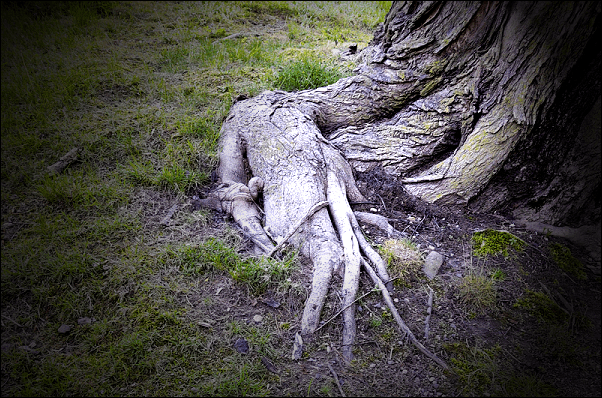
She understood. Her tree was trying to protect her. She laid back, her head against the wood. She listened as the tree absorbed her, turning her into wood. Her consciousness joined the others. After her transformation, she simply resembled a long, knobby, albeit strangely shaped root.
Escape Miriam H. Harrison
I could not escape. Not when you lured me with gentle words, not when you wooed me with practiced charm, not even when I first saw your anger flash red. No, your wrongs were terrible, but you always knew how to make them right. You knew how to be sorry—oh so sorry. You knew how to bare your vulnerable heart, cry your misunderstood tears, until I would forget who had hurt whom.
I remember now. I remember now that it’s too late.
I could not escape you then. Now, you will not escape me. I will be all you see. Look to the clouds, and I will be there, bleeding red sunsets. Look to the stones and you will see my broken bones. Look to the trees and I will look back, reaching to you with roots and branches, reminding you of what you will never escape.
Cradle Nina D’Arcangela
Barely able to see, I clamored on, climbing as quickly as I could. Passing the first bisected limb, I struggled further—not to the second, but the third. It was rumored the higher the elevation, the greater the enlightenment that would be achieved. I lay down and began to pant, my body slick and exhausted. The cradle of the tree welcoming. I chose this as my birthing place.
I began the arduous task at hand. Gaining my feet once more, I leaned my back against the main trunk and began to slough the mucus like cocoon that encased my body and hers. More than once, I had to readjust my stance for stability. With most of the shedding complete, I reached down to embrace the babe now laying at my naked feet. She was beautiful – as raw skinned as I, but still the most exquisite thing I had ever seen. A slight error in judgment as I leaned forward to bite through the umbilical, and I was airborne, until I wasn’t. Lying on the ground, I watched as my brothers made the same climb I had, but for a different purpose.
Broken and shattered, I could do nothing but watch as my siblings cleaned the ancient tree of the ichor I’d left behind. In their haste, they didn’t notice the small bundle among the discarded tissue. My broken body unable to speak, I lie at the base of the tree and watched as she plummeted to the ground, landing in the cook of my arm.
Nameless Louise Worthington
Only when she is dead will it stop coming for her. Only under the earth, when air is no longer a tormenter, will she be free to rest her weary head. There is no place that she can hide. No place where she can be who and what she is – was – is without it eating neurons. No matter the distance. No matter the country. She has no memory: no family or home. No roots. Earthbound: trapped and homeless inside a shrinking head.
‘There is no one to say goodbye to, is there?…’
She thinks it’s the ancient tree moaning in the autumn breeze and to soothe it, she places a frail hand on the bark grown thick and strong with every passing year. Her skin is as thin as paper.
‘No, I don’t think so.’
What fantasy can a splintering woman have, except to lie beside the stolid tree as though nature is her friend, too?
The Squid Man Harrison Kim
I float above old root veins holding a petrified body, legs decayed to squid like bits. The roots suck onto the body from beneath the ground. The condemned youth’s blood flowed thick, sustaining this mighty tree, with its bark foot inching forward, finding ways to grasp. Months ago, in the reflection of the water, and above it, from this mighty fir, this young man was hung from a rope, then his body cut down, left in these woods to rot and decay, as is the custom here. Around his corpse, leaves fall like the years, and the summer grass turns a weak green colour, with the autumn rains. The young man became a squid creature fallen, the tree feasting on his blood, a tree with a foot like an elephant’s, thick and strong. The young man, decapitated, the fall from the rope so powerful his head released and fell yards away, where it became a petrified ball.
I have this dream night after night, viewing the young man’s arm pulled off and his head and body decaying beneath the tree, and every night I want to cut his squid arm free, but it’s too late, it is fused to the roots. Headless corpse here, dry and drained, the living tree under which the young man was condemned possessing the body with its roots. A tree mighty and powerful, thrusting skyward strong where this man was hung for his crimes. My dreaming soul floats above the desiccated corpse in a forever dream. Beneath the earth, where I cannot see, the condemned man’s blood now absorbed by the fir roots. The nutrients still circulate here, bringing strength and life.
Waiting to Fall Elaine Pascale
You never loved me more than when you were dying,
nestled in your noose, waiting to fall.
I watched. I watched you die.
At your last breath, I fainted into the cold earth beneath your feet.
It was good there. It was good in the cold and dark.
I returned every night after your body had been taken down;
after your body had been disposed of
without ceremony
without any indication that you had ever lived.
The tree became a memorial.
I offered myself to it.
Offered my love to it, to you.
And you took it,
so that each night I grew weaker.
Your restless spirit sought sustenance from mine.
Your mouth, your lips, your teeth, they took
as I lay beneath the tree craving more darkness as you craved more light.
Before my eyes failed, I saw you shimmering,
draining me so that you could become more substantial.



 Pen of the Damned