The tendrils, that’s what Jimmy called ‘em. They got hold of his mind and reached in real far. Slithering, he called it. He said they pulled out something from deep inside, something he never could’ve reached on his own.
Oh, he fought it. That I know. Pills, powder, it didn’t matter. As long as it ‘altered his natural state’ he said, it was fine by him. But it was never enough. Reality was too bent for him to see straight, so crooked was the only way to be. That was the only thing that made sense to him. He said when reality became thought, and thought, reality, he couldn’t tell which was which. And when Jimmy’s mind was in a jumble, so was everything around him. I saw things fly off the shelves when he got upset, furniture jumped around the room when he was mad. Never saw nothing like it before. He just couldn’t control it.
When the walls closed in on poor old Jimmy, they really closed in. I think he lived his whole life in fear. I know I would if I had to live with that kind of…condition. Yes, I seen it myself. That run-down old trailer-home of his, crumpled up like a soda can. Poor bastard worried himself to death.
Adorned with only a simple handle and the number 57, the door stood closed. I stared at it for some time, eyes darting between the numerals and brass knob. It was one among many in this seemingly endless hall, but it garnered my interest more than any other. I couldn’t say why. The reason was just as much a mystery as what was behind that door.
Sweat dripped down my brow as I contemplated opening it. I feared I might be caught, only more reason for them to keep me here… But my curiosity outweighed my worries. I reached for the handle and turned it.
I was surprised it wasn’t locked. Maybe there was nothing there to behold other than an empty room. The darkness seemed to ebb from the small sliver between the door and frame. I pushed it all the way, only to see more darkness. The light from the hallway couldn’t travel beyond that threshold. It was as if the room itself pushed it away.
I had to know what was in there, so I stepped inside. The door slammed shut behind me, leaving me sightless. “Hello?” I called out.
Heavy breathing was the only reply.
Then the sound of dripping.
A rancid stench assaulted my nose as I felt warm breath on my face. Then agony as unseen teeth tore away at my flesh.
The air hummed a pregnant note. My very bones resonated with its energy. The dark went silent; insects stopped their nocturnal chatter, leaves hushed their low whisper in the vacant breeze, even my footfalls went mute in the grass. Within my chest, my heart rattled with a thunderous beat. Sudden light bloomed from above – the field below glowed with unimaginable hues.
My gaze was drawn skyward to a bulbous horror that hovered there. Its luminous glare nearly stole my sight. As it began its descent, a sound thrummed from its underbelly forcing my limp frame to the ground. Sudden vertigo whipped my head to the left as my body rose to meet the flashing sphere. I was paralyzed; not a muscle would obey my instincts.
The fierce light ceased and darkness subsumed all. I lay there motionless, not falling nor rising, suspended by a force unknown.
A red glow crept over the black shapeless space. From a square opening came globular mounds of mishappen pink flesh. They stood atop countless tiny legs protruding from their undersides. Six half-moon shaped pincers attached to multi-limbed arms grew from their flanks. No head accompanied their sickly bodies, only a shifting ebon undulation where one might have rested. Their innumerable feet clicked as they approached.
The urge to scream slithered through my esophagus; a need to release fear in a frenzied cacophony. But I could make no sound at all.
Their insectile skittering raced beneath me as my body lowered toward them. As I got closer, their movement increased with fervor. Their sharp pincers brushed against my hands. Unable to pull away, I could do nothing to stem my torrid panic.
Lowered to a solid surface, they crawled over my body in ordered chaos—searching for what, I did not know. They poked and prodded, picked at my clothes with their spiny appendages. They seemed to sniff me with their rippling dark spots. I thought for sure their intent had been to feast, but they never split flesh.
A pounding came from beyond the dark threshold that shook the floor. The massive form reared to its full height as it entered the chamber. I understood why the small ones hadn’t eaten me. The juggernaut stood ten times their size, and where the little ones’ dark spot had been, colossal mandibles chomped and drooled their way toward me.
Infinite snowflakes fall. Their pearl quilt builds upon pavement, tires tread, nerves tense. Sweaty palms grip the wheel. The picturesque wonderland glows in the headlights. Slow and steady, the destination of holiday cheer, of most special kin. The journey swerves upon beautiful danger. She tries to match the pitch and right the car. But nature draws her to its hold without release. As she watches the trees flip upside-down, the rose-colored box travels before her eyes, ejected from its place on the empty passenger seat. As metal crunches and glass shatters, she hopes that gift will reach her little Snowflake.
The baby lies in the crib, struggling to breathe. Her parents are passed out in the next room, the television screams overpowering her feeble cries. She is on the edge of the veil. This little thing is so frail—I envy her delicateness. She will pass from this life to the next as easily as a sparrow flies through shade.
Impervious, I travel anywhere I please on this planet—unaffected by heat, ice and flame. I explore it all. Lava has sizzled on my cold skin as I sunk into molten depths and I rose up to find myself unscathed. I once sought to drown myself in the deepest cracks of the ocean floor. I walked along the barren depths for an age, but eventually I again rose, unscathed.
Immortality hangs around me like a chain. I am the First Darkness. I am the Father of Death. Shtriga, vrykolakas and strigoi… I have many names. I have been here from the beginning and will likely remain until the end is memory. I have limitless power, but this tiny, weak thing goes where I may not.
I bend over the human trifle, a shadow moving within shadow. I have a gift.
I slide my hand beneath it, cradling the flesh clad bones against my palm. It shifts against me, mewls and falls still. They never fight. My omnipotence quells the mortal struggle. I am inevitable. They sense it.
I stroke my finger along the sallow cheek. It smells of feces and nicotine. The baby is naked, but for the bloated diaper. I trace the web of blue beneath the skin. There is life here. It belongs to me so I may choose: take or give. I choose to give.
I open my mouth and the gates of Hell gape wide. Here have passed kings and paupers, creators and destroyers, mothers and daughters… I do not discriminate. I descend upon the infant, my lips of ice do not warm on her fevered flesh, and breathe into her.
I am the keeper of life force, and a taste of this I send into this child. Her chest swells at the incoming gust, nearly bursting the sacs of air within, but she holds. Her baby mind lights up, synapses firing as they form a new network beyond the map to mediocrity they were originally programmed for. I breathe into this child and it lives.
“You will suffer,” I whisper to the infant. “But your suffering will give you depth. You will burn, but your heat will warm this earth.” I lower the baby back onto the stained crib mattress. Her breath is strong now. She is strong now. She will do much in a lifetime before I return and take back my gift.
I exit the crooked, grey trailer in its nest of junk. It sags in an unkempt copse of tree and shrub. Tattered remnants of plastic bag and paper tremble in the bushes like ghosts. A skinny dog watches me from beneath the splintered wooden stairs. He whines softly, a plea to leave his life to him, in spite of suffering. His blood smells sour and doesn’t call to me.
I leave the hovel, following a trail of moonlight. Anyone watching would see only the shadow of a cloud passing across the moon’s face. Some, more keen, may notice the dancing of dry leaves at my silent step. Only the mad would see my true form.
I have given a gift, and now I must receive a gift to retain the balance. There is no method to my choosing. I am neither good nor evil. I am yin and yang. I am the eternal circle of life. I spy a tent draped in white roses, and I move toward it.
Behind the tent is a small, yellow house. The scent of golden anticipation wafts toward me, drifting through twilight, and I follow. It leads me up the wooden siding, through a trellis of wisteria, to find an open window. Thin eyelet curtains are the only barrier between me and the heady odor that calls. I traverse glaciers. I push through ice sheets that trap mammoths. I meditate on mountains so high the air can’t climb them. I push through the curtain easily.
A young woman lays in a tumble of sheets. Her hair is tangled from restless sleep. Laid out on a nearby chair is a dress of white satin and sequin. Veils, silk flowers and ropes of pearl cover a bedside table. She smells like hope, love and lavender dreams. I lick my lips and move toward her.
I stroke my finger along her blooming cheek. It smells of perfume and musk. Her bare shoulder lies exposed where the sheets have fallen, cream against white. I trace the web of blue beneath the skin. There is life. It belongs to me so I may choose: take or give. I choose to take.
I slide my hand beneath her, cradling the flesh clad bones against my palm. Her head falls back, leaving her neck open to me. I descend, a shadow moving within shadow. I take a gift.
I open my mouth against her skin and the pulse of her blood warms me. I pierce her, and all of her joy flows into me. I fill with her essence, a rich and fragrant life. I drink deeply until she goes cold and I grow warm. I lower the woman back into her cocoon of linen and depart. Outside, beneath the trellis of heavy, purple flowers, I find night bleaching into dawn. I make my way silently through the tent, and toward my own repose.
In the tent, I pluck a rose, hold it to my face and kiss it. My lips are still wet from her blood and the petals curl and stain with red. I inhale deep, relishing my rich and fragrant life. Immortality graces me like a chain. I place the reddened rose on the altar and depart.
Gene looked at the photograph of his family. Death isn’t pure, he thought. It’s damn filthy. It chews and spits, leaving you half-digested until you eventually dissolve.
He watched the virus take them. Minions of quietus ravaged their bodies until souls departed through fevered brows. The infection killed them quickly. But it never let go. A collective consciousness still carried their undead frames. Shuffling feet and hands scraping against the boards nailed over the kitchen doorway were all he could hear anymore.
What little strength his mind retained had been used to pretend they weren’t there—trapped together, rotting away… But nothing remained in the world to divert his attention. He hadn’t seen another living person in weeks. He considered if he might be the last. In a way he hoped it were true. Then at least humanity would be unchained from the nightmare and could finally rest.
Guilt tightened his gut, more than pains of hunger. Why had he been spared? What made him immune? Was it punishment for some forgotten sin he committed? Maybe it was just shit luck. He preferred to assume it was only his misfortune; it made the most sense.
His eyes lazily rolled to the makeshift barrier keeping a ravenous, zombified family from eating him alive. He wondered how long it would hold; but realized it didn’t matter. Sure, he’d suffer an agonizing death if they broke through, but no one would ever know of it. He sat alone in a miniscule blip of time. Human life no longer held meaning. History had been erased and would never again be recorded. In a way, he didn’t even exist.
He found that to be a comforting thought. It settled his nerves, calmed his raging heart.
Fingertips released their grip. The picture of his family rested next to a shotgun on the table.
As a calm settled within, he picked up the gun. Peering into the box of shells to see how many were left, he made his choice.
A vast expanse lies before me. Its emptiness is broken only by ivory totems, arranged long ago by an unknown artist. Each one takes its own form; limitless shapes and arrangements construct the populace of bones. I follow the path without going astray. I know not to approach these structures. This land is cursed, forever soured by the evils it holds deep. A rumble sounds in the distant sky. The winds bring its inhuman voice to my ears. I hear it pure, unadulterated by the unnatural spires of mankind. It’s a calling, a welcome, an invitation. I must follow. The journey leaves my feet hot and blistered; my legs, weak and thin. But I know no choice existed. I come to meet the caretaker of this garden of death. And death, it is. My past is behind me. The present is here. My future, non-existent. I’ve arrived here not by folly, but by destiny. My life expired long before this trek. And this is but the final destination. My flesh dissolves, exposing the osseous frame which will be used to construct a new totem, my effigy, to be added to the growing garden of memories.
On the lower steps, you could just barely see him. A gray smoke. A whirl of ghostly gnats and ashes. Faintly glowing. On the move. Adrift but seeking. Rising up from the cellar’s darkness.
In the light. In a narrow place. Beneath the rococo wall of gold, he became invisible. And he waited. To take a lover. To kiss the first mouth that passed through him. To sup upon a soul and become manifest. To feast upon life so that he might return to flesh, and become a god.
Knock on Wood Marge Simon
I return to the house of my youth, where the newel post still stands at the foot of the stairs. Dear memories of childhood, that staircase with its banister, the game of Knock-on Wood. Down and around we children used to slide. At the landing, knock on wood, then change directions, plunging onward shrieking to the very bottom stair. There, we’d touch wood once more at the newel post, then scramble up to do it all again. The fastest one would take the win, such a lark in bygone days!
All too well, I remember Cousin James, who too often won the game. How he’d crow about his win, until the day I’d had enough, and pushed him downstairs to his death. I tell myself I’d meant no harm; it was just a game gone wrong. I go to leave, but a whuff of chill air stops me in my tracks. Suddenly afraid, I turn to see that newel post knows otherwise, a fiendish leer within its carved design. And, after all these years, there’ll be the devil to pay.
After Dark Nina D’Arcangela
In darkness there is patience, a quiet that waits; a moment pregnant with pure malevolence.
I lay in the dark, sheet tucked to my chin on this sweltering night. The small bulb fixed to the tin wall barely a beacon, let alone a source of comfort. I can hear the crick of the wooden stairs as it stealthily begins the climb. Eyes shuttered tight, breath fetid by fear, my muscles seize — I feel it watching me. Minutes pass as I count slowly in my mind. Finally, I hear it turn, I hear its bones and crepe paper skin as it scrapes the railing and planks. I hear the slight squeal of the hinge as it opens the hatch set into the stairwell. I let out a small sigh and immediately regret my mistake. As I throw the sheet over my head, the thing pounds back up the treads and across the room; bones slamming every surface it passes. It leaps onto the bed, and in a frenzy, begins to pound and slash at my body; the bruising from the last assault not yet healed. Both of us scream. Mine, a high-pitched shriek of terror; its, an unholy wail that splits the night.
Abruptly, the onslaught stops. As I lay panting beneath the torn and bloodied bedclothes, it retreats to the stairs once more. In the near silent room, I hear the latch click as it pulls the door shut behind it.
Locked-In with Dreams Louise Worthington
I eagerly wait for a new day inside my cold cell, even when the sun’s face is ready to give up on me. As usual, the sheets are unhappily twisted around me, hiding imprints from the vigour of my dreams. My secret light pollution. Only I can see them travelling on the train of my life going by, cabin by cabin. On waking, they are water spewing from a hose until it’s cut off mid-stream.
I am thirsty. So very thirsty.
Today I imagine myself escaping from a tower. I have grown my hair, and I lower myself down gently to the ground like precious cargo.
Outside, free from walls, stairs, and doors, I build a new country out of mirrors that heal fragmented reflections, like Picasso. I steal silver foil like magpies to protect my skin.
I skip stones across the pond – one, two, three – and bury seeds in the garden and water them in, then secure trellis for black-eyed Susans and ivy to spread over the ugliest and roughest of brickwork until this house disappears.
The precious things which I have lost shower like cherry blossom, and gusts of wind blow the soft-scented petals indoors, dispersed like breadcrumbs up the stairs, along the dark landing, to confetti beneath my locked bedroom door. If I try hard, I can catch their sweet scent.
Rebirth Lee Andrew Forman
Each footfall echoes with unnatural intensity as I ascend. The newfound light draws me, body and soul—this first dawn to repel the suffocating darkness in which I exist, is irresistible. The edge of all my eyes have witnessed have been no more than shadows and illusions of the psyche. I climb, against all struggle, into the blinding gleam, to flee this domain of suffering and feast on all that is within my grasp. I hunger for more than the rotten scraps the cold metal tube provides. As I reach the barrier I’ve never dared near, I wonder how their flesh will taste—the mother who expelled me from her womb as though I were pestilence, and the father who scorned all I am.
In My Darkness Miriam H. Harrison
The first time I saw her, she was little more than shadow. Walking through our sleeping city, she was a companion in my insomnia. A hope in my darkness. We had many more sleepless nights together, but the sunrises are what I remember best. The daily glow of warmth and colour filling her smile.
That was before the sickness came. Before it drained away her colour. Before all warmth faded to chills and aches. Still we spoke of our sunrises, but she was too weary to see new dawns rise. And without her, I saw no beauty in the light.
The longest, darkest night was when the sickness won. I dreaded the light of a new day, the start of my first day without her. But then, just before dawn, I saw her.
That last time I saw her, she was little more than light. Glowing like a sunrise in my home. Like hope in my darkness.
The Upper Room AF Stewart
He lived in a small room on the top floor of the monastery. A small space beyond narrow winding stairs that smelled of sour, musty age. The upper room they called it, at least the monks that spoke of it at all. Few wished to acknowledge its existence, nor the presence of its occupant.
“A holy man,” they sometimes murmured.
But no one truly knew. No soul saw him, not even the monks that brought him food, slipping it inside his darkened space. After all, who would wish to disturb a hermit lost to silent mediation and prayer?
Strange how the truth can be distorted over time. Equally strange how no one questioned the occasional missing traveller or how dissenting monks sometimes disappeared. Sin calls to sin after all.
For the creature that lived in the upper room was no holy man, nor even a man. Not any longer. Once perhaps, a devout monk seeking enlightenment, seeking the divine. But pride drove him beyond sense and he found only demonic secrets. Ones that devoured his soul. Now he waits in the upper room, a prisoner, consuming the sins of occasional fools that venture too far inside his lair.
But he knows one day someone will make a mistake. They will forget to replenish the wards, or he’ll devour enough sins to break his bonds.
He knows one day he will escape.
Stairwell of the Liquid Souls Harrison Kim
Edema steps up and down, up and down the stairs between the walls, under the light that never turns off. At the top, Edema cannot turn the corner because there is no corner. She can’t go through a door because one doesn’t exist. No turning, because her forehead’s becoming larger, her belly too, and her knees. Her body’s filling with liquid, what sort of liquid, she doesn’t know, all she does know is it is heavy and thick, seeping through from the walls, and it sloshes inside and slows her movements. Within her ears she hears a wailing, a crying in despair,
For God’s sake, get us out of here!
Her heartbeat thumps faster as the wailing rises, a heart that slops and slips as she climbs the stairs ever more slowly, hoping she may escape to freedom if she hits the walls hard enough, in this sick brown coloured stairwell with no night or day. Her forehead droops, her belly sags.
It’s her knees that first drag on the floor, her huge liquid filled knees. Then it’s the belly that drops, and now the forehead, pulling her head down, its creases lie flat on the upper stairs, her feet on the lower ones. Edema’s fluid engorged body fills the entire stairwell, a swampy miasma of skin, liquid soul and bones, she can’t climb any more though her legs continue in spasm. In her head the only thought is “For God’s sake, get me out of here!” how much time does her body lie there… ten days, a month, in stench and stink, seeping into the wood and plaster. Afterwards, the only indication that anything filled the empty space is a slightly brighter light atop the hallway of the liquid souls, an alabaster shimmering in the wall.
The Clearing RJ Meldrum
They parked, grabbed their gear and headed down the trail. Walking for about a mile, they reached a fork. Peter consulted the map. He was unfamiliar with the area, but their destination lay to the east, so he decided to follow the trail heading in that direction. Compared to the path heading west, this one was overgrown with grass and other foliage. It was clearly rarely used. Amanda was worried they were literally leaving the beaten path, but he had the map. Her instinct was correct; he’d chosen the wrong trail. It led to a remote, unpopulated part of the forest.
After an hour they entered a clearing. In the middle sat a ruined cabin. The lumber had decayed into indistinct piles. Only one part remained; a flight of stairs. In perfect condition, they climbed to a floor which no longer existed.
The sight was so incongruous, Amanda just had to take a closer look. She touched the bannister, but quickly withdrew her hand. It had vibrated. Peter placed his hand on the wood too, but felt nothing.
She started to climb the stairs. Her eyes were glazed and distant, as if she was seeing something Peter couldn’t. She reached the top and extended her hand. Her fingers mimicked opening a door. She stepped forward. Peter shouted she was about to fall. Instead, she simply disappeared. He ran up the stairs, but there was nothing. He had to get help. He headed back down the trail.
In the clearing, the ruined cabin sat quietly. The fresh varnish on the stairs reflected the evening sun, sending shafts of light to sparkle amongst the green leaves of nearby trees. There was a sense of calm and tranquility. The offering, although unexpected, had been acceptable.
The Servants’ Staircase Elaine Pascale
“I keep dreaming about the stairs.”
“The servants’ stairs?” Clay asked even though he knew the answer. His wife had complained of being haunted by the narrow staircase ever since they had been forced to relocate. She said there was bad energy trapped in the stairwell. He had caught her performing a ritual at the foot of the stairs.
“I wish you wouldn’t call it that…” Julia sighed.
“It’s historically accurate. Besides, neither of our families could have afforded servants. We have a clean slate.”
“Then explain the dreams.”
He tapped his forehead. “Your witchy brain, my dear.”
She frowned. “Can you try opening that weird cubby again? Maybe if I see the inside, the dreams will stop.”
“I’ve tried. It’s sealed shut.”
“Break the seal,” she pleaded.
Knowing that the landlord would not be thrilled with the act of vandalism but wanting his wife’s superstitions to stop, Clay tried the small door again, only to find that it opened easily.
“See, nothing—” Clay stopped when he spotted what looked like a sapphire ring peeking out of the dirt. “How did your ring get in there?”
Julia shrugged. “I bartered.”
Clay was confused. “Bartered? For what?”
As Julia swung the hammer at his forehead, Clay saw that the ring was garnishing a gnarled hand.
“Your life insurance policy.”
The hand grabbed Clay’s shirt just as the pain set in.
The last thing he heard was Julia say proudly, “Thank god for my witchy brain.”
The sweet milk drew them to the widow, Mrs. Keller daily. Their lips silently spoke of thirst; a parching despair was evident each morning upon their arrival. Mrs. Keller smiled with each new sun as she watched them come in droves. She waited at the door of her barn, tin containers filled with the greenish-white cream. One by one, she’d fill each jug the locals brought. They’d leave with both their spirits, and wallets, much lighter.
They always asked to see the cows that produced her famed product. An off-kilter smile was the only response she ever gave. They talked in hushed rumors of what might be in that old, red outbuilding, what wonderous dairy cattle gave their delicious milk in secret. They imagined a majestic specimen, the fur a color never before seen by human eyes. Others argued she dyed the milk and put something in it for flavor, but they were buying it as well—thus it was unanimously agreed that wherever it came from, it was the very best.
Despite the general consensus on the milk’s quality, some were too intrigued to stay away. Their curiosity made them brave fools, ready to risk a gut full of buckshot at a chance to know. A plan formed, in preparation for the night of the month when the moon would be most dim. A group of three prepped their tools, headed out at nightfall, and waited, watching the barn and Mrs. Keller’s house.
Long after the lights went out, when all went quiet and they thought she must be asleep, they approached the barn. One cut the chain while the others held it and let it down lightly on the ground. They opened the barn doors just enough to slip inside and face the darkness within.
One of them lit the oil lantern they brought and revealed the source of their town’s milk; the commodity they so cherished—the near-godly nectar of some unknown animal’s bosom. Their faces went slack, as did their minds upon the ghastly sight that lay within Mrs. Keller’s barn. It was no cow that produced their prized milk, but a monstrosity they couldn’t have imagined.
In the stall at the far end, a man’s upper half was chained to the wall. His waistline was no more than a scarred line where stitches had once been. Below that, attached to that man, was something inhuman. Its physique didn’t recall anything they could identify. The flesh, if it could be called that, was dark and had the texture of motor oil. It stank of sulfur and burnt rubber. The three intruders held their noses and gagged against the stench.
The man attached to this multi-legged thing beneath howled in agony, raising both the attention and incalculable fear of the trio. His inexplicable bottom half began to shudder and heave. A slit of flesh opened up near its end, which they then noticed was attached to a hose. The human top wailed while that hose pumped green, viscous fluid into tin canisters lined against the other side of the barn.
When the event was over, the wretched smell intensified, and the man atop this beast fell to rest again. Two of the men heard a loud bang, something wet splashed the side of their faces. By the time they realized what happened, Mrs. Keller shot them as well.
As she began with a shovel to bury her unwanted guests, she had a thought: They may be the first to discover what became of my husband, but they most likely won’t be the last.
The mating time was brief this year. Our women sang notes like floss on the wild-wind plains. A human came who forced his seed on sweet Ala of the Yellow Eyes. We went on, saying not a word, bent to harvesting our Caddo root.
Afterward, Ala wasn’t the same. She cut her marvelous hair which had been dark and long, grown down below her knees. She wandered off to the Darklands, heavy with child and none to celebrate. We mourn her fate. If she survives, she’ll not return. She’ll raise his spawn alone. She was the envy of us all. When the child is born, she’ll burn his father’s image in the sands of our dead oceans. The human sits on our sacred stones. He preens his beard and leers at females, with no more thoughts to waste on Ala; he never even knew her name.
Come burrow season, we prepare, sharpen our talons on the Caddo root. When the freezing gales begin, the human will demand sanctuary, as his kind always does. We bring him the rich sap of our Caddo root, watch his flabby face turn pale as the winter moons. We will confirm his welcome with the strewing of his bones.
Petrified Wishes A.F. Stewart
“Round and round the tree, who will it be? One wish for you, none for me.” But don’t get too close. “Forever you may find, is far too unkind.” Forever… don’t think about that. “In a circle we dance, now only two. One wish for me, none for you.”
“Footsteps, footsteps, roundabout. Sure with the pacing, never in doubt.” One little slip… Nancy slipped. Oh god, poor Nancy. And Deidre. Can’t think, have to keep moving. Finish the song. It’s the only way. “Complete the circle, one by one. Pay the piper, single survivor. The wish is yours when the song is done.”
Why did we come here? Wishes? Fortunes? Happiness? It was only supposed to be silly fun. Grandma warned me. I didn’t believe her. Foolish tales. I never thought it could be… Not this… Cara, did she? Yes, Cara stumbled. I’m going to survive!
Just to be certain, I helped my friend to her death with a push, watching the tree consume her flesh, until nothing remained but a petrified corpse. Then on trembling legs, I made my wish and whispered the last line of the song.
“To the one left standing, a wish granted you see. The others have fallen, now part of the tree…”
Passing Time Lee Andrew Forman
Time uncounted passed since the radiance of our love ended. We adored that barken pillar and its canopy, the shade it provided from the fury of a summer sun. Blankets lain and baskets aplenty carried by lovers’ hands, words of angels and moments of bliss born into existence—each an expanding universe of our contentment.
But these years, so soft and kind, turned bitter and dealt spite upon our miracle. An affliction came upon her, and through its vile nature, her lips ceased to smile. All they had to offer was a cold, passionless touch. I wept over her body until my nostrils could no longer stand the scent. Only then did I begin the work of finding and putting to use a shovel.
What more fitting place than at the foot of our favorite tree to bury her emptied vessel. I sat with her daily. I spoke the words I would have, had she lived. I picnicked with fine cheese and her favorite wine. With each passing year, the roots grew; they twisted as slowly as grief.
With each new moon, the hair upon my scalp grayed, and I smiled knowing we’d soon be together again.
Survival Charles Gramlich
Only dirt, a patch of grass, and one tree survive. Besides black and white, the only colors left here are gray and green and shades of brown. Everyone worried about nuclear war, or the coming of AI. They worried about pollution and overpopulation, about new plagues and old, about the revenge of plants, or insects, or birds, or the frogs, or mutated beasts. They worried about climate change and super storms. No one worried about the thing that actually killed us, that left earth a corpse world. It happened when useless, meaningless words began to proliferate from the mouths of idiots. When bloviating fools talked and talked and talked and talked. And words lost their meaning and strangled all thought, and then all life. Until only this one patch of grass and a tree are left. For now.
Transformation RJ Meldrum
She went to the forest. It was the place she always visited when her heart was broken. Another failed romance; perhaps her standards were too high, perhaps the boys she chose were just assholes. She drifted along trails, leaves speckled with sunlight. She was heading to the tree. It was her place of peace, her thinking tree. She often visited it, when she was happy but also when she was sad. There was just something about the oak, as it towered a hundred feet into the air above her. She sat and rubbed the bark.
“Just you and me again. I wish I had a heart like yours. A wooden heart can’t be broken.”
She closed her eyes and drifted off to sleep, lulled by the warm, scented summer breeze. She woke to coolness. The sun had shifted. Her hand was stiff and dead. Must have slept on it funny and cut off the circulation. She tried to lift it but found herself unable to. Looking down she screamed. Her hand had all but disappeared into the wood of the tree. The skin on her forearm was no longer skin, instead it was scaly and brown. Like bark. She realized with increasing horror she was unable to escape. A whispering came from above her. The wind in the leaves serenaded her.
Sleep, it will soon be over. Soon be better. You will have a wooden heart and that can never be broken.
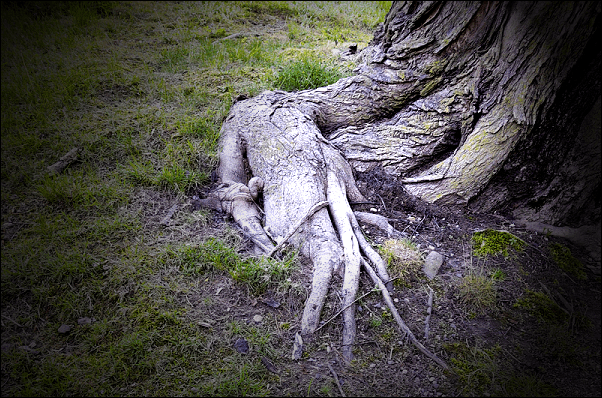
She understood. Her tree was trying to protect her. She laid back, her head against the wood. She listened as the tree absorbed her, turning her into wood. Her consciousness joined the others. After her transformation, she simply resembled a long, knobby, albeit strangely shaped root.
Escape Miriam H. Harrison
I could not escape. Not when you lured me with gentle words, not when you wooed me with practiced charm, not even when I first saw your anger flash red. No, your wrongs were terrible, but you always knew how to make them right. You knew how to be sorry—oh so sorry. You knew how to bare your vulnerable heart, cry your misunderstood tears, until I would forget who had hurt whom.
I remember now. I remember now that it’s too late.
I could not escape you then. Now, you will not escape me. I will be all you see. Look to the clouds, and I will be there, bleeding red sunsets. Look to the stones and you will see my broken bones. Look to the trees and I will look back, reaching to you with roots and branches, reminding you of what you will never escape.
Cradle Nina D’Arcangela
Barely able to see, I clamored on, climbing as quickly as I could. Passing the first bisected limb, I struggled further—not to the second, but the third. It was rumored the higher the elevation, the greater the enlightenment that would be achieved. I lay down and began to pant, my body slick and exhausted. The cradle of the tree welcoming. I chose this as my birthing place.
I began the arduous task at hand. Gaining my feet once more, I leaned my back against the main trunk and began to slough the mucus like cocoon that encased my body and hers. More than once, I had to readjust my stance for stability. With most of the shedding complete, I reached down to embrace the babe now laying at my naked feet. She was beautiful – as raw skinned as I, but still the most exquisite thing I had ever seen. A slight error in judgment as I leaned forward to bite through the umbilical, and I was airborne, until I wasn’t. Lying on the ground, I watched as my brothers made the same climb I had, but for a different purpose.
Broken and shattered, I could do nothing but watch as my siblings cleaned the ancient tree of the ichor I’d left behind. In their haste, they didn’t notice the small bundle among the discarded tissue. My broken body unable to speak, I lie at the base of the tree and watched as she plummeted to the ground, landing in the cook of my arm.
Nameless Louise Worthington
Only when she is dead will it stop coming for her. Only under the earth, when air is no longer a tormenter, will she be free to rest her weary head. There is no place that she can hide. No place where she can be who and what she is – was – is without it eating neurons. No matter the distance. No matter the country. She has no memory: no family or home. No roots. Earthbound: trapped and homeless inside a shrinking head.
‘There is no one to say goodbye to, is there?…’
She thinks it’s the ancient tree moaning in the autumn breeze and to soothe it, she places a frail hand on the bark grown thick and strong with every passing year. Her skin is as thin as paper.
‘No, I don’t think so.’
What fantasy can a splintering woman have, except to lie beside the stolid tree as though nature is her friend, too?
The Squid Man Harrison Kim
I float above old root veins holding a petrified body, legs decayed to squid like bits. The roots suck onto the body from beneath the ground. The condemned youth’s blood flowed thick, sustaining this mighty tree, with its bark foot inching forward, finding ways to grasp. Months ago, in the reflection of the water, and above it, from this mighty fir, this young man was hung from a rope, then his body cut down, left in these woods to rot and decay, as is the custom here. Around his corpse, leaves fall like the years, and the summer grass turns a weak green colour, with the autumn rains. The young man became a squid creature fallen, the tree feasting on his blood, a tree with a foot like an elephant’s, thick and strong. The young man, decapitated, the fall from the rope so powerful his head released and fell yards away, where it became a petrified ball.
I have this dream night after night, viewing the young man’s arm pulled off and his head and body decaying beneath the tree, and every night I want to cut his squid arm free, but it’s too late, it is fused to the roots. Headless corpse here, dry and drained, the living tree under which the young man was condemned possessing the body with its roots. A tree mighty and powerful, thrusting skyward strong where this man was hung for his crimes. My dreaming soul floats above the desiccated corpse in a forever dream. Beneath the earth, where I cannot see, the condemned man’s blood now absorbed by the fir roots. The nutrients still circulate here, bringing strength and life.
Waiting to Fall Elaine Pascale
You never loved me more than when you were dying,
nestled in your noose, waiting to fall.
I watched. I watched you die.
At your last breath, I fainted into the cold earth beneath your feet.
It was good there. It was good in the cold and dark.
I returned every night after your body had been taken down;
after your body had been disposed of
without ceremony
without any indication that you had ever lived.
The tree became a memorial.
I offered myself to it.
Offered my love to it, to you.
And you took it,
so that each night I grew weaker.
Your restless spirit sought sustenance from mine.
Your mouth, your lips, your teeth, they took
as I lay beneath the tree craving more darkness as you craved more light.
Before my eyes failed, I saw you shimmering,
draining me so that you could become more substantial.



 Pen of the Damned